

 English

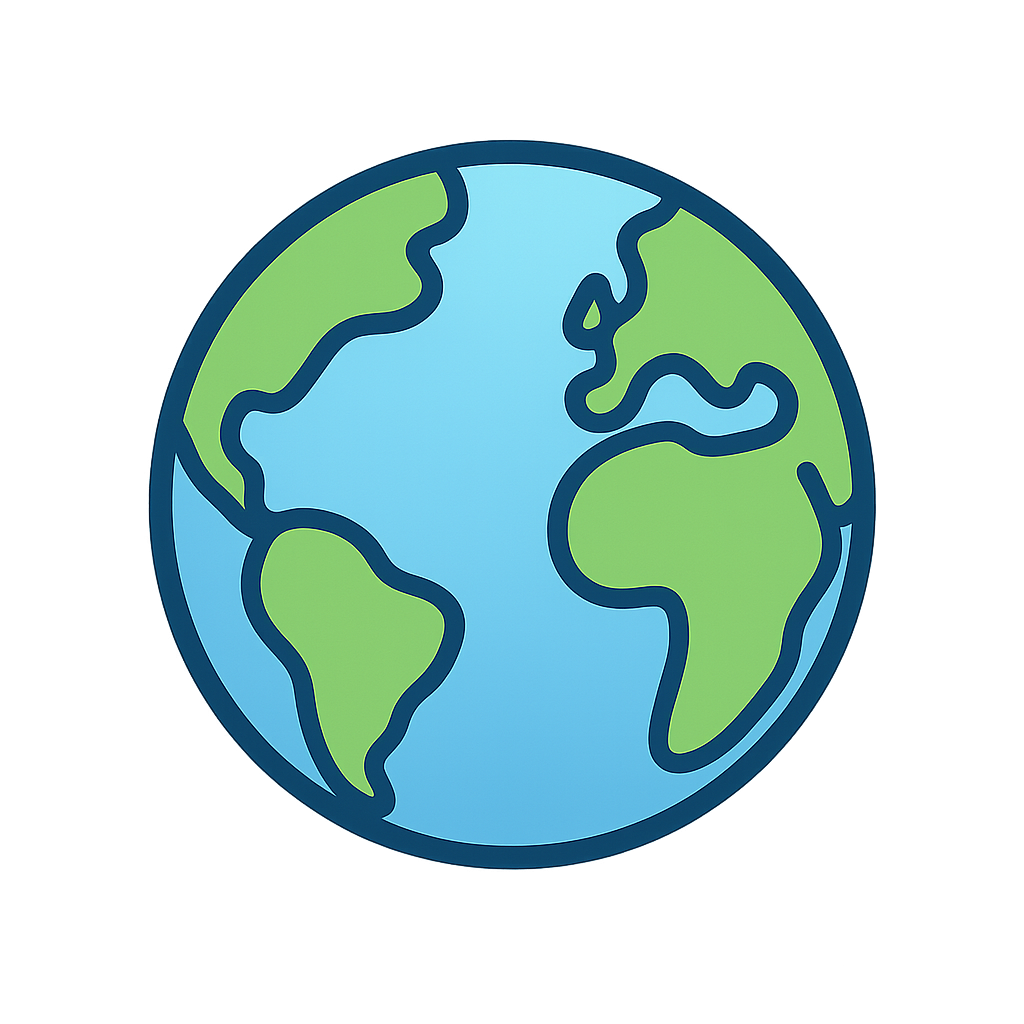
A World in Your Hands
Imagine holding the entire world in your hands. Feel the cool, smooth surface under your fingertips as you trace the vast blue of the oceans, then the rough, bumpy texture of mountain ranges rising from the land. You can spin me on my axis, watching continents blur and day turn into night in a single second. With one finger, you can travel from the frozen southern pole all the way to the icy north, crossing invisible lines that sailors and pilots use to navigate the real planet. You can see how the coast of South America seems to fit perfectly against the edge of Africa, like pieces of a giant puzzle. I hold deserts and rainforests, ancient cities and sprawling countries, all in a perfect, miniature sphere. For a long time, what I represent was the greatest mystery of all, a question that sparked debates and daring adventures. I am a Globe, a tiny, perfect copy of your amazing planet Earth.
For thousands of years, the idea of me wasn't even possible because most people believed the world was a flat disc. They imagined ships sailing too far and tumbling off the edge into a sea of monsters. But some curious thinkers, the ancient Greeks, weren't so sure. They were excellent observers. They watched ships sail away and noticed the hull disappeared before the mast, a trick of the eye that could only happen on a curved surface. They studied the stars, charting their movements and realizing the constellations changed as they traveled north or south. They saw the Earth’s curved shadow on the moon during an eclipse. These clues led them to a revolutionary conclusion: the Earth must be a sphere. One of these brilliant minds, a man named Crates of Mallus, decided to build one of my very first ancestors around 150 BCE. It wasn't detailed like I am today. It was more of an idea made solid, a simple sphere divided into four sections by great rivers, showing continents that were mostly guesswork. It was a bold statement that the world was round, a complete whole, even if no one yet knew what it truly looked like.
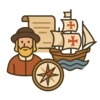
My story truly takes off during the Age of Discovery. As centuries passed, brave explorers began venturing into the unknown, and with them, I started to become more accurate. My most famous early relative was crafted in Germany in the year 1492 by a man named Martin Behaim. He called it the 'Erdapfel,' which means 'Earth Apple.' It is the oldest surviving version of me, a beautiful and intricate object, but it has a huge, empty ocean where the Americas should be, because at that very moment, Christopher Columbus was still sailing across the Atlantic. My existence was directly tied to exploration. When Ferdinand Magellan’s crew did the impossible and circumnavigated the planet between 1519 and 1522, they provided the ultimate proof that the world was round. Their harrowing journey erased all doubt. After that, every ship that returned from a long voyage brought back new information for the cartographers, the mapmakers who painstakingly drew the world. They were my artists. With each new discovery—a coastline charted, an island found, a river mapped—they would update their drawings, and I would be reborn, a little more complete, a little more truthful. I grew up alongside humanity's knowledge of itself, my blank spaces slowly but surely filling with the incredible diversity of our world.
Today, you have maps on your phone and giant atlases in the library, but I offer something they cannot. A flat map has to stretch and distort the land to make a round planet fit on a flat page. Greenland might look bigger than Africa on a map, but a gentle spin of my sphere shows you the truth of their sizes. I am the only way to see the continents and oceans in their true shape, size, and position relative to one another. I don't have to flatten the poles or warp the equator. I sit quietly in classrooms, studies, and libraries, waiting to spark your curiosity. I invite you to trace the routes of famous explorers, to find the capital of a country you’ve just read about, or to simply wonder what life is like on the other side of the world. I am more than just a model of the Earth; I am a reminder that we all share this one beautiful, spinning home. I hope that when you look at me, you feel a connection to every other person on the planet and are inspired to learn, to explore, and to dream of your own future adventures.
Activities
Take a Quiz
Test what you learned with a fun quiz!
Get creative with colors!
Print a coloring book page of this topic.






 Free for Educators