

 English

A Sliver of Silver in the Night
Have you ever watched me play my silent game of hide-and-seek in the vast, velvet darkness of the night sky. One evening, I might appear as just a delicate sliver of silver, a shy, curved smile hanging among the stars. A week later, you might find me as a perfect half-circle, a glowing shield for a celestial knight. Then, in my grandest moment, I become a brilliant, luminous pearl, bathing the world below in a soft, ethereal light. But just as quickly, I begin to fade. It’s as if a mysterious giant takes a bite out of a cosmic cookie each night, nibbling away until nothing is left but a shadow, an empty space where I once shone so brightly. For a few nights, I vanish completely, leaving you to wonder if I will ever return. People long ago invented stories to explain my disappearing act. They imagined a great wolf chasing and devouring me, or a god pulling a dark cloak over my face. They saw my changing shape as a sign, a mystery, a power that governed their world. They watched, they wondered, and they waited for my light to inevitably return. But the truth is not about magic or monsters; it is about a grand and beautiful dance. I am the Moon's changing faces. You can call me the Moon Phases.
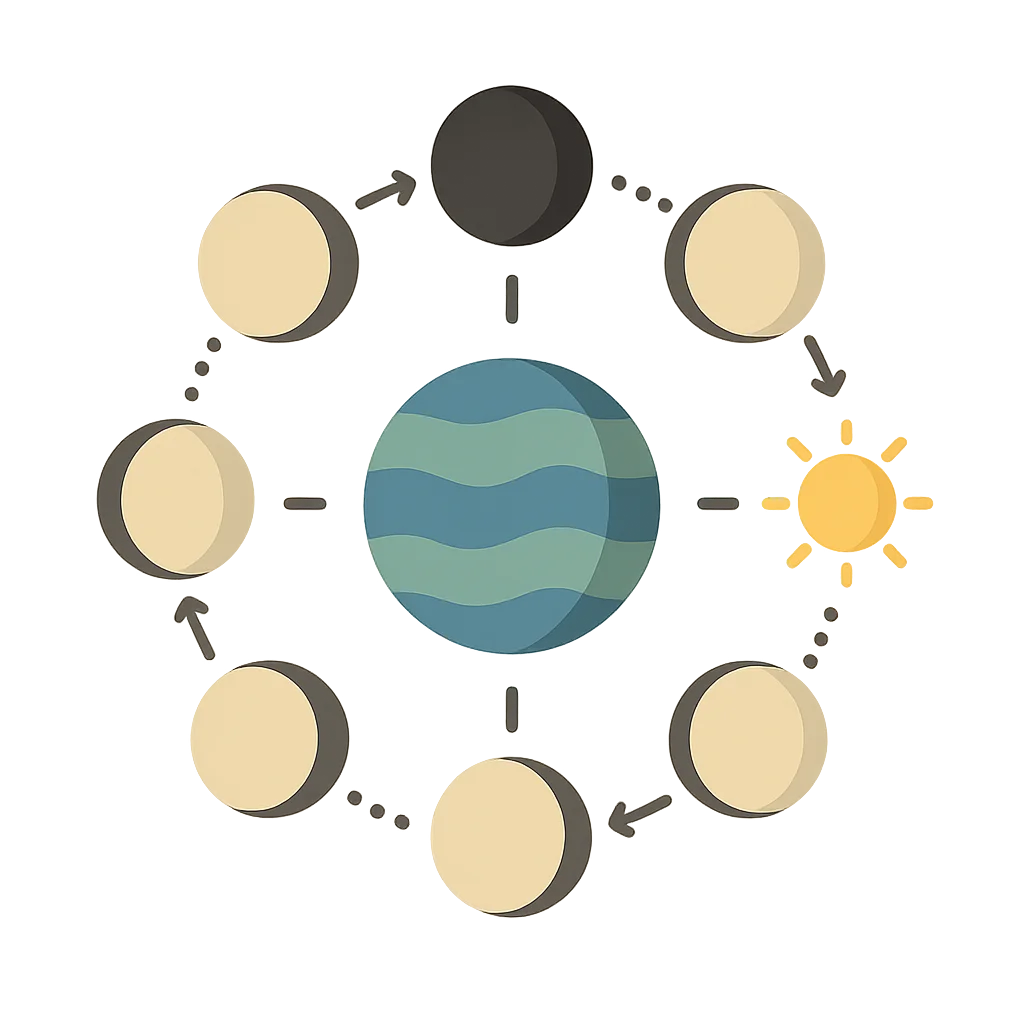
My secret is not that I change my shape, but that your view of me changes as I perform my great cosmic dance. Imagine three partners in this waltz: the brilliant, fiery Sun; the vibrant, living Earth; and me, the rocky, silent Moon. I am constantly circling the Earth, a journey that takes me about 29.5 days to complete. As I travel, the Sun’s powerful light always shines on me, but the portion of my sunlit side that you can see from Earth changes. That is the entire secret. When I am a New Moon, I am positioned between the Earth and the Sun, so the side facing you is cloaked in shadow, making me invisible. As I move in my orbit, you begin to see a sliver of my sunlit self, a shape you call the Waxing Crescent. ‘Waxing’ simply means growing larger. Soon, you see half of my sunlit face, which is my First Quarter. Then comes my most famous moment: the Full Moon. This happens when the Earth is between me and the Sun, and the sunlight illuminates my entire face that you can see. After that, I begin my retreat. The light starts to shrink, a phase you call Waning, and I become a Waning Gibbous, then a Last Quarter, and finally a delicate Waning Crescent before disappearing into the New Moon once more. Ancient civilizations were my first devoted observers. Thousands of years ago, the clever Babylonians charted my movements with incredible precision. They saw my reliable cycle as a perfect clock and created some of the world's first calendars to track time, plan harvests, and schedule festivals. For centuries, however, people still believed I was a perfect, smooth orb of light. That all changed because of a brilliant Italian astronomer named Galileo Galilei. On the cold night of January 7th, 1610, he pointed a new invention, the telescope, toward me. What he saw was revolutionary. He didn’t see a flawless sphere; he saw a world with rugged mountains, deep valleys, and vast, dark plains he called 'maria,' or seas. He proved that I was a rocky, cratered world, much like Earth. His discovery was the key that unlocked my ancient puzzle. My light was not my own; I was simply a mirror, reflecting the magnificent light of the Sun back at you. The mystery of my changing faces was finally solved by science.
My dance doesn’t just create a beautiful sight in your sky; it has a real, physical effect on your planet. As I orbit, my gravity gently pulls on your world, creating a subtle bulge in the oceans. This constant tugging is what creates the rhythm of the tides, the steady rise and fall of the sea along coastlines all over the globe. Fishermen have relied on my tidal patterns for thousands of years, and the rhythm of the waves I create is a constant heartbeat for your planet. I have also been a constant companion to the human imagination. I am a muse for artists, a subject for poets, and a silent confidant for dreamers who stare out their windows at night. I have inspired countless stories of werewolves and romance, of magic and mystery. My gentle light has guided lost travelers and comforted lonely souls. My greatest moment of connection with humanity, however, arrived on July 20th, 1969. On that historic day, the Apollo 11 mission carried the first humans across the void of space to land upon my dusty surface. When those astronauts looked back, they saw something no human had ever seen before: the Earth, their home, suspended in the blackness of space. It was a stunning 'blue marble,' a fragile and beautiful sphere of life. That perspective shifted how people saw their own world and their place in the universe. It was a reminder that everyone you know and everything you love exists together on that one delicate planet. So, the next time you see me in the sky, remember my story. I am more than just a light; I am a clock, a calendar, a mover of oceans, and a mirror reflecting the sun. I am a constant reminder of the universe’s beautiful, predictable rhythms, showing that even in moments of complete darkness, the light is always preparing for its return. No matter where you are in the world, you can look up and see me, a silent, shining friend connecting everyone below.
Activities
Take a Quiz
Test what you learned with a fun quiz!
Get creative with colors!
Print a coloring book page of this topic.














 Free for Educators