

 English


The Speedy Secret of Multiplication
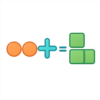
Have you ever wanted to share something with all of your friends at once. Imagine you baked a huge batch of cookies and you want to give four cookies to each of your six friends. You could count them out… one, two, three, four for the first friend… five, six, seven, eight for the second… but doesn’t that feel a little slow. What if there was a secret, a special power that let you do it all in a flash. That’s me. I am the magic that helps things grow in big, neat groups. I am a shortcut, a way to jump ahead in counting so you don’t have to plod along one step at a time. I’m the reason you can look at a parking lot with eight cars and know instantly there are thirty-two wheels without bending down to count every single one. I’m the secret behind figuring out how many crayons are in three brand-new boxes of twenty-four. I take small groups and stack them up, again and again, to make something much bigger. I am a hidden pattern that connects everything from the legs on a spider to the stars in a galaxy. For a long time, people used me without even knowing my name. They just knew I was a faster, smarter way to see the world. But I can’t be a secret forever. So let me introduce myself. I am Multiplication.
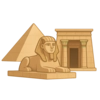
My story didn't begin in a classroom or a textbook. It started thousands of years ago, with people who were building amazing things and needed a faster way to count. Imagine trying to build a giant city wall, brick by brick. Just adding one brick at a time in your calculations would take forever. People needed me. My journey into the history books began in a warm, sunny land called Mesopotamia. There, around 2000 BCE, very clever people called the Babylonians realized they could save a lot of time by writing me down. They didn't have paper, so they took soft clay and carefully etched little marks onto it, creating the world's very first multiplication tables. They would bake the clay in the sun, and suddenly, they had a permanent tool for trading grain and counting their herds. A little later, my adventure took me to ancient Egypt. Have you ever seen pictures of the giant pyramids. They are made of millions of heavy stone blocks. The builders needed to know exactly how many blocks they would need for each level. They called on me for help. Their secret calculations were written on a special scroll made from a plant, called the Rhind Mathematical Papyrus, around 1550 BCE. This scroll showed how they used me to plan one of the wonders of the world. For centuries, people all over the world found their own ways to use me, from China to Greece. But I didn't have a symbol that everyone recognized. That all changed on February 13th, 1631. A smart mathematician from England named William Oughtred decided I deserved my very own sign. He drew a simple, elegant cross: the ‘×’ sign. Now, instead of writing out long sentences, anyone could just use my symbol to call on my power.
You might think I only live in your math homework, but I am out in the world having adventures every single day. I'm not just for ancient builders anymore. I am working behind the scenes in your favorite video games, helping the computer quickly create amazing forests with thousands of trees or huge cities with hundreds of buildings. When you go to the grocery store with your family and you want five boxes of your favorite cereal, I’m the one who helps the cashier figure out the total price in a snap. My work is even hiding in nature. I am the quiet power that helps a single flower drop its seeds, which then multiply into a whole field of beautiful blossoms the next year. I am inside you, right now. The tiny cells that make up your body are multiplying to help you grow taller, stronger, and heal a scraped knee. I am a tool, but I’m not just for counting things. I am a tool for building, for creating, and for understanding the beautiful patterns that make up our world. When you use me, you're not just doing math; you're learning to see things in bigger, more exciting ways, connecting small ideas to create something grand. So next time you see groups of things, remember me, and know that you have a powerful secret for understanding the world.
Activities
Take a Quiz
Test what you learned with a fun quiz!
Get creative with colors!
Print a coloring book page of this topic.









 Free for Educators