

 English


I Am Multiplication: The Story of Seeing in Groups
Have you ever looked up at the night sky and tried to count every single star in a constellation? Or stared at a tall brick building and wondered exactly how many bricks it took to build? Maybe you’ve sat in a huge stadium, trying to guess how many seats surrounded you. In those moments, you might have called on my old friend, Addition. Addition is loyal and trustworthy, always there to help you count one by one. But when the numbers get big, Addition gets tired and slow. One plus one plus one… it takes forever. That’s where I come in. I was born from the need for speed, from the desire to see the world not as single items, but as beautiful, organized groups. I am the secret that turns a long, winding path of counting into a single, powerful leap. I am the magic that sees five rows of six chairs and knows instantly that there are thirty. I am the power of groups, the whisper of 'lots of.' I am Multiplication.
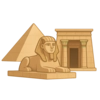
My story is as old as human curiosity itself. Long before you knew my name, people felt my presence. Journey with me back to the fertile lands of Mesopotamia, to ancient Babylon around 2000 BCE. There, clever scribes etched my patterns onto wet clay tablets using sharp reeds. They didn't have calculators, but they needed to manage enormous grain harvests and track goods for trade. They would create tables showing what happened when you had 5 groups of 12, or 20 groups of 30. I was there in the marks on that clay, helping their civilization thrive. Then, let's travel across the desert sands to ancient Egypt, around the year 1550 BCE. On a famous scroll you now call the Rhind Papyrus, scribes showed their genius. They used a clever system of doubling to figure out huge calculations. To find 5 times a number, they would find 1 times the number and 4 times the number, then add them together. I was their secret tool for calculating the millions of stone blocks needed to build their magnificent pyramids, ensuring each one rose perfectly toward the sun. But it was in ancient Greece where I truly found my shape. A thoughtful man named Euclid, around 300 BCE, looked at me and saw more than just numbers. He saw geometry. He realized I was the very area of a rectangle, a perfect grid of length and width. Suddenly, I wasn’t just an abstract idea; I was a physical space, a tidy field of squares you could see and measure.
For thousands of years, I existed in many forms but without a single, simple name tag. People in different parts of the world had to write things like 'the product of 5 and 7' or use other long descriptions. It was confusing and slowed down the sharing of ideas. Imagine trying to explain a brilliant thought but having to invent the words every time. That was my reality. Then, in England, a mathematician named William Oughtred changed everything. In his 1631 book, 'Clavis Mathematicae,' which means 'The Key to Mathematics,' he decided I needed a symbol of my own. He gave me a simple, elegant cross: the × sign. Finally, I had a universal calling card. Anyone who saw it knew it meant me. It was a wonderful gift, but it led to a new kind of confusion. As algebra grew more popular, my × sign looked exactly like the letter 'x' used to represent an unknown number. Thinkers would squint at their pages, wondering, 'Is that 'times' or is that 'x'?' The problem was solved by another genius, Gottfried Wilhelm Leibniz from Germany. In a letter he wrote on July 29th, 1698, he suggested a different mark. He proposed a simple raised dot (⋅) to be used between numbers. It was brilliant. The dot was clean, impossible to confuse with a letter, and perfectly clear. With these two symbols, the cross and the dot, I was finally free. I could travel across borders, in books and letters, speaking a language that every mathematician and scientist could understand instantly.
From ancient clay tablets to your glowing screen, I am still here, working quietly in the background of your life. You meet me when you’re at the store buying three packs of your favorite snack and want to know the total cost. You see me in the technology you use every day; the number of pixels on your phone screen is just its height multiplied by its width. When your family doubles a recipe to have enough for guests, I am the one helping you figure out the new measurements. In your video games, I am calculating the damage your character deals over several hits. But I am more than just a tool for counting. I am a source of creativity. Artists use me to design repeating patterns and beautiful mosaics. Musicians feel my rhythm in the structure of a song, with its repeating measures and beats. Architects rely on me to design buildings with rows of windows and floors of tiles, turning a simple grid into a stunning skyscraper. I am proof that an ancient idea can be a modern superpower. I am a way of thinking, a method for seeing order in chaos, and a key that helps you build, create, and understand the incredible patterns that make up our world.
Activities
Take a Quiz
Test what you learned with a fun quiz!
Get creative with colors!
Print a coloring book page of this topic.











 Free for Educators