

 English

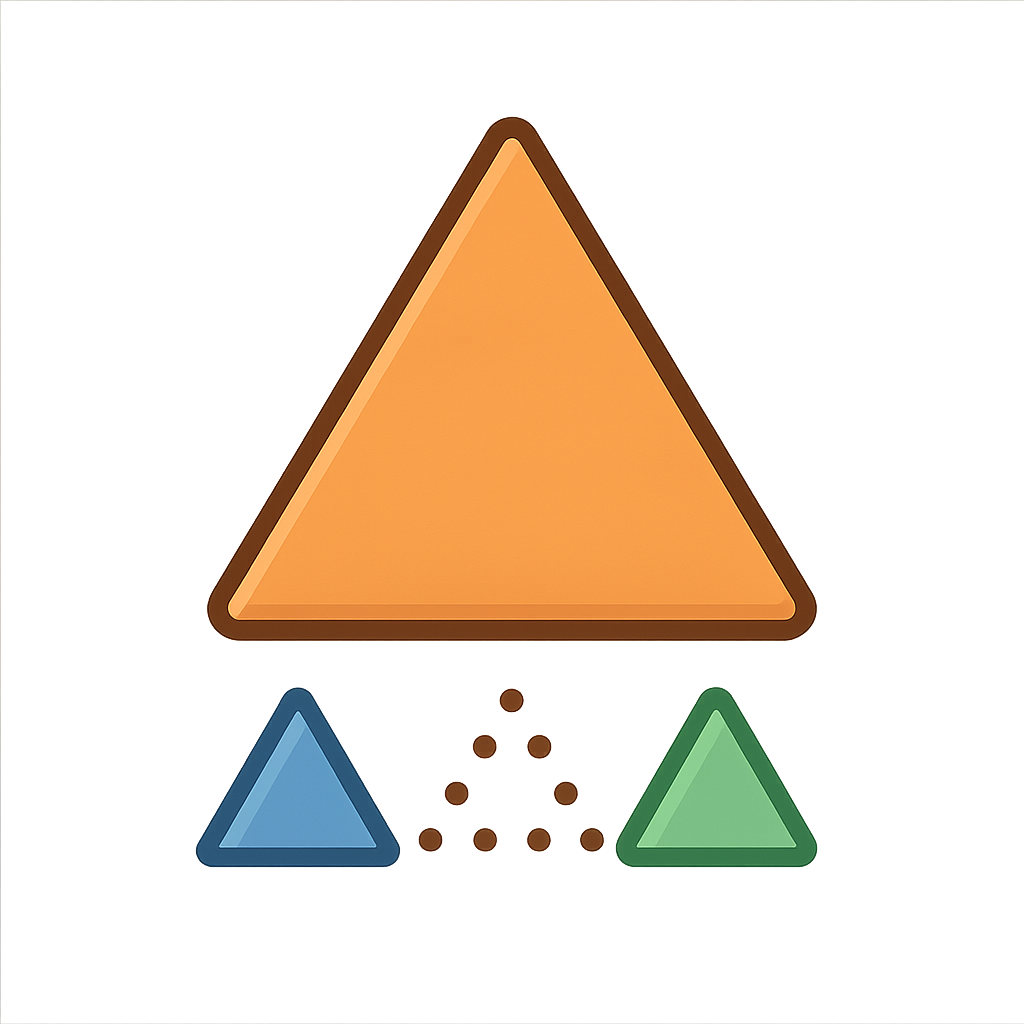
I Am the Triangle
Have you ever looked up at the sharp peak of a snowy mountain, or watched the wind puff out the sail of a boat as it cuts through the water? Have you ever noticed the sturdy shape holding up a bridge, or the way a roof slopes down to keep the rain away? I am there, in all those places. I am the perfect, delicious slice of pizza, the invisible force in a powerful crane, and the simple pattern in a beautiful mosaic. My structure seems basic: just three straight sides that meet at three corners, or vertices. But in this simplicity lies my greatest secret. Unlike a wobbly square that can be squished into a diamond, I am rigid. If you push on me, my sides work together to resist the force, distributing the pressure perfectly. This makes me the strongest of all the polygons, a foundation for much of the world you see. I have been a symbol of strength, balance, and mystery for thousands of years. I am the Triangle.
My story as a tool for humankind began a very long time ago, on the hot, dusty plains of ancient Egypt. The brilliant engineers there were building magnificent pyramids, tombs for their pharaohs that needed to be perfect. They faced a huge challenge: how to create a perfect ninety-degree corner using only simple tools. They found the answer in me. Around the 26th century BCE, these builders would take a long rope and tie thirteen knots in it at equal distances. By stretching that rope out to form my shape with sides of three, four, and five units long, they discovered they could create a perfect right angle every single time. It was a practical, clever trick that allowed them to build structures so precise they still inspire awe today. But while the Egyptians used me, the ancient Greeks wanted to understand me. In the 6th century BCE, a curious thinker named Thales of Miletus looked at those same pyramids and asked a question no one had been able to answer: exactly how tall are they? He used me to find the answer. Thales waited for the moment in the day when his own shadow was the same length as his body. He reasoned that at that exact instant, the pyramid’s shadow must also be equal to its height. By measuring my shape on the ground, he measured the unmeasurable. This act of wonder was the true beginning of geometry, the art of understanding the world through shapes.
After Thales opened the door to my secrets, others rushed in, eager to learn more. One of my greatest admirers was a philosopher and mathematician named Pythagoras, who lived around 500 BCE. He and his followers believed that numbers were the language of the universe, and I was one of its most important words. He spent years studying my right-angled form and uncovered a relationship so profound and elegant that it is still named after him: the Pythagorean Theorem. He proved that if you take my two shorter sides—the ones that form the right angle—and draw a square on each, the combined area of those two squares is exactly equal to the area of a square drawn on my longest side, the hypotenuse. You might know it as a² + b² = c². This wasn't just a neat party trick; it was a key that unlocked countless problems. Now, builders, sailors, and astronomers could calculate an unknown distance just by knowing two others. About two centuries later, around 300 BCE, another brilliant mind decided I needed an official biography. His name was Euclid, and he lived in the great city of Alexandria. He wrote a book called 'Elements,' which organized all the known truths about geometry. In its pages, he laid out my fundamental properties with pure logic, proving beyond all doubt that my three interior angles will always add up to 180 degrees. It doesn’t matter if I am tall and skinny like a spire or short and wide like a ramp; that rule is unbreakable. Euclid’s work gave me a solid foundation that has lasted for more than two thousand years.
That foundation allowed people to build incredible new ideas. The study of my angles and sides blossomed into a whole new branch of mathematics called trigonometry, which literally means ‘triangle measurement.’ This powerful tool changed the world. Using trigonometry, sailors could navigate the vast, featureless oceans by measuring the angles of the stars in the sky. Astronomers could map the heavens, calculating the staggering distances to the moon and planets, all from their observatories on Earth. This ancient magic is still hard at work today, and it’s probably in your pocket or backpack right now. When a phone uses GPS to find its location, it is listening for signals from satellites orbiting high above the planet. By calculating the time it takes for signals from at least three different satellites to arrive, the phone creates a series of giant, invisible versions of me. This method, called trilateration, pinpoints its exact spot on the globe. And I have another secret identity. In the digital worlds of video games, every character, every landscape, and every object is secretly built from a mesh of thousands of tiny versions of me. I am the hidden skeleton that brings virtual reality to life, one polygon at a time.
My journey has been a long one, stretching from a knotted rope in the Egyptian sand to the glowing screen of a smartphone. I have helped raise pyramids to the sky and helped map the stars in that same sky. I am a symbol of unyielding strength in architecture and the fundamental building block of digital dreams. But I hope you see that I am more than just a shape. I am a reminder that the simplest ideas often hold the greatest power. I represent balance, harmony, and the beautiful logic that underpins our universe. So the next time you see me, whether in the trusses of a bridge, the wings of a jet, or a simple house roof, remember my story. Remember that within the most basic forms lie the secrets to building the most amazing and complex future imaginable.
Activities
Take a Quiz
Test what you learned with a fun quiz!
Get creative with colors!
Print a coloring book page of this topic.









 Free for Educators