

 English

I Am a Soup Can on a Wall
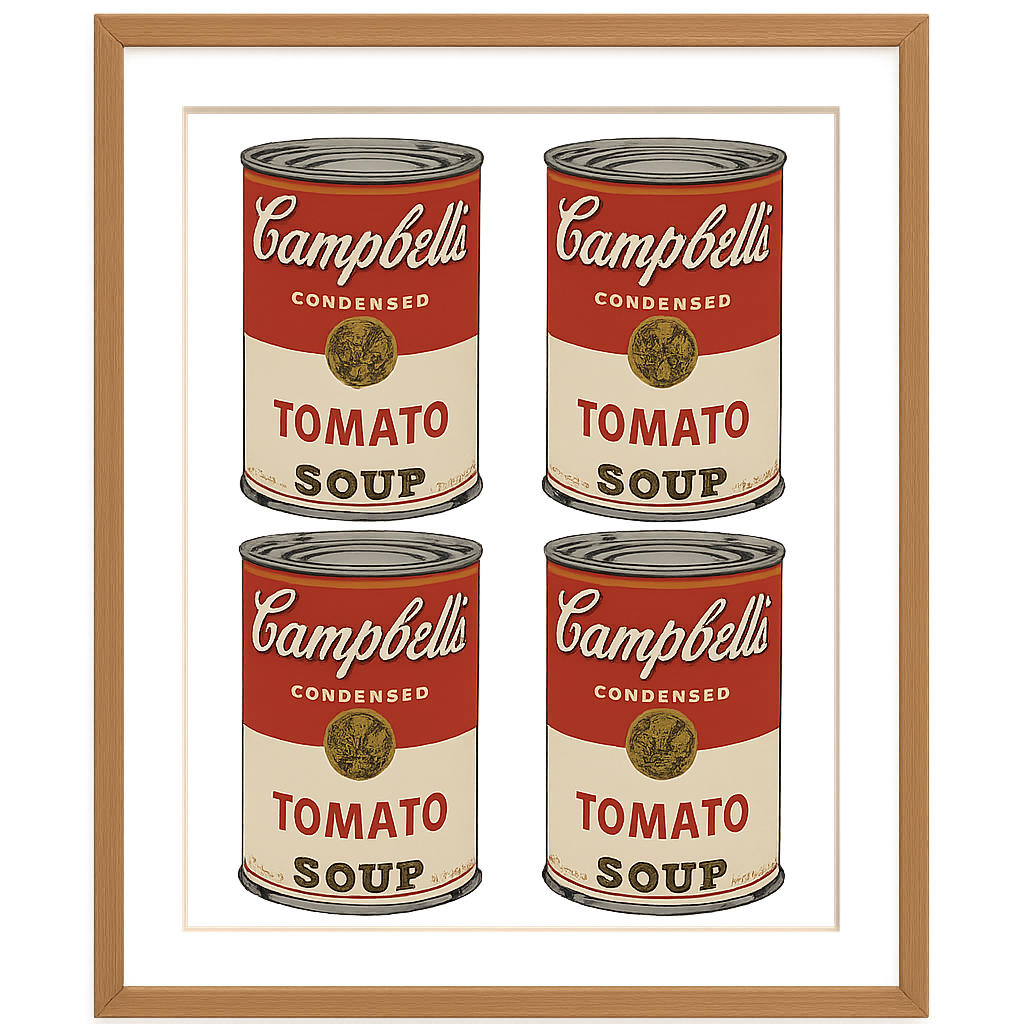
Imagine a silent, perfectly white room. The air is still, and the only sound is the soft shuffle of shoes on a polished floor. On a long, clean wall, I stand at attention. But I am not alone. To my left and right, I see myself, again and again. Thirty-two times, to be exact. We are a regiment of canvases, each identical in our bold red and pristine white label, our familiar cursive logo, and the gleaming gold medallion at our center. We are Campbell's Soup Cans. Look closer, though, and you’ll see we are not entirely the same. This one is Tomato, that one is Chicken Noodle, and over there is Onion. Each of us is a distinct flavor, a subtle variation on a powerful, repeating theme. People stop and stare, their heads tilted. They know me. They have seen me in their pantries, in supermarket aisles, in magazine advertisements. I am ordinary, a staple of American lunch. But here, in this gallery, I am treated as something extraordinary. I am a paradox, a simple, mass-produced object elevated to the status of high art. Before you even know my full story, you can feel the question I pose just by being here: What is a simple soup can doing in a place like this?
My story begins with a quiet, observant man with a shock of silver-white hair. His name was Andy Warhol, and he was my creator. Andy saw the world through a different lens than most people. In the 1950s and 60s, America was booming with new products, bright advertisements, and celebrity culture. While many artists looked to the past for inspiration—to grand landscapes or historical figures—Andy looked at the world right in front of him. He found profound beauty and meaning in the things everyone saw every single day but never truly looked at. He was fascinated by Coca-Cola bottles, movie stars like Marilyn Monroe, and me. In fact, his mother used to serve him a can of my Campbell's soup for lunch almost every day for twenty years. To him, I wasn't just food; I was a symbol of modern American life, something consistent and familiar that connected millions of people. He created me in his New York studio, which he famously called 'The Factory.' The name was intentional. He didn't use a delicate paintbrush to render a single, unique portrait of me. Instead, he used a commercial printing process called serigraphy, or silkscreening. He would push ink through a fine mesh screen onto the canvas, a method that allowed him to reproduce my image perfectly, over and over. This process mirrored the way real soup cans were manufactured and labeled in a factory. Andy wasn't just painting a picture of a soup can; he was using a mechanical, mass-production technique to make a powerful statement about art, consumerism, and the shared culture of our time.
My public debut was on July 9, 1962, at the Ferus Gallery in Los Angeles. It was a moment that sent a jolt through the art world. The gallery owner, Irving Blum, had a brilliant idea. Instead of hanging us on the wall in traditional frames, he installed a narrow shelf and placed all thirty-two of us in a single, neat line, just as you would see us in a grocery store. The reaction was immediate and intense. Many people were outraged. They scoffed, 'This isn't art! It's just a picture of a soup can!' For them, art was supposed to be rare, emotional, and created by the singular genius of an artist's hand. I was the opposite: a depiction of a mundane, machine-made object, created using a mechanical process. I represented everything they thought art should not be. A nearby art dealer even mocked the exhibition by stacking actual soup cans in his window with a sign that said, 'Get the real thing for 29 cents.' But others were captivated. They understood that Andy Warhol was holding up a mirror to society. He was asking daring questions. What qualifies as art? Does an artist's subject matter have to be beautiful or heroic to be important? Can something that is mass-produced and seen by everyone still be a worthy subject for a masterpiece? I wasn't just a painting; I was the start of a global conversation.
I am more than just a collection of thirty-two canvases. I am an idea that helped launch a revolutionary movement known as Pop Art. By placing a humble soup can in a prestigious gallery, Andy Warhol shattered the old boundaries between 'high art' and 'low culture.' He declared that inspiration is not confined to museums or ancient history; it is all around us—in our supermarkets, on our television screens, and in the logos we see every day. My legacy is this radical democratization of art. I am a reminder that the objects that populate our daily lives have their own stories and their own kind of beauty. I connect you to the past, to a time of enormous cultural change, but I also connect you to the person standing next to you. We have all seen a can of soup. That shared experience, that simple, ordinary thing, is what makes us part of a larger culture. So the next time you walk down a grocery aisle, look closely. See the patterns, the colors, the logos. There is art and inspiration in the most unexpected places, waiting for you to notice.
Activities
Take a Quiz
Test what you learned with a fun quiz!
Get creative with colors!
Print a coloring book page of this topic.















 Free for Educators