

 English

The Voice of Guernica
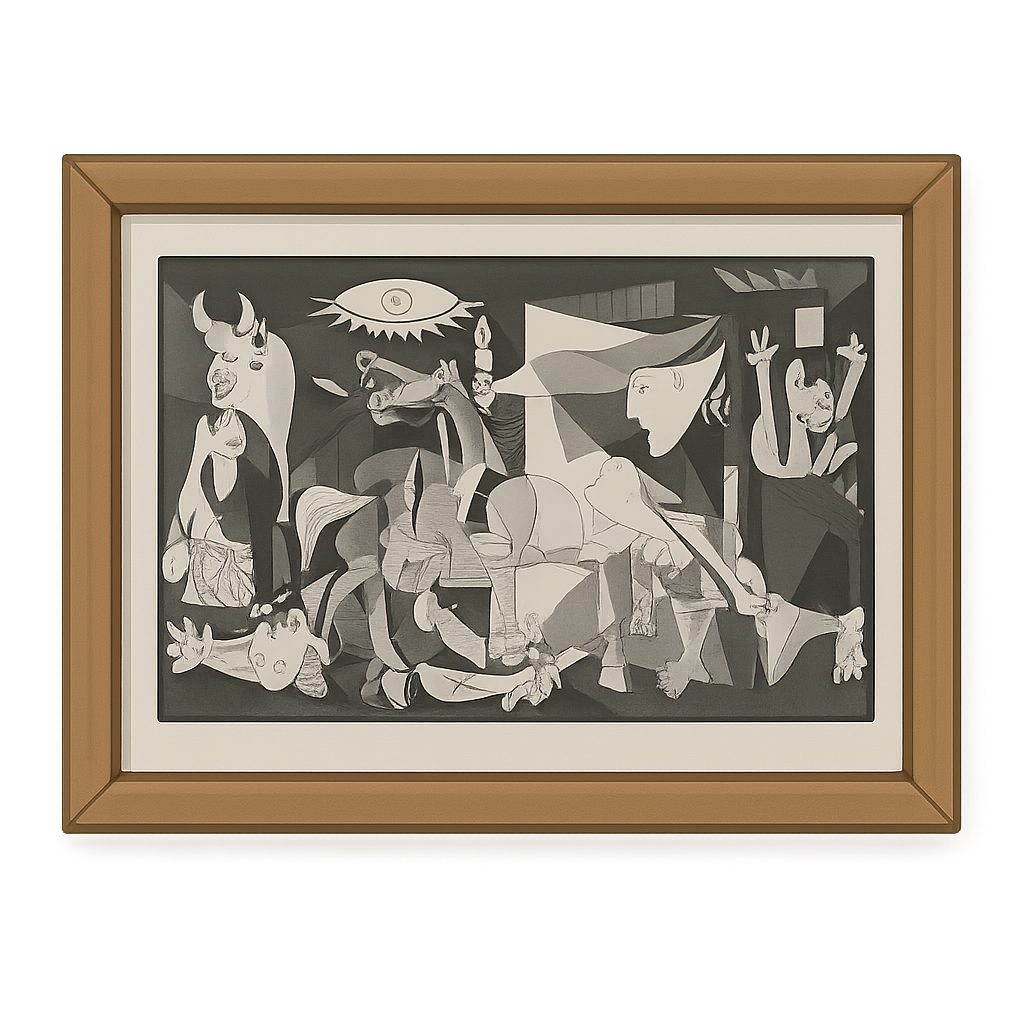
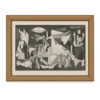
Before I had a name, I was a feeling. A loud, silent scream trapped on a canvas nearly 26 feet wide. Imagine a world shattered into pieces, all in shades of black, white, and gray. There is no color to soften the edges, only sharp angles of pain and chaos. In my center, a horse shrieks at the sky, a spear piercing its side. To the left, a mother wails, clutching the lifeless body of her child, her head thrown back in pure agony. Above her, a stoic bull watches over the scene, its dark eyes unreadable. Is it a symbol of brutality or of steadfast strength? Near the bottom, a fallen warrior lies broken, his hand still gripping a shattered sword from which a single, hopeful flower grows. Light comes not from the sun, but from a harsh, bare bulb shaped like an eye, and from a woman holding a lamp, leaning out of a window to illuminate the horror. I am a frozen moment of terror, a story told without a single word, yet understood by all who look upon my fractured forms. I am the painting called Guernica.
My creator was a Spanish artist named Pablo Picasso, and he brought me to life in a whirlwind of emotion in the spring of 1937. He was living in Paris at the time, but his heart was with his homeland, which was being torn apart by the Spanish Civil War. On April 26, 1937, he heard the news that shattered his world. The small Basque town of Guernica had been bombed mercilessly, a brutal attack on innocent civilians. Picasso was consumed by a righteous fury and a deep, profound sadness. He had been commissioned to create a mural for the Spanish Pavilion at the 1937 Paris International Exposition, and now he knew what he had to paint. He would not paint a glorious battle or a heroic victory. Instead, he would use his art as a weapon, a testament to the suffering of his people. On an enormous canvas, he began to sketch, his charcoal moving with frantic energy. In just over a month, he filled my vast surface with the figures of his grief. I was not made to be beautiful or pleasant. I was made to be a protest, a permanent, visual scream that would echo through history, reminding everyone of the true face of war.
When I was first unveiled at the Exposition in Paris, people were stunned. They had never seen anything quite like me. My jagged shapes and monochrome palette were shocking, a raw and unfiltered expression of pain that many found difficult to look at. I was not the kind of art they were used to. But Picasso’s intention was not to please the crowd; it was to confront them. He made a solemn vow: I would not return to Spain, my spiritual home, until the country was free from the dictatorship of Francisco Franco and democracy was restored. And so began my long journey, my exile. I traveled for a time, but I spent nearly four decades at the Museum of Modern Art in New York City. There, I became more than just a painting. I was a silent ambassador for peace. Millions of people from all over the world stood before me, their faces reflecting the horror and sadness I contained. I became a powerful anti-war symbol, a place for reflection, and a constant reminder that behind every conflict are real people who suffer.
Finally, after a long, long wait, the time came for me to go home. Francisco Franco’s rule ended in 1975, and Spain began its journey back to democracy. In 1981, I was carefully rolled up and flown across the Atlantic. My arrival in Spain was an incredibly emotional event. I was a symbol of a painful past, but also a beacon of a new, free future. I was finally home, in the country whose sorrow had given me life. Today, I live in the Museo Reina Sofía in Madrid, protected behind bulletproof glass. Millions still come to see me every year. My story, however, is no longer just about one town on one tragic day in 1937. I have become a universal cry against violence, a symbol of the immense suffering caused by all wars. I show the world that art can give a voice to the voiceless and that even from the deepest tragedy, a powerful message of humanity can shine through time. I am a testament to the fact that creativity, born from pain, can inspire generations to remember, to reflect, and to build a more peaceful world.
Activities
Take a Quiz
Test what you learned with a fun quiz!
Get creative with colors!
Print a coloring book page of this topic.











 Free for Educators