

 English

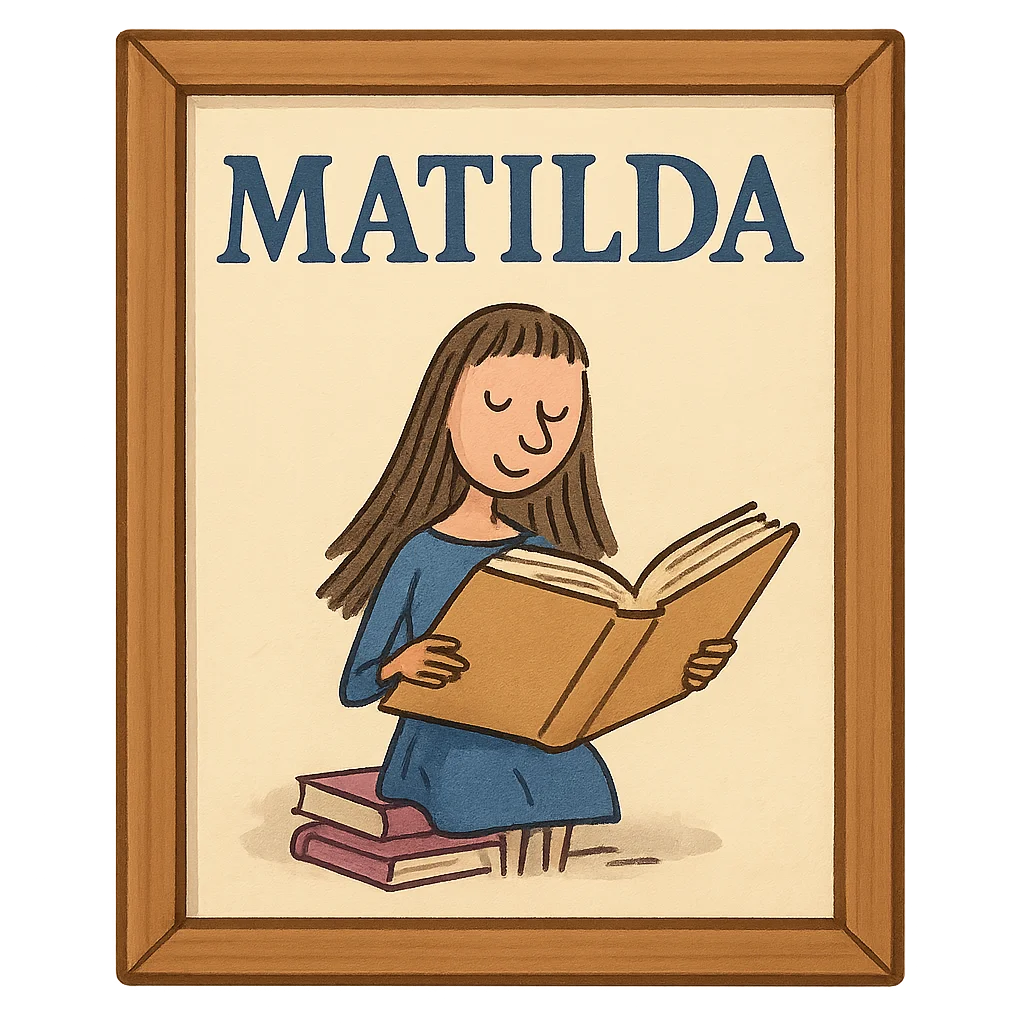
I Am Matilda
Before I had a name, before my pages were even bound, I was just a whisper of an idea. I was the feeling of turning a crisp, new page, the silent, comforting magic of a library, and the promise of an adventure waiting between two covers. I began as a spark in a storyteller's mind, a question he pondered: what if a little girl, overlooked and underestimated by her own family, possessed a mind so powerful it could change her world? I was the thought of a child finding solace and strength not in toys or television, but in the boundless worlds offered by books. I am that idea, given paper and ink, and a story to hold. I am the book, Matilda.
My storyteller was a man named Roald Dahl. He worked in a special white hut in his garden, nestled in an old armchair with a board across his lap. It was there, with his favorite pencils, that he spun my words together on yellow paper, crafting my world with meticulous care. He imagined my main character, a brilliant girl named Matilda Wormwood, and her lovely teacher, the gentle Miss Honey. He also dreamed up one of the most terrifying villains in children's literature: the formidable headmistress, Miss Trunchbull. Roald Dahl understood that for light to shine its brightest, the shadows must be very dark. But my words were only half of my being. An artist named Quentin Blake was my other creator. With his scratchy, energetic, and wonderfully expressive ink drawings, he gave me a face. His illustrations brought my characters to life in a way that felt both chaotic and perfect. He drew Matilda small but defiant, Miss Honey with a kind and hopeful smile, and Miss Trunchbull as a towering figure of pure tyranny. Together, these two men, a storyteller and an artist, built me from the ground up, making sure every word and every line worked in harmony to tell a tale of courage and wit.
My own story is about Matilda Wormwood, a girl with an extraordinary intellect born into a family that celebrated ignorance. Her father was a crooked car salesman and her mother was obsessed with bingo, neither of whom understood or appreciated their daughter’s love for reading. To escape her dreary home life, Matilda made a daily pilgrimage to the public library, where she devoured classic literature meant for adults, teaching herself complex mathematics and expanding her vocabulary far beyond her years. The library was her sanctuary, a place where her mind could truly be free. When she finally started school at Crunchem Hall, she met two people who would change her life forever: her sweet, encouraging teacher, Miss Honey, and the school’s monstrous headmistress, Miss Agatha Trunchbull, a former Olympic hammer-thrower who despised children. Faced with injustice and cruelty, something incredible happened. Matilda discovered that her powerful mind, simmering with frustration and a fierce sense of right and wrong, had developed a secret power: telekinesis. She realized her brain could do more than just read books and solve equations; it could move objects, and more importantly, it could move her world toward justice.
On October 1st, 1988, I was officially published, and my journey into the world truly began. I flew off bookshelves and into the hands and hearts of children everywhere. They saw themselves in Matilda’s loneliness, cheered for her cleverness, and felt empowered by her strength. My story resonated so deeply that it soon leaped beyond my pages. In 1996, my tale was adapted into a beloved film directed by and starring Danny DeVito as the dreadful Mr. Wormwood. Children could now see Matilda's magic come to life on screen. But my evolution didn't stop there. My story was filled with so much emotion that it seemed destined to be sung. On November 9th, 2010, I premiered as a stage musical, full of dazzling songs, incredible choreography, and a powerful message that captivated audiences in London, New York, and across the globe. From a quiet idea in a writing hut, I had become a book, a film, and a theatrical spectacle, proving that a good story is a powerful force that can take on many forms.
My magic isn’t just about making a newt jump into a glass of water with your mind. The true magic I hold within my pages is the power of knowledge, the unshakeable strength of kindness, and the profound courage it takes to stand up for what is right, even when you feel small and alone. I am a reminder that every child has the potential to be the author of their own destiny. My story whispers to every reader that your mind is your greatest tool, that compassion is your greatest strength, and that sometimes, being a little bit naughty is necessary to change the world for the better. The power to write your own story is in your hands, just as mine is in yours right now.
Activities
Take a Quiz
Test what you learned with a fun quiz!
Get creative with colors!
Print a coloring book page of this topic.



 Free for Educators