

 English

The Star-Spangled Banner's Story
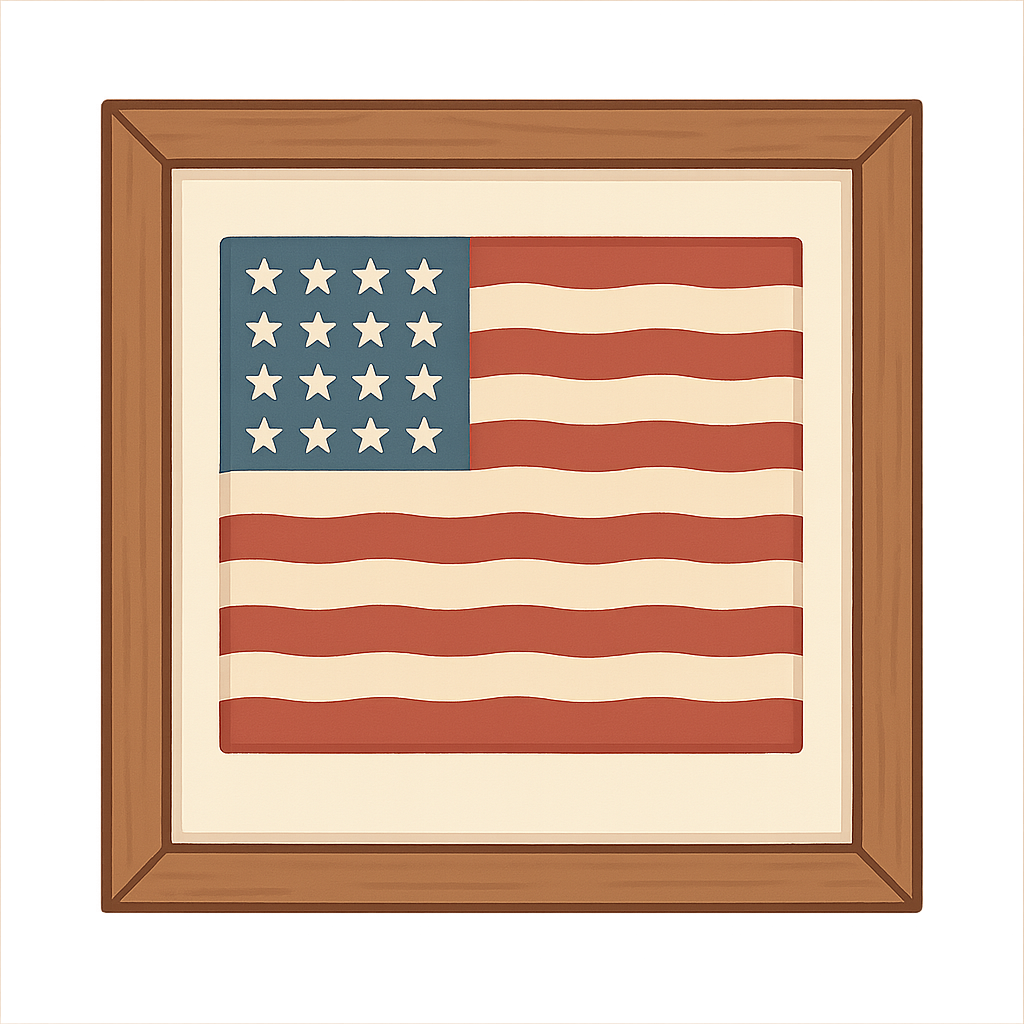
I first awoke to a whisper of thread and thunder. The world was a symphony of sounds and smells: the sharp snip of scissors through fabric, the rich, earthy scent of dyed wool and linen, and the constant murmur of determined voices in a busy Baltimore home. I was not small or neat. I was a vast sea of red, white, and blue, a universe of cloth spread across the wooden floorboards. As nimble fingers guided needles through my fabric, I could feel the hopes and anxieties of the people stitching me together. There was an undeniable urgency in their work, a quiet prayer in every single stitch. They knew, and I somehow knew, that I was being made for a momentous purpose. I was destined to fly high above the ramparts of a fort, a defiant beacon meant to be seen from miles away across the water. I am the Great Garrison Flag, but soon the world would come to know me by a much more famous name.
My story truly begins in the sweltering summer of 1813, during a tense and difficult chapter in American history known as the War of 1812. The commander of Fort McHenry, a resolute man named Major George Armistead, was preparing his defenses for an imminent British attack on Baltimore. He declared that he wanted a flag for the fort so large 'that the British will have no difficulty in seeing it from a distance.' This formidable task was given to a skilled professional flagmaker, Mary Pickersgill. She did not work alone. With her daughter Caroline, her two nieces Eliza and Margaret Young, and an indentured African American servant named Grace Wisher, she embarked on the colossal project. I am enormous—thirty feet high and forty-two feet long. My fifteen broad stripes are each two feet wide, and my fifteen brilliant cotton stars measure two feet from point to point. My sheer scale was a challenge; Mary's home was not large enough to accommodate me. The team had to move to the floor of a nearby brewery, the only space in the neighborhood big enough to lay me out completely. For weeks they labored, carefully piecing me together. Every stitch was an act of patriotism, a tangible hope for the safety of their city and the endurance of their young nation.
My night of trial by fire and glory arrived on the evening of September 13th, 1814. As darkness fell over the city, the British fleet unleashed a ferocious bombardment on Fort McHenry. The air cracked and shuddered with the roar of cannons, and the sky was streaked with the terrifying, fiery trails of Congreve rockets. Rain lashed down, soaking my heavy woolen fabric and making me even heavier, but I whipped and snapped defiantly in the turbulent wind. Shrapnel from exploding shells tore through me, leaving holes in my stripes and stars, yet my pole held firm and I did not fall. Through the seemingly endless night of explosions and chaos, I held my place, a silent witness to the battle raging below. Aboard a British ship, a young American lawyer named Francis Scott Key was being held as he negotiated a prisoner exchange. He watched the relentless assault all night, his heart filled with dread, fearing that the fort would be forced to surrender. When the sun finally began to rise on the morning of September 14th, a tense silence fell. The smoke from the cannons slowly began to clear. Through the dawn's early light, straining his eyes toward the shore, Key saw me. I was tattered and torn, but I was still there, waving proudly over the fort. The sight filled him with such profound relief and pride that he began to write a poem on the back of a letter he had in his pocket, a poem about what he had seen: my survival against all odds, a symbol of his country's resilience.
That powerful poem Francis Scott Key wrote was first called 'The Defence of Fort M'Henry.' It was quickly printed and distributed, and soon set to the tune of a popular song. People across the country sang the words, and I was transformed from a simple garrison flag into a national treasure. I was kept and treasured by Major Armistead's family for many years. As time went on, I became fragile from age and exposure. Sadly, small pieces were sometimes snipped from my edges and given away as mementos to honored veterans and officials, which is why I am not perfectly rectangular today. In 1912, the Armistead family recognized my national importance and gave me to the Smithsonian Institution, entrusting me to the care of the nation so that I could be preserved for everyone to see. The song I inspired, 'The Star-Spangled Banner,' officially became the United States' national anthem on March 3rd, 1931. Today, I rest in a special, climate-controlled chamber, a silent witness to a nation's history. Though I am old and delicate, I hope that when people see me, they feel a connection to that night of struggle and endurance. I want them to remember the courage and hope stitched into my very fabric—a reminder that even after the darkest night, a symbol of home can still be there, a promise of a new day.
Activities
Take a Quiz
Test what you learned with a fun quiz!
Get creative with colors!
Print a coloring book page of this topic.















 Free for Educators