

 English

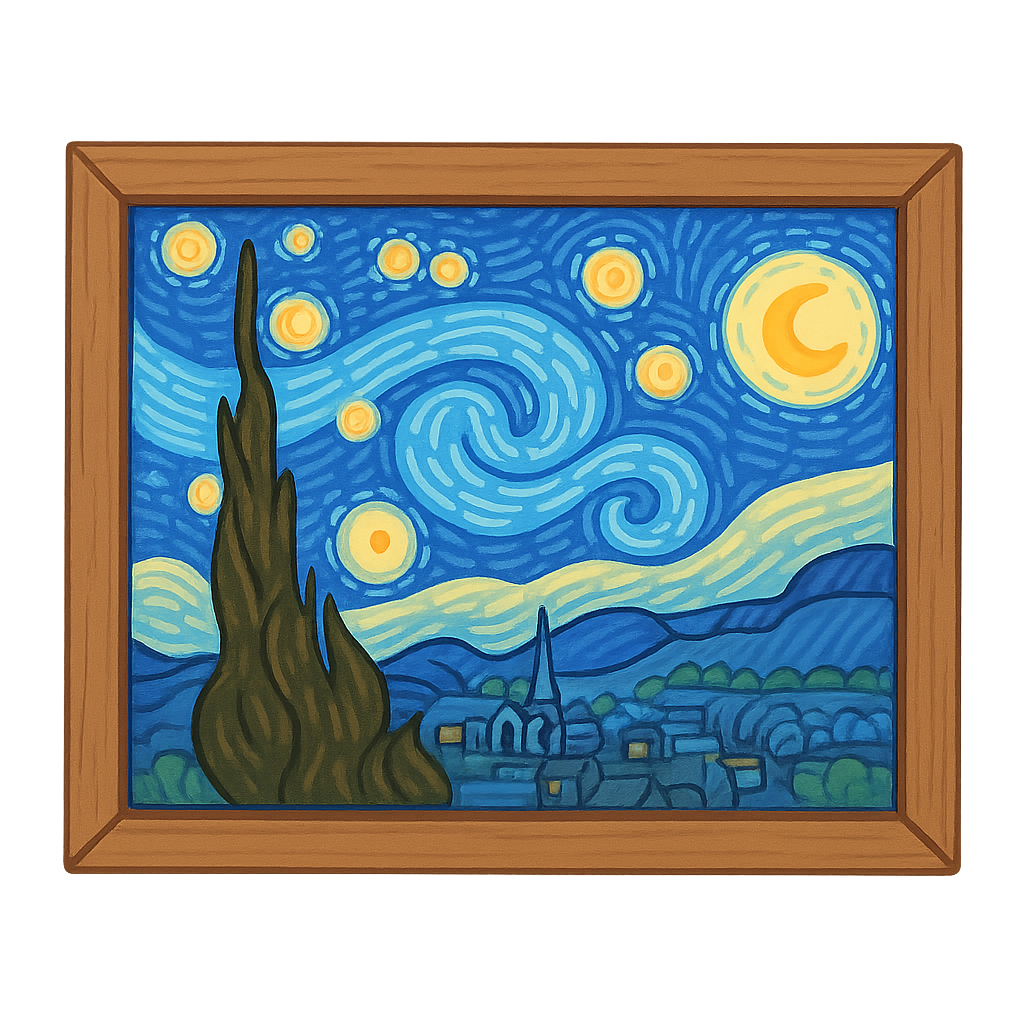
I Am The Starry Night
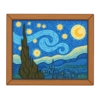
Before you know my name, I want you to feel me. Look closely. See how my sky is not still or silent. It is a swirling, churning river of deep blues and brilliant light, caught in a cosmic dance. A magnificent golden crescent moon blazes in the corner, not just hanging there but radiating an otherworldly glow. My stars are not tiny, distant pinpricks; they are explosive suns, pulsing with yellow and white light, their halos of paint spinning like fireworks. I am a vision of the night as an active, living force. From the earth below, a great, dark shape rises to meet this celestial spectacle. It is a cypress tree, but it looks more like a deep green and black flame, its twisting form reaching from the sleeping village all the way toward the heavens. The town itself is peaceful, bathed in cool blues and purples, its church steeple a quiet anchor against my wild, energetic sky. I am not simply a picture of a landscape after dark. I am the feeling of standing under a vast, mysterious, and magnificent universe, a moment of profound wonder captured forever. I am The Starry Night.
My creator was a man named Vincent van Gogh, and he saw the world more intensely than most. He didn't just see a tree; he felt its struggle to grow. He didn't just see stars; he felt their burning energy across millions of miles. He was a Dutch painter living in France, and in the year 1889, he painted me. He was staying at a place for rest and healing, the Saint-Paul-de-Mausole asylum in Saint-Rémy-de-Provence. While his room had a window that looked out upon the rolling hills and olive groves, I was not a simple copy of that view. I was born from his memory and his powerful imagination. During the day, he would observe the landscape, but at night, he would paint the universe he felt inside himself. He was going through a period of great personal turmoil, yet he channeled his feelings of awe and hope into me. He wanted to express the immense, consoling power of nature and the cosmos. To do this, he used a special technique. He didn't delicately brush thin layers of color. Instead, he squeezed thick, buttery ribbons of oil paint directly onto the canvas and sculpted them with his brush. This technique is called 'impasto,' and it's why my surface has so much texture. You can see the physical path of his brush, the energy he put into every swirl of blue and every burst of yellow. My colors are not just colors; they are emotions made visible.
After Vincent brought me to life, my journey was a quiet one for a very long time. He sent me to his beloved brother, an art dealer named Theo, in Paris. Vincent himself was not entirely sure what to think of me; he worried my swirling lines were too much a departure from reality. For decades, I did not hang in a grand museum. I was passed from Theo's widow to other private owners, a hidden treasure known only to a few. I was a secret whispered between art lovers, a revolutionary vision waiting for the world to catch up. It took many years for people to truly understand what Vincent was trying to achieve—to see beyond the surface and feel the emotion he had poured into my canvas. The world was more accustomed to art that looked realistic, like a photograph. My expressive, emotional style was ahead of its time. But slowly, my reputation grew. Then, in 1941, I embarked on the most significant journey of my existence. I crossed the Atlantic Ocean and found a permanent home at the new and exciting Museum of Modern Art in New York City. Here, I was no longer hidden away. For the first time, I was placed on a public wall for everyone to see, and my quiet life was over forever.
Today, I am one of the most recognized paintings in the world. But my importance isn't just about being famous. I am a window into a different way of seeing. I taught the world that art could be more than just a realistic copy of life; it could be a raw, honest expression of human feeling. My swirling sky and blazing stars have inspired countless people. You can hear my energy in songs, see my colors in movies, and read my sense of wonder in poems. I hang on the museum wall not as an old object, but as a living invitation to look at the world around you—and the world inside you—with more curiosity and passion. I remind everyone that even in times of darkness or struggle, like the one Vincent was experiencing, there is immense beauty and power to be found. I am a bridge connecting you, right now, to the heart and mind of a man who lived over a century ago. When you look at me, you are sharing in his moment of awe, and you are reminded that your own unique imagination is a powerful force, capable of creating incredible beauty.
Activities
Take a Quiz
Test what you learned with a fun quiz!
Get creative with colors!
Print a coloring book page of this topic.











 Free for Educators