

 English

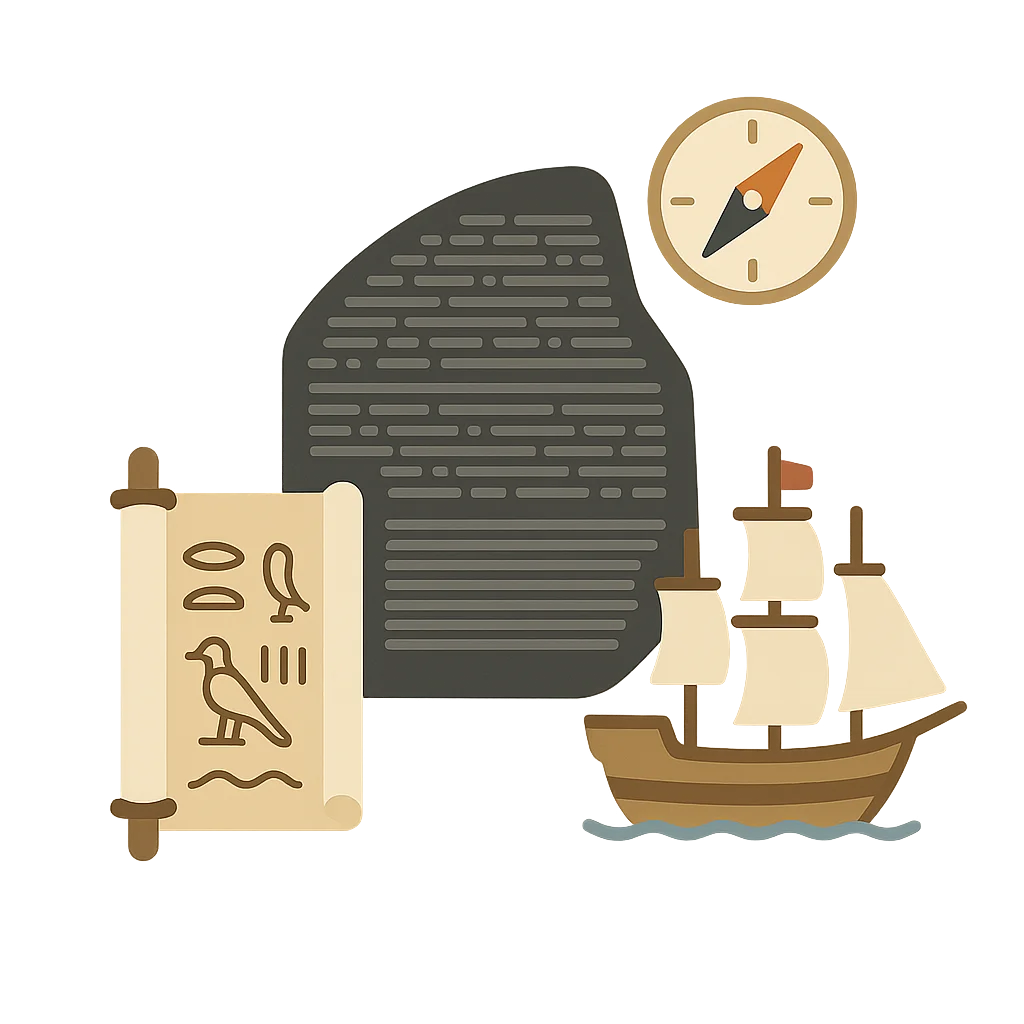
The Stone of Rosetta
My name is Pierre-François Bouchard, and though I am a soldier and an engineer, my story is not about a great battle, but about a great discovery. The year was 1799, and the summer sun over Egypt was relentless. I was serving in the French army under our general, Napoleon Bonaparte. We had come to this ancient land of pyramids and pharaohs not just to fight, but also to learn. Our army included brilliant scientists and scholars, eager to study the country’s incredible history. My own men and I were stationed near a small port town on the Mediterranean coast called Rosetta. The heat was immense, and the sand seemed to get into everything. Our task was to rebuild a crumbling old fort, which we called Fort Julien. Day after day, my soldiers worked, digging foundations and moving heavy stones to make the walls strong again. It was hard, sweaty work, but we knew it was important for protecting our army. Little did I know that hidden within one of those old, dusty walls was a treasure greater than any gold.
On July 15th, 1799, a day that started like any other, one of my soldiers called out to me with excitement in his voice. He had been tearing down a damaged section of a wall when his tool hit something unusual. I walked over, expecting to see just another large block, but my heart began to beat faster as soon as I saw it. There, half-buried in the dirt and rubble, was a large slab of dark, greyish-pink stone. It was different from the other stones in the fort. It was smooth on one side and covered in carvings. I knelt in the dust, wiping away the sand with my hands. I was not a scholar, but I was an educated man, and I could see immediately that this was something special. There were three distinct sections of writing, each in a different script. The top section was filled with the beautiful picture-writing of the pharaohs—birds, reeds, and strange symbols. We called them hieroglyphs. Below that was a script of flowing, cursive-like letters. But it was the bottom section that made me gasp. It was written in a language I recognized: Ancient Greek. At that moment, I knew. I realized that if all three scripts told the same story, then the Greek we could read would become a key. It would be our guide to finally understanding the mysterious hieroglyphs, a language that had been silent for more than 1,400 years. It was a map to a lost world.
I understood at once that this stone was far too important to be used as a simple building block. I ordered my men to carefully move it to a safe place. We couldn't risk it being damaged. I made sure it was cleaned and then sent it to our best scholars who were gathered in the city of Cairo. I knew they were the only ones who could truly begin the difficult work of solving its puzzle. For centuries, people had looked at the hieroglyphs on ancient temples and tombs and thought they were just magical symbols or decorations. No one believed they were part of a real, written language. The stone we found, which everyone started calling the Rosetta Stone, proved they were wrong. The puzzle, however, was incredibly difficult to solve. It took another brilliant man, a French scholar named Jean-François Champollion, more than twenty years of dedicated study to finally crack the code. He was the one who unlocked the secrets. My discovery on that hot July day provided the key that opened a door to the entire world of ancient Egypt. Because of that stone, we can now read their stories, understand their beliefs, and hear the voices of the pharaohs. It taught me that sometimes the greatest discoveries come not from searching for treasure, but simply from paying attention to the world around you.
Activities
Take a Quiz
Test what you learned with a fun quiz!
Get creative with colors!
Print a coloring book page of this topic.













 Free for Educators