

 English

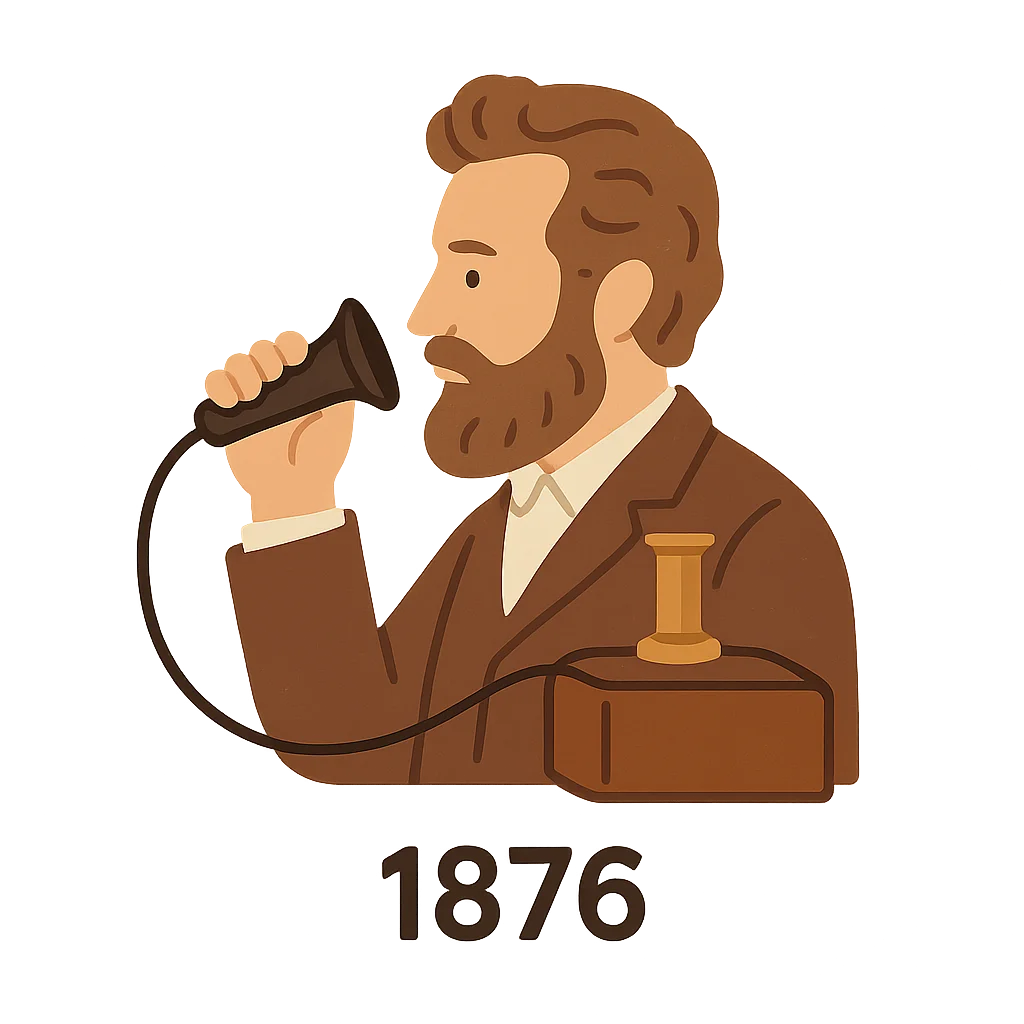
Mr. Bell and the Talking Wire
Hello there. My name is Alexander Graham Bell, but you can call me Aleck. Long before you could talk to anyone, anywhere, just by tapping a little glass screen, the world was a much quieter and slower place. If you wanted to send a message to someone far away, you had to write a letter, which could take weeks to arrive. Or, you could send a telegram, which was faster, but it was just a series of dots and dashes—a secret code called Morse code. You could never hear the warmth, the excitement, or the worry in a person’s voice. This world of silence was something I understood deeply. My own dear mother was hard of hearing, and later, my wonderful wife, Mabel, was deaf. I spent my life studying the science of sound and speech, always driven by a desire to bridge the quiet gaps that separated people. I dreamed of something that seemed like magic to everyone else. I pictured a “talking wire,” a device that could carry not just clicks and beeps, but the actual sound of a human voice, with all its emotion and personality. In the 1870s, this idea was considered pure fantasy. People were amazed by new inventions like the steam engine and the electric lightbulb, but sending a voice through a wire seemed impossible. But for me, it wasn’t just an invention; it was a mission. I believed that if I could understand how sound waves traveled through the air, I could find a way to make them travel through an electrical current. I was determined to make the impossible possible, to give the world a new voice.
My workshop in Boston was my sanctuary, a place filled with a chaotic jumble of wires, batteries, magnets, and strange-looking metal contraptions. It probably smelled of chemicals and metal filings, but to me, it smelled like progress. I was not alone on this quest. I had a brilliant and dedicated assistant, a young man named Thomas A. Watson. Mr. Watson was a master craftsman; he could build anything I could imagine. I would come up with the theories and the designs, and he would use his skilled hands to bring them to life. Our days were long, and our nights were even longer. We worked tirelessly, fueled by coffee and the burning excitement of our shared goal. The heart of our problem was this: how could we make an electrical current vary in intensity, just as the sound waves from a person’s voice do? We experimented with tuning forks, reeds, and thin membranes, hoping to find something that would vibrate perfectly in response to sound. Failure was a constant visitor in our workshop. We would build a new transmitter, test it, and hear nothing but a frustrating buzz or a dead silence. We would adjust a screw, change a wire, and try again, only to be met with the same result. There were moments of deep despair when I thought perhaps everyone was right, that it simply couldn't be done. But then, a tiny glimmer of hope would appear. On a hot afternoon, on June 2nd, 1875, we had a breakthrough. Mr. Watson was in another room, and he plucked one of the metal reeds on his machine. In my room, I heard a faint twang come from my own receiver. It wasn't a voice, but it was a complex sound—the overtone of the reed. My heart leaped. In that moment, I knew. We had proven that our theory was correct. We could send more than just a simple click; we could send a real sound. We were closer than ever before.
After that breakthrough in 1875, we spent months refining our equipment. The excitement was so thick you could feel it in the air, but the final piece of the puzzle remained just out of reach. Then came the day that would change everything: March 10th, 1876. It began like any other day of experiments. I was in one room with our new liquid transmitter, and Mr. Watson was in another room down the hall, with his ear pressed to the receiver, waiting. I was carefully preparing our equipment, which involved handling jars of battery acid. As I leaned over my workbench, my hand slipped, and I tipped a jar of the stinging acid right onto my trousers. “Mr. Watson—Come here—I want to see you.” I shouted it without thinking. It wasn't an experiment; it was a genuine, urgent cry for help. I had completely forgotten about the machine in front of me. I stood there for a moment, annoyed at the mess and the stinging on my leg. And then, I heard it. The sound of footsteps, not from the hallway, but from the other room, running toward me. The door burst open, and there was Mr. Watson, his eyes wide with utter astonishment. “Mr. Bell. I heard you.” he said, his voice trembling with excitement. “I heard every word you said, distinctly.”. We stared at each other for a long moment, the spilled acid forgotten. A slow smile spread across my face, and then we both erupted in joyous celebration. It had happened. Not in a planned experiment, but by a complete accident. My voice had traveled through the wire and into his ear. The talking wire was no longer a dream.
That accidental shout became the first telephone call in history. In that moment, the world shrank. The distance between people no longer seemed so vast. Of course, our work was far from over. At first, many people didn't believe us. They thought it was some kind of trick or ventriloquism. We had to prove our invention worked. Later that year, at the Centennial Exposition in Philadelphia, we demonstrated our telephone. The Emperor of Brazil, Dom Pedro II, was there. When he put the receiver to his ear and heard me reciting Shakespeare from the other end of the room, he dropped it in shock and exclaimed, “My God, it talks.”. From that day on, the world began to listen. The telephone was not just a machine of convenience; it was a tool of connection. It brought families closer, helped doctors reach patients, and allowed businesses to grow in ways never before imagined. My journey started with a simple curiosity about sound and a deep desire to help people communicate. That first, accidental call taught me that perseverance is everything, and that sometimes the greatest discoveries come when you least expect them. My invention was a voice for the world, and it is my greatest hope that it has been used to bring more understanding and connection to humanity.
Activities
Take a Quiz
Test what you learned with a fun quiz!
Get creative with colors!
Print a coloring book page of this topic.















 Free for Educators