

 English

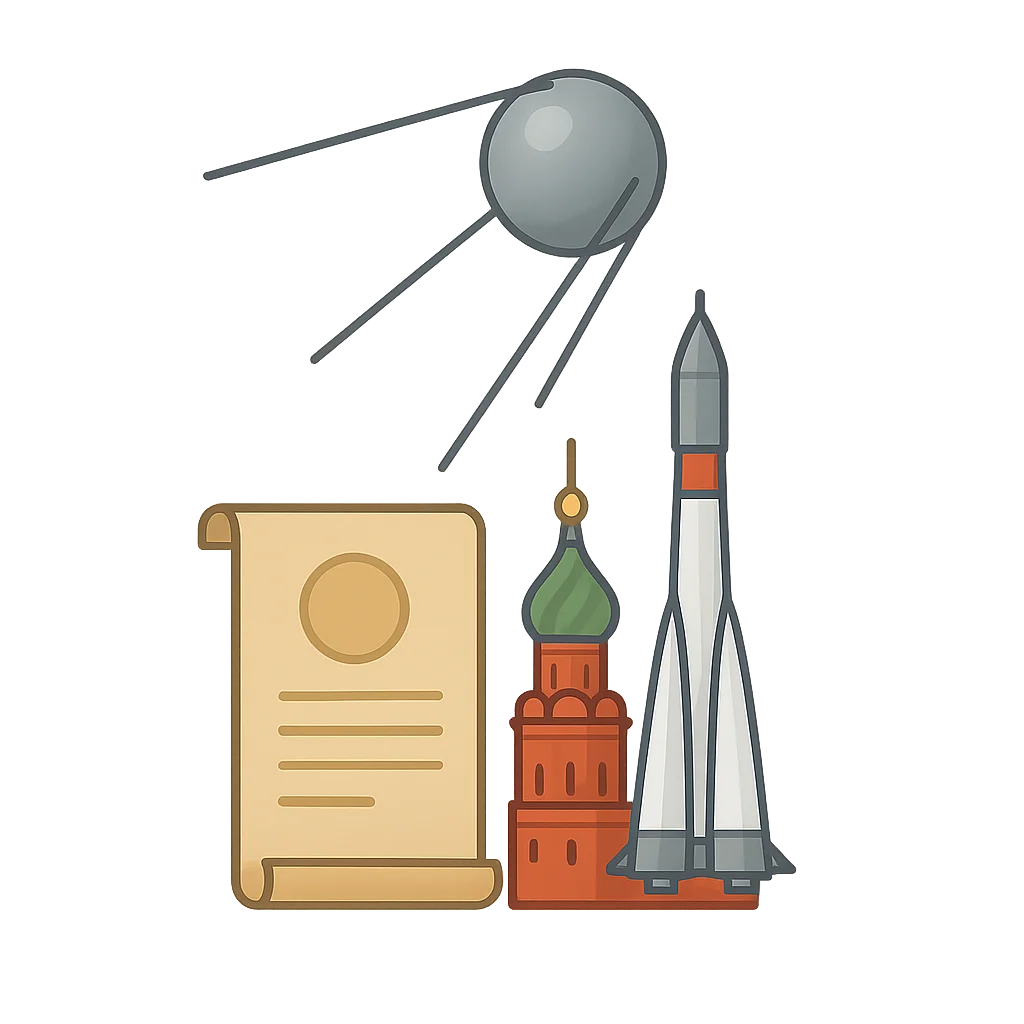
The Little Star That Beeped
Hello there. My name is Sergei Korolev, and I want to tell you a story about a dream that reached the stars. Ever since I was a boy, I was fascinated with flying. I learned to fly gliders and felt the wind lift me up, but even that wasn't enough. I would lie in fields at night, staring at the twinkling stars, and I would dream of building a machine that could travel all the way up there. That dream never left me. As I grew up, I became an engineer, and eventually, I was given a very important job: I became the Chief Designer for the Soviet space program. It was an exciting time, during the 1950s. My country, the Soviet Union, and another great nation, the United States, were in a special kind of competition. It wasn't a race on a track, but a race of ideas, science, and bravery. We called it the 'Space Race.' The challenge was clear: who would be the first to send a human-made object into orbit, to circle our planet high above the clouds? It was a friendly race in some ways, because it pushed us all to be our best, but it was also very serious. The whole world was watching. And it was my job to lead my team to build that very first bridge to the cosmos.
My team and I got to work right away. We were a group of brilliant scientists and engineers, all sharing the same big dream, working day and night in our workshops. Our task was to build the world's first artificial satellite. We decided to call it 'Sputnik,' which means 'traveling companion' in my language, because it would be Earth's first companion in space. It wasn't a fancy or complicated machine. It was a simple, polished metal sphere, about the size of a beach ball, with four long, skinny antennas sticking out like whiskers. It was designed to be strong and simple. Inside its shiny shell, we placed a radio transmitter that would send a signal back to us on Earth—a simple 'beep-beep.' But getting our little Sputnik into space was the real challenge. For that, we needed a rocket of incredible power. We designed the R-7, a giant machine taller than a ten-story building, with engines that roared like a dozen dragons. The days leading up to the launch were filled with a buzzing, nervous energy. We checked every wire, every bolt, every single calculation a hundred times over. One mistake could ruin everything. Finally, the day arrived: October 4th, 1957. We were at our launch site, the Baikonur Cosmodrome, a vast, empty place under a huge night sky full of the very stars we hoped to reach. As darkness fell, our R-7 rocket stood on the launchpad, gleaming under the bright lights, with Sputnik tucked safely inside its nose. My heart was pounding in my chest. I walked around the rocket one last time, patting its cool metal skin and whispering good luck. When the countdown reached zero, fire and smoke erupted from the bottom. The ground shook so hard it felt like an earthquake, and the roar was deafening. I watched, holding my breath, as our creation slowly lifted off the ground, then faster and faster, climbing into the dark sky like a new, man-made star until it was just a tiny speck of light. We had done everything we could. Now, we just had to wait and listen.
After the rocket disappeared from sight, the control room was silent and tense. Everyone was staring at the clock and the radio equipment. Had we done it? Was our little Sputnik really circling the Earth? Minutes felt like hours. We tracked its path, calculating where it should be. Then, exactly when our calculations predicted, a sound came through the speakers. It wasn't a voice, but a simple, steady pulse: 'Beep-beep-beep.' A cheer erupted in the room. People were hugging, laughing, and some were even crying with joy. I felt a wave of relief and pride wash over me. That little beep was the most beautiful sound I had ever heard. It was a message from space, telling us that we had succeeded. For the first time in history, an object made by human hands was orbiting our planet. That night, people all over the world went outside to try and spot the tiny light of Sputnik as it passed overhead. They tuned their radios to hear its simple song. That little metal ball changed everything. It proved that space travel wasn't just a dream from a book; it was possible. It started a new age of exploration and discovery that led to people walking on the Moon and sending robots to other planets. Looking back, I am so proud of what my team accomplished. Our little Sputnik was a small beginning, but it showed the entire world that if we work together and dare to dream big, there is no limit to what we can achieve.
Activities
Take a Quiz
Test what you learned with a fun quiz!
Get creative with colors!
Print a coloring book page of this topic.














 Free for Educators