

 English

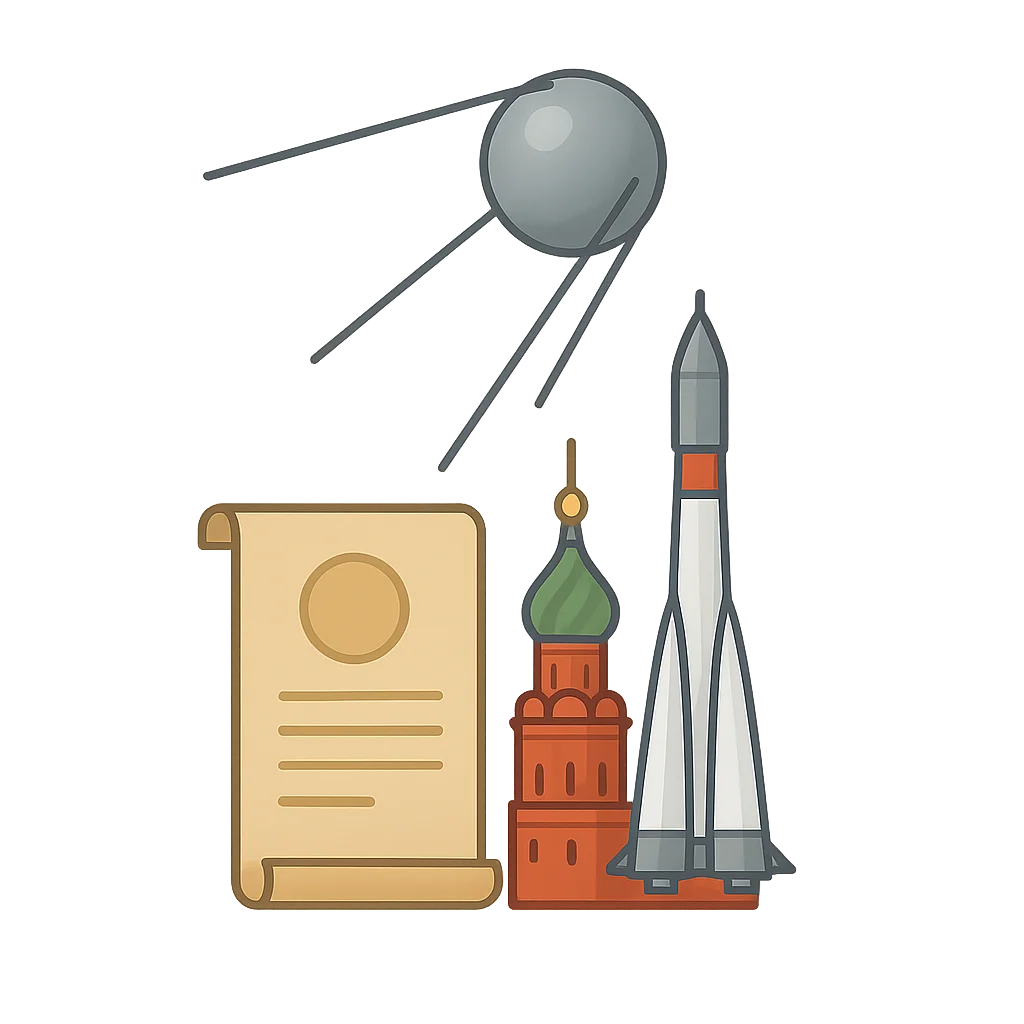
The Chief Designer's Secret Star
Most people from my time never knew my name. To the world, and even to many of my own colleagues, I was known only as the 'Chief Designer.' My name is Sergei Korolev, and it was my job to keep our nation's greatest dreams a secret. My own dream began long before, as a boy in the early 1900s, when I read the incredible books of a schoolteacher named Konstantin Tsiolkovsky. He wrote about rockets that could travel to other planets and people living among the stars. While others thought it was fantasy, I believed it was the future. I spent my life learning to build airplanes and gliders, always looking higher. By the 1950s, the world was a tense place. My country, the Soviet Union, was in a quiet but fierce competition with the United States. It wasn't a war with soldiers, but a contest of ideas, technology, and influence that people later called the Cold War. The next great frontier was not on Earth, but above it, in the black emptiness of space. Both our nations were racing to be the first to leave our world behind. My team was given a monumental task: to build a rocket powerful enough to escape Earth's gravity and place the very first artificial satellite into orbit. It was a dream I had held since childhood, and now, it was my secret mission.
The object we designed was beautifully simple. We called it 'Sputnik,' which in my language means 'fellow traveler.' It was a perfect, polished metal sphere, no bigger than a beach ball, with four long, slender antennae that swept back like the legs of a curious insect. Inside, it carried only a radio transmitter and batteries. Its job was not to take pictures or conduct complex experiments, but simply to announce its presence to the world, to be a voice from the void. But building our little traveler was only half the problem. The bigger challenge was the journey. We needed a rocket with unbelievable power, something the world had never seen before. We worked day and night, year after year, to create the R-7 Semyorka. It was a giant, a beast of metal and fuel, standing taller than a 10-story building. There were many failures and setbacks. Rockets are unforgiving machines, and a single mistake could lead to disaster. The pressure was immense. Finally, after countless calculations and tests, we were ready. We brought Sputnik and its mighty R-7 rocket to a secret, remote launch site in the vast, flat plains of the Kazakh steppe. On the morning of October 4th, 1957, a nervous energy filled our control bunker. We looked out at our creation, gleaming under the bright lights, its breath of cold, vaporous oxygen pluming in the air. The countdown began.
Ten. Nine. Eight. My heart pounded against my ribs with each number. This was the moment that would define my life's work. Seven. Six. Five. I looked at the faces of my team—tense, hopeful, exhausted. We had poured everything we had into this. Four. Three. Two. One. Ignition. A brilliant flash of orange light blinded us, followed by a ground-shaking, deafening roar that felt like the world was tearing itself apart. The R-7 rocket rose slowly at first, then gathered speed, pushing against gravity with millions of pounds of thrust. It climbed into the dark sky, a man-made star on a pillar of fire, until it was just a tiny, fading light. Then, there was silence. The most difficult part of all was the waiting. Had we done it? Was the rocket powerful enough? Did our little sphere separate properly? We sat in the bunker, staring at our radio equipment, listening to the static. Minutes felt like hours. Then, through the crackle, we heard it. A faint, rhythmic pulse from hundreds of miles above the Earth. 'Beep… beep… beep…' It was the most beautiful sound I had ever heard. A wave of pure joy and relief washed over the room. We had done it. Men were shouting, hugging, some even crying. That simple, steady signal was Sputnik's voice, and it was being heard by radio operators all over the planet, telling everyone who was listening that a new age had begun. Humanity was no longer bound to Earth.
Our little fellow traveler, Sputnik 1, circled the globe for three months, its voice beeping down from the heavens before it finally fell silent and burned up re-entering Earth's atmosphere. Its mission was short, but its journey changed the world forever. That single event on October 4th, 1957, officially started the Space Race. It was a challenge to the world, showing what was possible. It pushed scientists and engineers in both my country and the United States to dream bigger and work harder. That first small step made all the next steps possible. Because we proved we could reach orbit, we later had the confidence to send the first living creature, a dog named Laika, into space. And just a few years after that, in 1961, we sent the first human, a brave pilot named Yuri Gagarin, to see our planet from above. My name, Sergei Korolev, remained a secret until after my death, but my dream was shared with the entire world that night. The launch of Sputnik was more than a technical achievement; it was a message that a bold idea, pursued with passion and determination, can open up a new future for everyone. So, I hope you will never stop looking up at the stars and wondering what lies beyond. That is where the next great journey always begins.
Activities
Take a Quiz
Test what you learned with a fun quiz!
Get creative with colors!
Print a coloring book page of this topic.














 Free for Educators