

 English

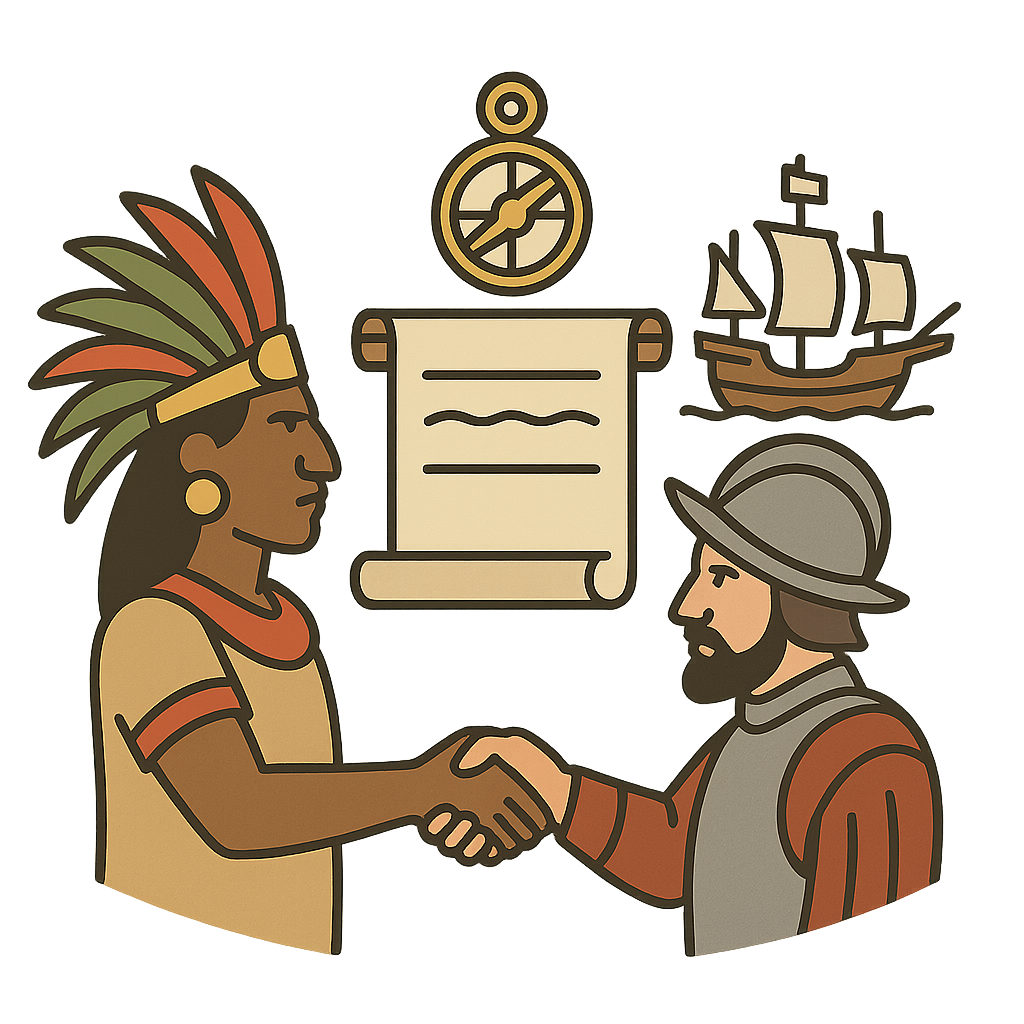
Hernán Cortés and the City of Dreams
My name is Hernán Cortés, and I have always been a man driven by ambition and a desire for glory. Growing up in Spain, I heard tales of a New World across the great ocean, a land of unimaginable riches and untold stories. By the year 1519, I was a landowner in Cuba, but my heart yearned for a greater destiny. It was then that whispers reached us of a vast and wealthy empire on the mainland to the west. On February 18th, 1519, my moment arrived. I stood on the deck of my flagship, one of eleven vessels in my fleet, the salty wind whipping at my cloak. Below me, nearly six hundred brave men—soldiers, sailors, and adventurers—made their final preparations. We were leaving the known world behind, sailing toward a mystery. The journey was filled with both excitement and trepidation. The sea could be a cruel master, but the promise of what lay ahead pushed us onward. When we finally sighted the coastline of what is now Mexico, it was a breathtaking vista of dense green jungle that seemed to steam under the tropical sun. It felt like we had arrived at the dawn of creation. Our first encounters with the local peoples were cautious. They were unlike anyone we had ever seen, with their own languages, customs, and beliefs. Communication was a great challenge until a gift of fate came to us. Among a group of enslaved women given to us was a young woman named Malintzin, whom we christened Doña Marina. We would come to call her La Malinche. She was brilliant, quickly learning Spanish to add to her knowledge of Nahuatl, the language of the Aztecs, and several Mayan dialects. She was more than an interpreter; she became my advisor, my guide, and my indispensable link to this complex new world. Without her, our expedition would have surely been lost before it had truly begun.
With La Malinche to guide us, we began our incredible march inland, leaving the coast behind in August of 1519. Our destination was the heart of the Aztec Empire, the magnificent city of Tenochtitlan. The journey was a true test of our endurance. We crossed sweltering jungles, climbed towering, snow-capped mountains that left us breathless from the thin air, and navigated arid plains. We were a small force in a vast, unknown land, and we faced resistance from some local tribes who saw us as invaders. Yet, we also discovered that the Aztec Empire had many rivals. The mighty Tlaxcalans, a proud and warlike people, had never been conquered by the Aztecs. After a series of fierce battles, we proved our strength, and they decided to become our allies. They saw in us a chance to defeat their old enemies, and their thousands of warriors would prove essential to our survival. Their alliance was a turning point, giving us the strength and knowledge we needed to proceed. As we drew closer to the Valley of Mexico, we began to see the true scale of the Aztec civilization. We saw great cities, bustling markets, and advanced systems of farming. Finally, on November 8th, 1519, we stood upon a high pass and looked down upon our destination. What we saw silenced every man among us. Tenochtitlan was a city of dreams, an island jewel floating in the center of a vast lake, connected to the mainland by three massive causeways. Great pyramids and temples pierced the sky, and canoes glided through a network of canals that served as streets. It was larger, cleaner, and more magnificent than any city I had ever seen in Spain, including Seville or Salamanca. We were led across one of the causeways into the city, where the great Emperor Moctezuma II came to greet us. He was carried on a lavish litter, adorned with shimmering feathers of the quetzal bird and brilliant gold. The tension was thick enough to taste. We were outsiders, men of steel and beard, in a world of obsidian and feathers. I dismounted and we exchanged greetings and gifts. He was a noble and intelligent ruler, but I could see the uncertainty in his eyes. He welcomed us into his city as honored guests, providing us with a palace for lodging. In those first weeks, we lived in a state of awe and suspicion, exploring the incredible city while a complex and delicate relationship formed between me and the most powerful man in this land.
Our status as guests in Tenochtitlan was always fragile. Mistrust grew on both sides, and the situation became increasingly tense. To ensure our safety, I made the bold decision to place Moctezuma under house arrest within his own palace. This act created a deep rift, and the city simmered with anger. The situation exploded while I was away from the city dealing with a rival Spanish force. My lieutenant, Pedro de Alvarado, fearing an uprising, ordered an attack on Aztec nobles during a religious festival. When I returned, the city was in open revolt. The Aztecs, now led by Moctezuma's brother, Cuitláhuac, laid siege to our palace. We tried to have Moctezuma calm his people, but he was struck down and died shortly after. Our position was hopeless. On the night of June 30th, 1520, we attempted a desperate escape under the cover of darkness and rain. That night became known as 'La Noche Triste,' the Night of Sorrows. The Aztec warriors were waiting. They attacked us on the causeways, and hundreds of my men, along with many of our Tlaxcalan allies, were lost to the battle and the lake. It was a harrowing retreat, and we who survived were wounded and defeated. But we were not broken. We retreated to the safety of Tlaxcala, where our allies helped us recover and rebuild our strength. My resolve hardened. We would return. Over the next year, we built a new fleet of small warships, designed to be carried in pieces over the mountains and reassembled at the lake. We gathered more allies and began a systematic siege of Tenochtitlan. We cut off the causeways and used our ships to control the lake, stopping food and fresh water from entering the city. The fighting was long and brutal, and the Aztecs, now led by their final emperor, the courageous young Cuauhtémoc, fought with incredible bravery. Finally, on August 13th, 1521, the city fell. The beautiful City of Dreams was in ruins, but from its ashes, a new era would begin. We started to build a new city on the same spot, which would become the capital of 'New Spain.' The fall of Tenochtitlan marked the end of the Aztec Empire, but it was also the beginning of a new culture, a blending of Spanish and native ways that would shape this land for centuries. My journey was one of ambition and conflict, but it also opened a door between two worlds that could never again be closed. It is a reminder that history is complex, with many perspectives, and that true courage is needed not only to explore the unknown but also to understand the consequences of our actions.
Activities
Take a Quiz
Test what you learned with a fun quiz!
Get creative with colors!
Print a coloring book page of this topic.















 Free for Educators