

 English

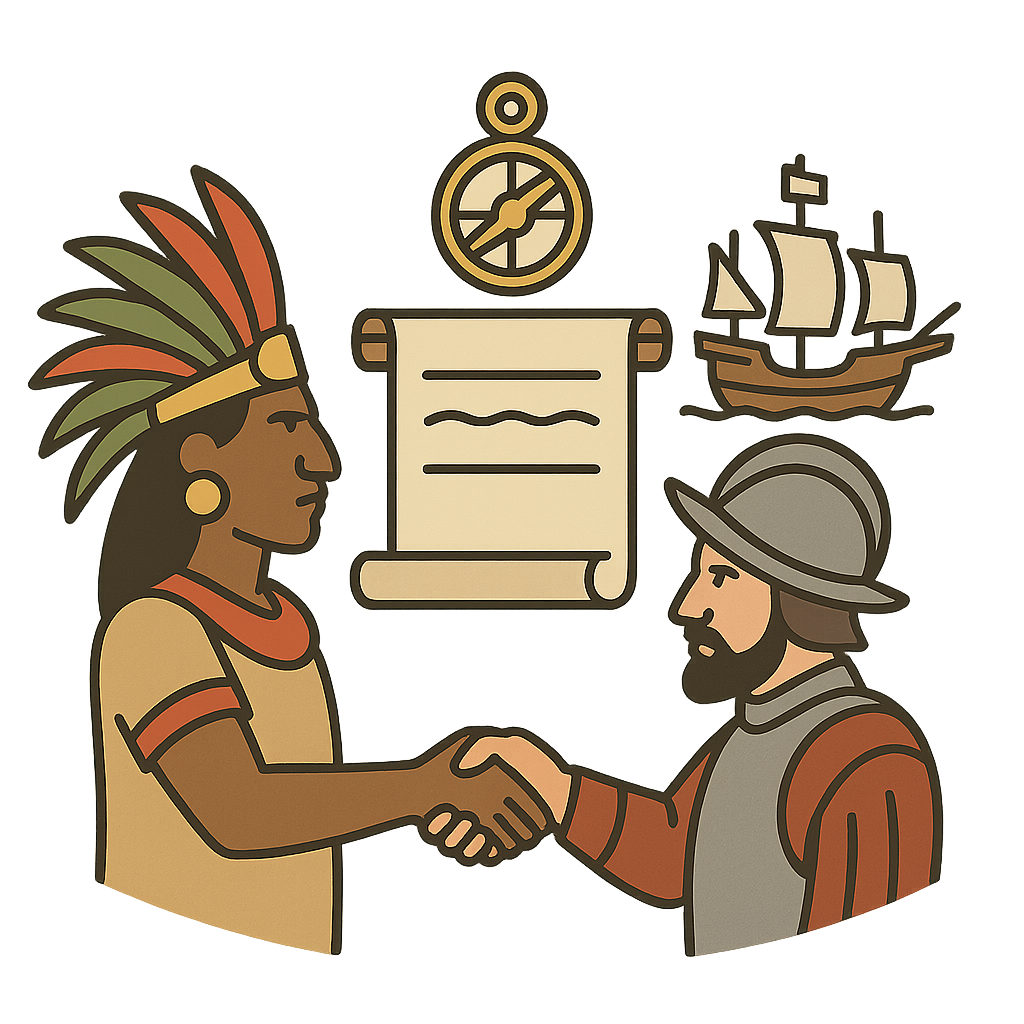
Malintzin: The Voice Between Two Worlds
My name is Malintzin. Before I was known as a voice between two worlds, I was just a girl who grew up under the warm sun, with two languages resting on my tongue. I spoke Nahuatl, the language of the mighty Aztec Empire whose temples touched the clouds, and I also spoke the Mayan tongue of the jungle lands. My world was filled with the scent of corn tortillas cooking on a hot stone and the bright colors of the marketplace, where feathers, cocoa beans, and sparkling jade were traded. I remember the stories of our gods, the rhythm of the drums, and the sight of canoes gliding silently through the canals. Life was as it had always been, guided by the seasons and the stars.
Then, one day in the year 1519, everything changed. I stood on the shore and saw something impossible on the horizon. They weren’t clouds, and they weren’t islands. They were like floating mountains with great white wings that caught the wind. Men with skin as pale as the moon and hair like the sun came from these giant wooden houses on the sea. They wore armor that shone so brightly it hurt my eyes. I felt a shiver of fear run down my spine, but there was also a spark of wonder. Who were these strangers? What did they want from our land? I did not know it then, but my two languages, the gift I had carried since childhood, were about to become the most important thing in the world.
The leader of these strangers was a man named Hernán Cortés. He soon discovered that I could understand the Mayan people along the coast, and when he found another Spaniard who could speak Mayan, we formed a chain of translation. But my true value was revealed when we met people who only spoke Nahuatl. Suddenly, I was the only one who could speak directly from Cortés to the messengers of the great Aztec Emperor, Moctezuma II. I became their bridge, their tongue. My words were the only things that could cross the great river of silence between their two worlds. It was a heavy weight for a young woman to carry, but I knew my life depended on it.
Our journey inland was something I will never forget. We walked for weeks, through humid jungles buzzing with insects and over chilly mountains that scraped the sky. Finally, we saw it. Tenochtitlan. It was more magnificent than any story could describe, a city that seemed to float on the shimmering waters of a vast lake. Great stone roads, called causeways, connected it to the mainland, and thousands of canoes darted between floating gardens full of flowers and vegetables. It was the heart of the Aztec world. The day we met Emperor Moctezuma II is burned into my memory. He was carried on a litter decorated with brilliant green quetzal feathers, and he wore sandals with soles of pure gold. Cortés stood before him in his dull iron armor. The air was thick with tension and wonder. I stood between them, my heart pounding. I took Moctezuma’s words of welcome, spoken in elegant Nahuatl, and turned them into Spanish for Cortés. Then I took Cortés’s strange greetings and turned them into words the emperor could understand. In that moment, I felt the fate of everyone around me resting on my translations. But communication is more than just words. As the days turned into weeks, I could feel the understanding between the two leaders begin to crack. Fear and suspicion grew like weeds, and no matter how carefully I chose my words, I could not stop the sadness that was coming.
The misunderstandings grew into a terrible conflict, and the beautiful city I had marveled at became a place of sorrow. On August 13th, 1521, after a long and painful siege, the great city of Tenochtitlan fell. Seeing the temples crumble and the canals run cloudy with sadness broke my heart. The world I had known was gone forever. The sounds of the market, the beat of the drums, and the proud Aztec warriors were now just memories. It was an ending, but it was also a beginning.
From the ruins of the old city, a new one began to rise. It was not Tenochtitlan, but it was not a Spanish city either. It was something new: Mexico City. The Spanish brought their language, their religion, and their ways, but our food, our knowledge of the land, and the strength of our people remained. A new culture was born, a blend of two worlds that had once been separated by an ocean. My life was spent walking the difficult path between them. Some would say I helped the Spanish, while others would say I helped my people survive by allowing them to communicate. I only know that I used the gift I was given—my two tongues—to build a bridge instead of a wall. And that bridge, though it was crossed with much pain, became the foundation for a new nation and a new people.
Activities
Take a Quiz
Test what you learned with a fun quiz!
Get creative with colors!
Print a coloring book page of this topic.









 Free for Educators