

 English

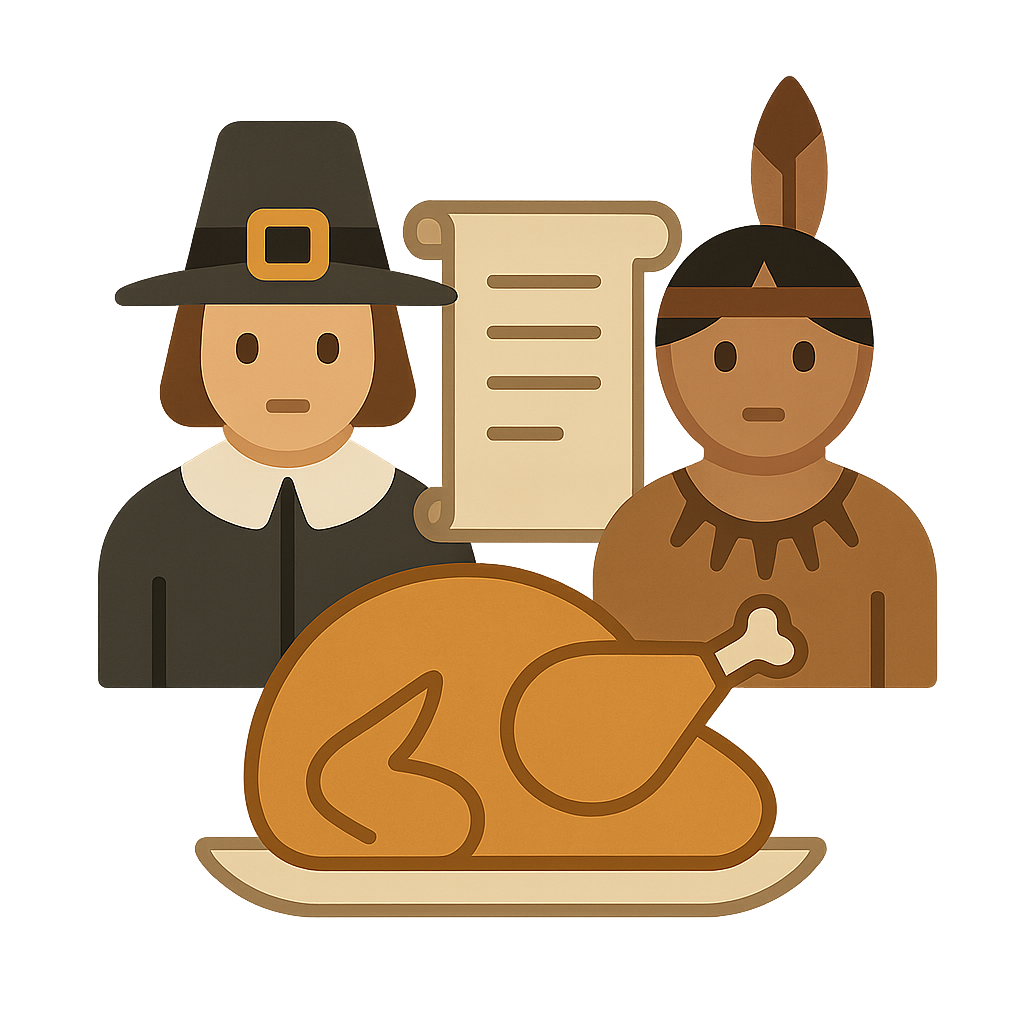
William Bradford's Story: The First Thanksgiving
A Perilous Journey and a New Beginning
My name is William Bradford, and I had the great responsibility of serving as the governor of our Plymouth Colony. Our story, however, begins not in the wilds of America, but across the vast ocean in England. We were known as Separatists, for we wished to separate from the Church of England, which we believed had strayed from the true path of our faith. For this belief, we were persecuted, hunted, and imprisoned. Seeking freedom, we first moved to Holland, a place of greater tolerance. But after a decade, we saw our children growing up more Dutch than English, and we feared losing our heritage. So, we made the monumental decision to journey to the New World, a place where we could build a community based on our own principles and worship freely. On September 6th, 1620, we set sail from Plymouth, England, aboard a small, creaking ship called the Mayflower. The journey was more arduous than we could have ever imagined. For sixty-six days, we were tossed about by furious storms that cracked our main beam and filled our small quarters with the chilling spray of the sea. We lived in cramped, damp conditions, with little food and rampant sickness. Yet, amidst the despair, there was hope. A baby, whom his parents aptly named Oceanus, was born at sea. Before we even set foot on land, we knew we needed a plan to govern ourselves. So, we gathered together and drafted an agreement, which we called the Mayflower Compact. In it, we all promised to create “just and equal laws” for the good of our new colony. It was a simple document, but it was our pledge to one another that we would build our new life on a foundation of law and community, not chaos.
The Starving Time and Unexpected Friendship
We finally made landfall in November of 1620, far north of our intended destination in Virginia. The land was a “hideous and desolate wilderness, full of wild beasts and wild men,” and winter was upon us. That first winter was a time of immense suffering, a period we would forever call the “Starving Time.” The cold was unrelenting, our shelters were crude, and our food supplies were dangerously low. A terrible sickness swept through our small community, and barely a day went by when we did not have to bury one of our own. Of the one hundred and two passengers who arrived, nearly half perished before spring. I myself lost my beloved wife, Dorothy. It felt as though our dream had turned into a nightmare, and our faith was tested to its very limits. We were weak, grieving, and fearful of the native people we occasionally saw watching us from the woods. Then, on March 16th, 1621, a miracle occurred. A tall Native man walked boldly into our settlement and greeted us in broken English. His name was Samoset. We were astonished. He later returned with another man, Tisquantum, whom we came to know as Squanto. Squanto’s life story was one of great tragedy; he had been kidnapped years before by an English sea captain and taken to Europe, where he learned our language. When he finally returned home, he found his entire Patuxet tribe had been wiped out by disease. He was the last of his people. Despite his own sorrows, he became, as I wrote, a “special instrument sent of God for our good.” He taught us how to plant native corn, burying fish with the seeds to fertilize the soil. He showed us the best places to fish and hunt. He acted as our interpreter and helped us forge a crucial alliance with Massasoit, the great sachem of the Wampanoag people. We signed a treaty of peace that spring, promising mutual support and protection, a treaty that would last for over fifty years.
A Bountiful Harvest and a Shared Feast
With Squanto’s guidance and our own hard labor, the spring and summer of 1621 were far more hopeful than the preceding winter. The skills he taught us proved invaluable. Our corn grew tall and strong, our gardens produced beans and squash, and the forests and waters provided us with meat and fish. As autumn arrived, we looked upon our stores of food with immense gratitude. We had survived. We had built homes. We had a harvest that would see us through the coming winter. We felt so profoundly thankful to God for His mercy that we decided to hold a special celebration. I, as governor, declared a harvest feast to give thanks for our bounty. I sent four of our best men, including our military captain Miles Standish, out to hunt for fowl, and they returned with enough ducks, geese, and turkey to feed our entire settlement for a week. As we prepared for our celebration, a party of guests arrived. Massasoit, our Wampanoag ally, appeared with about ninety of his men. For a moment, we worried if we had enough food for so many, but our guests did not come empty-handed. They went into the forest and soon returned with five deer, a generous contribution to the feast. For three days, our two communities shared a meal together. We colonists and the Wampanoag men sat down to eat roasted fowl, deer meat, corn, squash, and other vegetables from our harvest. It was a time of great fellowship. We ran races, played games, and our men held shooting demonstrations with their muskets, which greatly impressed our Wampanoag friends. There was no fear or mistrust, only a shared sense of peace and mutual respect. We were two different peoples, from different worlds, but in that moment, we were united by a shared meal and a spirit of gratitude.
The Meaning of Our Thanksgiving
That feast in the autumn of 1621 was more than just a meal. It was a celebration of life itself. It was a moment to give thanks for our very survival after a year filled with unimaginable hardship and loss. We were thankful for the bountiful harvest that promised we would not starve again. We were thankful for our newfound home, a place where we could live and worship in freedom. And we were profoundly thankful for the unexpected friendship of the Wampanoag people, without whom we surely would not have survived. That gathering represented hope, a belief that different people could live together in peace and help one another. Today, when your families gather for Thanksgiving, you are continuing a tradition that began with that simple, grateful feast. It is a time to remember the importance of community, the blessing of a full table, and the kindness of strangers who become friends. My hope is that the spirit of that first Thanksgiving—a spirit of gratitude, sharing, and peace—will always be remembered as the true heart of the holiday.
Activities
Take a Quiz
Test what you learned with a fun quiz!
Get creative with colors!
Print a coloring book page of this topic.












 Free for Educators