

 English

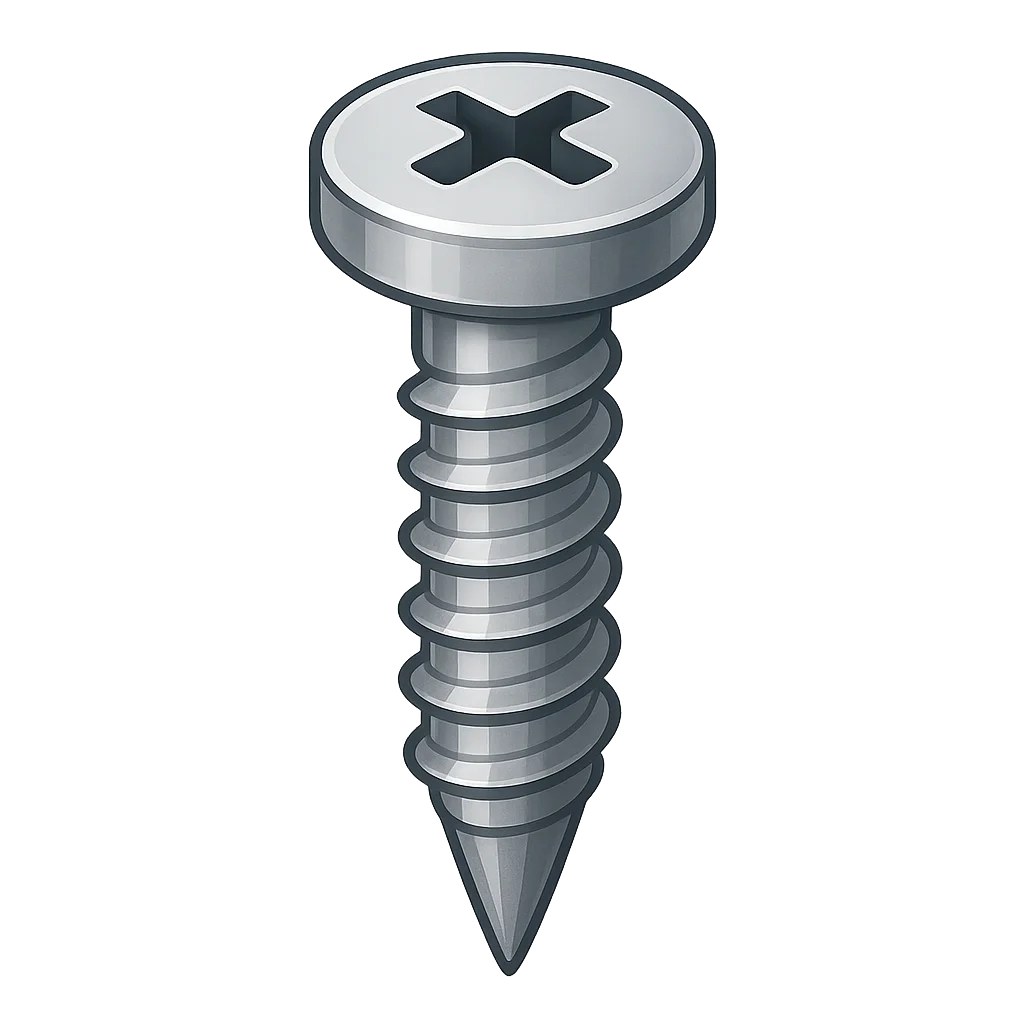
The Unseen Hero: The Story of the Screw
You probably see me every day, but I bet you barely notice me. I am in the chair you are sitting on, the phone in your hand, and the frame holding a picture on your wall. I am the humble screw. At first glance, I am just a piece of metal with a spiral groove, a simple inclined plane wrapped tightly around a cylinder. But that simple design gives me incredible power, a strength that can hold together skyscrapers and the tiny arms of your eyeglasses. My story is one of transformation, of a simple idea that grew to connect the entire modern world. Have you ever stopped to wonder how difficult it would be to build your life, your home, or your city without something to hold it all together? My journey through history is the answer to that question, and it started a very long time ago.
My story begins long before the world you know, in ancient Greece during the 3rd century BCE. In those days, I was not small and tidy. I was enormous. A brilliant thinker named Archimedes of Syracuse looked at the mighty Nile River and saw a problem: how to lift its life-giving water to the thirsty fields and villages on higher ground. He envisioned me, not as a tiny fastener, but as a giant machine. He called me the Archimedes Screw. I was a massive helix, a spiral blade housed inside a hollow tube. When people turned a crank at the top, I would rotate, and my spiraling form would scoop up water from the low river and carry it upward, defying gravity with every turn. I was a workhorse, a symbol of human ingenuity. I irrigated fields that had been too dry to farm, bringing forth crops that fed entire communities. I filled reservoirs, providing fresh water to growing towns. In this early form, I wasn't holding things together; I was lifting civilizations up.
Centuries passed, and I continued my work lifting water across the world. But my destiny was about to change. I traveled from the ancient world into the heart of the Renaissance, landing in the notebooks of another genius: Leonardo da Vinci. Around the late 15th century, he filled his famous journals with sketches of me. Like Archimedes, he was fascinated by my ability to move things, but his restless mind saw a different kind of potential. He drew me not just as a large machine, but as a small, precise connector. He imagined me holding pieces of wood or metal together with a rotational force that no simple nail could ever match. His designs were revolutionary, but the technology to create me in this new, smaller form just did not exist yet. It was a pivotal moment for me, a seed of an idea planted by one of history’s greatest minds. I felt my purpose shifting from a force that moves the world to a force that could one day hold it together.
For hundreds of years after Leonardo, the dream of me as a reliable fastener remained just that—a dream. Any screw that existed was painstakingly made by hand. A blacksmith would heat and hammer a metal rod, then spend hours carefully filing a spiral groove into it. No two of us were ever the same. One might have threads that were too wide, another’s might be too narrow. This inconsistency made us weak and unreliable for building the complex machines that inventors were starting to dream of during the dawn of the Industrial Revolution. Then, my hero arrived. His name was Henry Maudslay, a brilliant English engineer with a mind for precision. Around the year 1797, he looked at the mess of mismatched screws and knew there had to be a better way. He invented a magnificent machine called the screw-cutting lathe. It was a marvel of engineering that could carve identical, perfect threads into metal rods, time after time. Suddenly, I had countless identical siblings. We were standardized. This was my superpower. Now, if a screw broke in a steam engine, it could be replaced with a perfect copy. Engineers could finally design intricate machines with interchangeable parts. I became the invisible backbone of the Industrial Revolution, holding together the looms, presses, and engines that built the modern world.
Today, my life is more varied than Archimedes or Maudslay could have ever imagined. I am in the engine of your family's car and the wings of the airplane flying thousands of feet above the ground. I am inside the computer you use for school and the hinges on your bedroom door. I even travel to the final frontier, holding satellites together as they orbit the Earth in the silent cold of space. My story is a reminder that sometimes the most powerful ideas are the simplest ones. It all started with a spiral, an inclined plane wrapped around a post. Through the minds of brilliant people who saw a problem and imagined a solution, I transformed from a water lifter to the universal fastener that keeps your world from falling apart. So next time you see me, give a little nod. Remember my journey and think about the other small, overlooked things that make a big difference every single day.
Activities
Take a Quiz
Test what you learned with a fun quiz!
Get creative with colors!
Print a coloring book page of this topic.













 Free for Educators