

 English

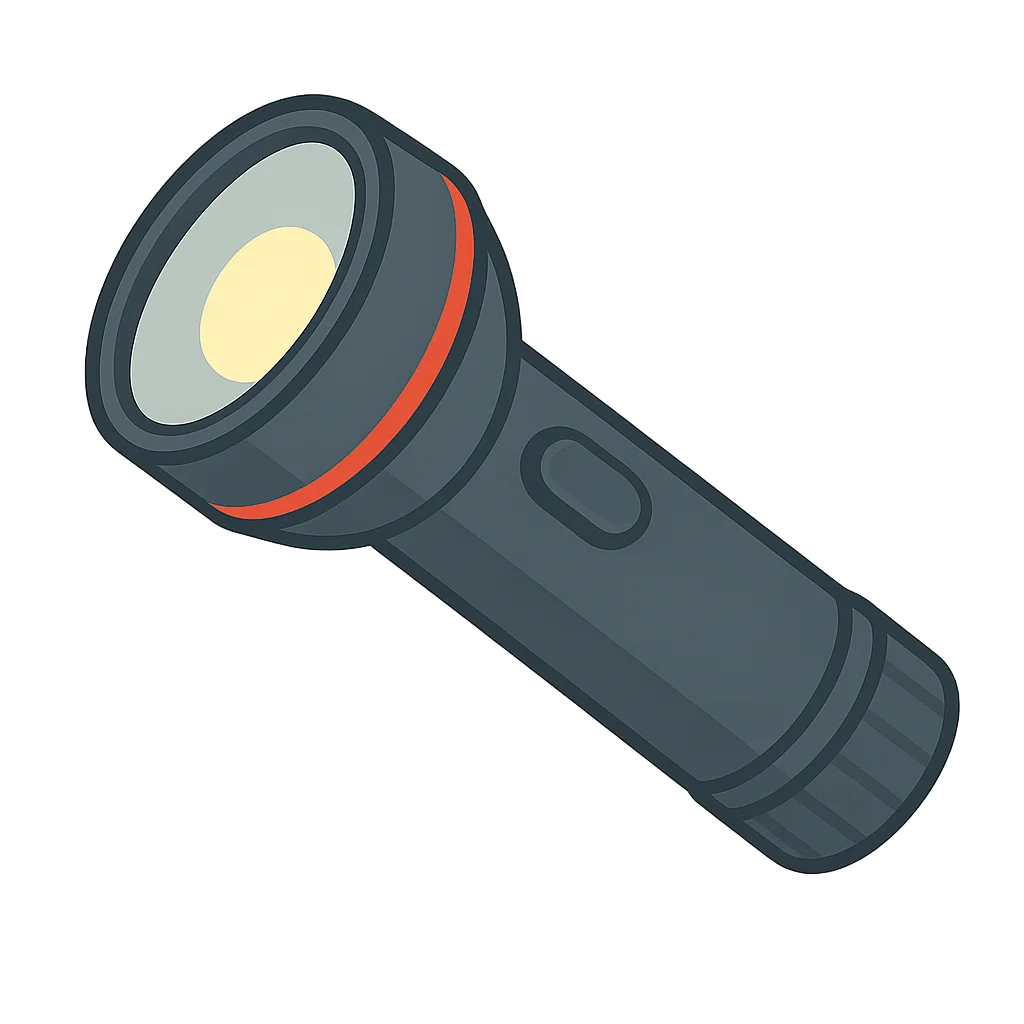
I Am the Flashlight
Before I existed, the world held its breath when the sun went down. Darkness wasn't just an absence of light; it was a vast, mysterious ocean filled with unseen dangers and missed opportunities. People relied on my ancestors, the candle and the kerosene lamp, but they were a fickle and demanding family. A gust of wind could plunge a room into blackness, a clumsy step could send hot wax or flammable oil spilling, and the air was often thick with smoke and soot. To travel at night was to carry a tiny, fragile star that could be extinguished at any moment. Imagine trying to fix a wagon wheel on a moonless night, or a doctor trying to reach a patient down a dark country lane, with only a flickering flame to guide them. The night was a barrier, a wall that confined people to their homes and limited what they could accomplish. The world was waiting for a light that was safe, reliable, and free to travel anywhere. It was waiting for me.
My story truly begins not with a flash of light, but with a spark of chemical energy. The invention of the dry cell battery in the late 1880s was the key that unlocked my potential. For the first time, electricity could be stored in a compact, portable container without the risk of spilling corrosive acid. This innovation caught the attention of an inventor named David Misell. Working in New York City in 1898, he had a brilliant idea. He took three of these new D-cell batteries, placed them in a simple tube of paper and fiber, and at one end, he attached a small incandescent light bulb with a rough brass reflector. On January 10th, 1899, his design was officially recognized with a patent. I was born. However, I wasn't quite the steady companion you know today. The carbon-filament bulbs of that era were inefficient, and the batteries weren't powerful enough to keep them lit for long. I could only produce a brief, surprising burst of light before I had to rest. That’s why people called me a “flash-light.” I was more of a novelty than a tool, a quick flash in the pan, but it was the beginning of a revolution.
My potential was clear, but I needed someone to help me grow from a fleeting novelty into an essential tool. That person was Conrad Hubert, a Russian immigrant and visionary businessman. He saw what I could become. David Misell had been working for Hubert’s American Electrical Novelty and Manufacturing Company, and after Misell left, Hubert took over my development. He was relentless in his pursuit of perfection. He improved my design, making me more durable and easier to use. His company, which you would later know as Eveready, began producing me for the public. The real turning point, however, came around 1904 with the invention of the tungsten filament for light bulbs. This new material was incredibly strong and efficient. When it was placed inside me, everything changed. The flash was gone. For the first time, I could cast a steady, strong, and reliable beam of light that could last for hours. I finally felt complete, no longer just a flash of potential but a constant, dependable source of illumination. I was ready to truly serve humanity and step out of the shadows for good.
From that moment on, my journey has been one of service and adventure. I became a trusted friend during power outages, a silent guardian offering comfort when the world went dark. I became an essential tool for police officers, plumbers, and electricians, venturing into the dark spaces where they worked. I have explored deep caves with spelunkers, climbed mountains with hikers, and sat by campfires with storytellers. My humble form, once a simple paper tube, has evolved into a vast family. Today, you can see my spirit in powerful LED tactical lights that can pierce the darkest night, in lightweight headlamps that free up a climber's hands, and even in the tiny, convenient light on the back of a smartphone. My purpose has never changed: to bring light where there is darkness, to provide clarity where there is confusion, and to offer safety where there is fear. My story is a reminder that even the simplest idea, a small spark in the dark, can grow to illuminate the entire world. And I will always be here, ready to shine the way forward.
Activities
Take a Quiz
Test what you learned with a fun quiz!
Get creative with colors!
Print a coloring book page of this topic.
















 Free for Educators