

 English

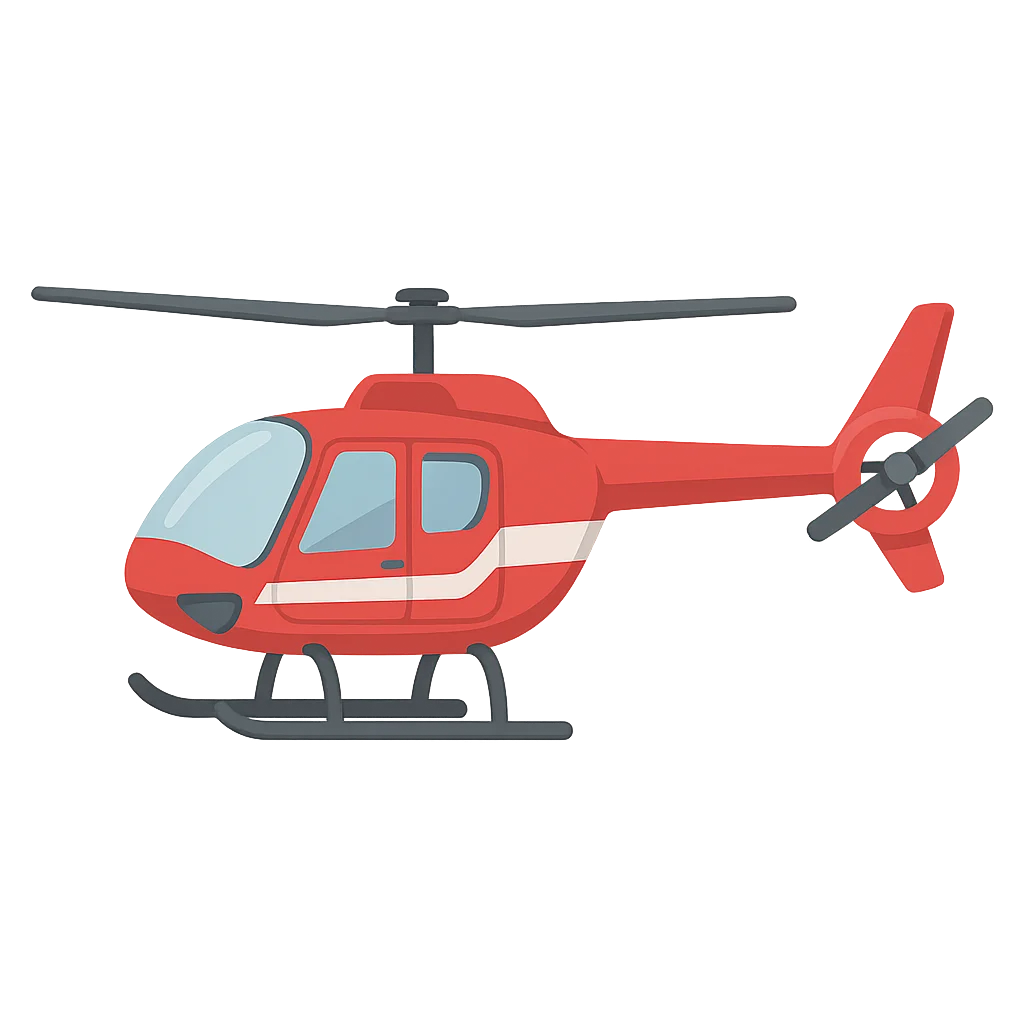
I Am the Helicopter
Before I was a body of metal and rotors, I was a dream, an idea that floated in the air like a spinning maple seed. Hello, I am the Helicopter. For centuries, humans watched dragonflies dart and hover, changing direction in an instant. They saw seeds twirl gracefully to the ground, and they longed to fly in the same way—not just forward, but straight up, straight down, and sideways. The dream of me is ancient. As far back as the 1480s, a brilliant man named Leonardo da Vinci sketched a design he called an 'aerial screw.' It looked like a giant corkscrew pointing to the sky. His machine was never built, but the drawing was a promise, a seed of an idea planted deep in the soil of human imagination. It was the first whisper of my name, a hint that one day, humans wouldn't just soar like eagles, but hover like hummingbirds.
My journey from a dream to reality was long and full of frustrating stumbles. For centuries, the puzzle of vertical flight seemed impossible to solve. You see, it’s one thing to generate enough power to lift a heavy machine off the ground, but it’s another thing entirely to control it once it’s up there. Early versions of me were wild and unpredictable. Imagine trying to balance a spinning top on the tip of your finger; that’s what it felt like. One of my first significant steps happened in France. A determined inventor named Paul Cornu built a strange-looking machine with two large, rotating blades. On November 13th, 1907, he coaxed me into the air for about twenty seconds, rising just a few feet off the ground. It wasn't a true flight, more like a clumsy, wobbly hop. I felt unstable, shaky, and I couldn't go anywhere but up and then back down. Still, that brief moment was a victory. It proved that lifting straight up was possible. But the great challenge remained: how to tame my wild spin and give me direction. For years, inventors wrestled with this problem, feeling the sting of failure as I bucked and twisted, refusing to be controlled.
Then came the man who would finally give me balance and purpose: Igor Sikorsky. His fascination with flight began in his childhood in Russia, a dream he carried with him when he moved to America. He had already found success designing airplanes, but his heart was set on me, the machine that could hover. He believed in me when many others had given up. In his workshop, he brought me to life as the VS-300. I wasn't sleek or beautiful; I was a skeleton of welded steel tubes, with a single large rotor above my head and a smaller, propeller-like rotor on my long tail. That little tail rotor was the key. On September 14th, 1939, Igor himself sat in my open cockpit. I felt the engine roar to life, and my main rotor began to beat against the air, a rhythmic thumping sound. As he increased the power, I felt a lightness I’d never known. The ground fell away. But this time was different. The small rotor on my tail pushed against the air, stopping me from spinning wildly. I was steady. I was controlled. For the first time, I wasn't just hopping; I was hovering, hanging in the air with purpose. In that moment, Igor Sikorsky didn't just fly a machine; he fulfilled an ancient dream.
My true purpose became clear once I left the workshop and went out into the world. Unlike my cousins, the airplanes, I don't need long runways to take off or land. I can touch down gently in places they could never dream of reaching. I became a helping hand from above, a lifeline for people in desperate situations. I have landed on the jagged peaks of mountains to rescue stranded hikers, the wind from my rotors whipping at their jackets as they were lifted to safety. I have settled onto the rooftops of busy city hospitals, delivering patients who needed urgent care faster than any ambulance could. I can hover over dense forests to lower firefighters to battle a blaze, or carry heavy equipment to help build bridges and skyscrapers. From my cockpit, the world looks different. I see the patchwork of farmlands, the winding rivers, and the tiny figures of people looking up. Knowing that I can be the difference between hope and despair, that I can bring help where it is needed most, gives my flight meaning. I am not just a machine; I am a rescuer, a carrier, and a guardian.
My story is far from over. I am always changing, evolving. Engineers are constantly working to make me faster, quieter, and more capable. But perhaps my proudest moment came recently, when the dream of vertical flight traveled beyond our own world. My tiny, robotic cousin, a drone helicopter named Ingenuity, took to the thin Martian air. On another planet, hundreds of millions of miles away, a small machine with spinning rotors lifted off the ground, hovered, and landed safely. It proved that the seed of an idea planted by Leonardo da Vinci centuries ago has grown into a tree with branches that can reach for the stars. My journey from a wobbly hop to a controlled flight across the solar system is a testament to human persistence. It shows that with a powerful dream and the courage to never give up, even the most impossible-seeming ideas can take flight and change the world forever.
Activities
Take a Quiz
Test what you learned with a fun quiz!
Get creative with colors!
Print a coloring book page of this topic.








 Free for Educators