

 English

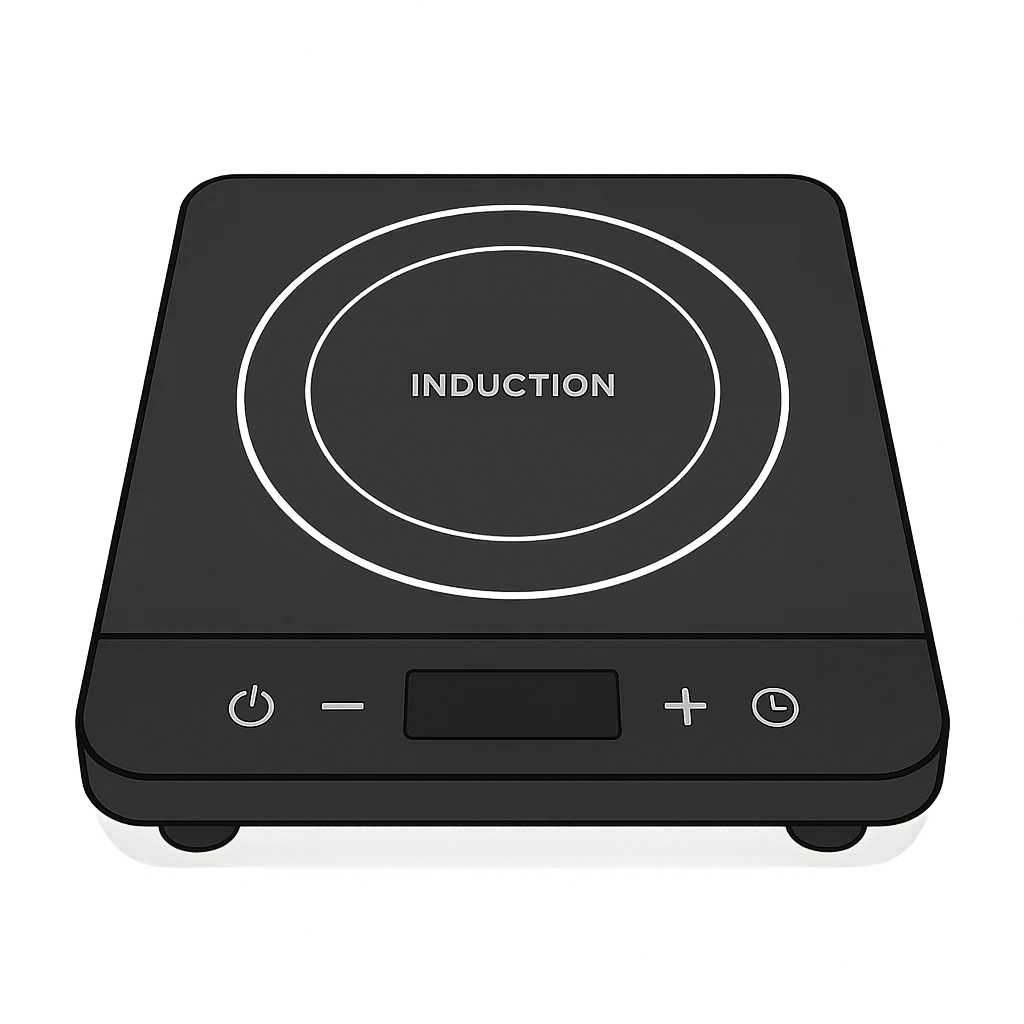
The Cooktop with a Cool Secret
My Magical Secret
Hello there. You might have seen me in your kitchen, or maybe a friend’s. I am an induction cooktop, and at first glance, I might not seem like much. I’m just a smooth, dark, glassy surface, cool and quiet. There are no grates to scrub, no fiery blue rings of flame, and no electric coils that glow an angry, warning orange. But don’t let my calm appearance fool you. I hold a kind of magic. I can take a pot of cold water and bring it to a rolling boil faster than you can say “electromagnetic field.” The most curious part? While the pot gets sizzling hot, my own surface remains surprisingly cool, safe enough to touch just moments after the pot is removed. I can even cook with a paper towel between me and the pan, and the paper won't even turn brown. People used to rely on the fiery breath of gas stoves or the intense heat of electric ones, but I do my work with an invisible power. Have you ever placed your hand near me while I’m cooking and wondered where all the heat is coming from? It’s a secret that connects a brilliant mind from long ago to the meal you eat today, a secret hidden right beneath my sleek glass skin.
A Spark of an Idea from Long Ago
My story didn’t begin in a modern kitchen. It began in a laboratory in London, long before kitchens even had electricity. My entire existence is thanks to a curious and brilliant scientist named Michael Faraday. Back in the 1830s, he discovered a fundamental secret of the universe: that a changing magnetic field could create an electric current. He called it electromagnetic induction. It was a monumental discovery, proving that magnetism and electricity were partners in a secret dance. For a long time, this powerful idea was used for enormous jobs, like running huge motors in factories. I was still just a whisper of a possibility, a scientific principle waiting for the right moment to be born. That moment finally came on May 27th, 1933, at the Century of Progress World’s Fair in Chicago. A company called Frigidaire built an early version of me and put on a show that felt like a magic trick. They placed a newspaper on my surface, put a pot on top of the newspaper, and cooked food right through the paper without it ever catching fire. The crowds were astounded. They couldn't understand how the pot got hot but the paper did not. It was a revolutionary demonstration. But even after that amazing debut, I wasn't ready for people's homes. I was too big, too expensive, and the technology was too complex. I had to be patient. For decades, engineers worked to solve these problems. It wasn't until the 1970s that a company named Westinghouse made breakthroughs that finally made me smaller, more efficient, and more affordable. It took nearly 150 years of perseverance, from Michael Faraday’s initial spark of genius in the 1830s to the clever engineering of the 1970s, for me to become the helpful appliance you see today.
How I Cook with a Magnetic Dance
So, are you ready for my secret? It’s time I told you how I perform my magic. Hidden just beneath my smooth glass surface is a tightly wound coil of copper wire. When you turn me on, electricity flows through this coil, but it’s a special kind of electricity that changes direction very, very quickly. This rapid switching creates a powerful and fast-changing magnetic field above me. Now, this magnetic field is a bit particular. It doesn't affect my glass top, your hands, or a piece of paper. It is looking for a specific dance partner: a pot or pan made of a magnetic material, like iron or steel. When you place one of these pans on my surface, my magnetic field reaches into the metal and tells all the tiny iron particles inside to start a frantic, vibrating dance. This super-fast movement creates friction, and that friction generates heat. The heat is created directly inside the bottom of the pan itself. That is my whole secret. I don't get hot and then heat the pan; I make the pan heat itself from within. This is why I am so fast and efficient. Almost no energy is wasted heating the air or my own surface. It’s also why I am so safe. There is no open flame to worry about and my surface cools down very quickly. I feel a great sense of pride knowing that the scientific curiosity of Michael Faraday from the 1830s now lives on in my work. Every day, I help families cook meals safely and quickly, saving energy and making the kitchen a better place. I am proof that a single, brilliant idea, when nurtured with patience and creativity, can change the world one meal at a time.
Activities
Take a Quiz
Test what you learned with a fun quiz!
Get creative with colors!
Print a coloring book page of this topic.















 Free for Educators