English
 Continue with Google
 Continue with Apple

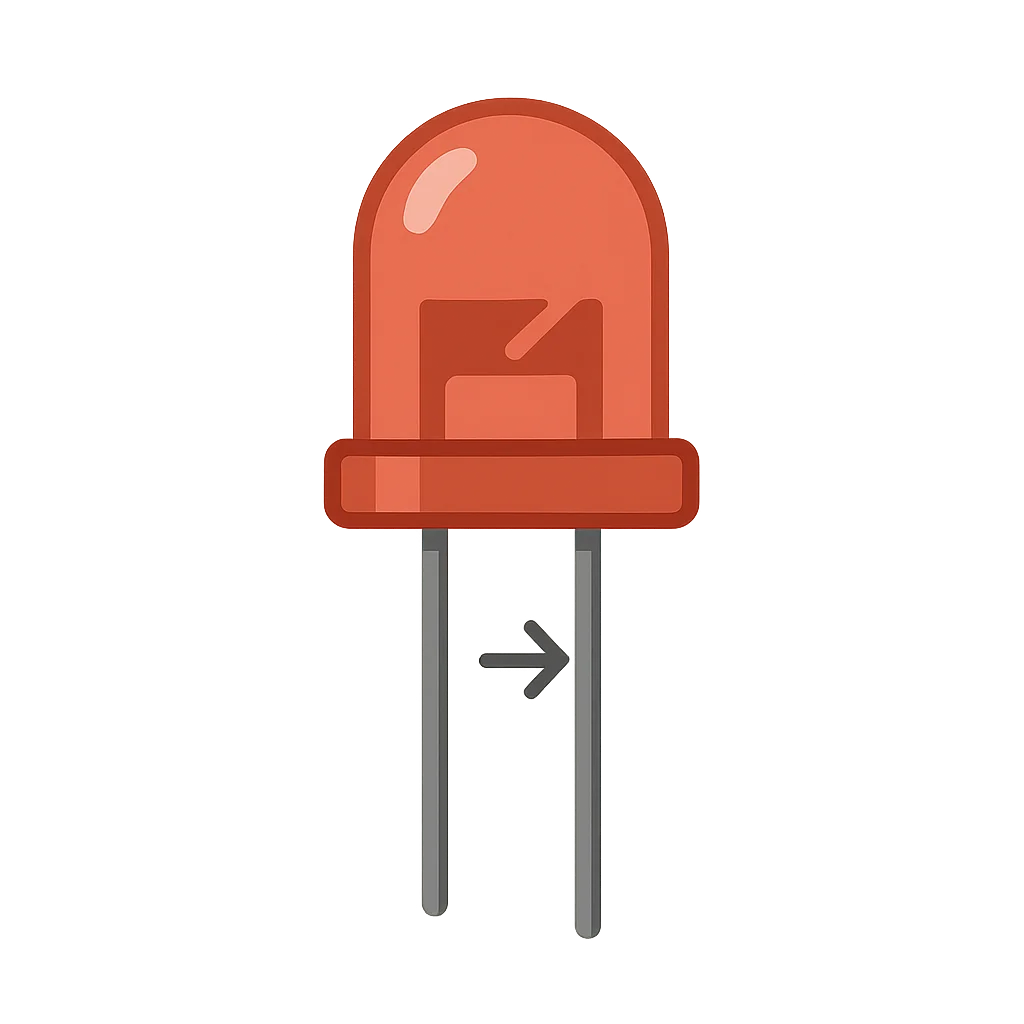
I Am the LED: A Story of Light
Hello, I am a Light Emitting Diode, but my friends call me LED. Before I lit up your world, there were my ancestors, the incandescent bulbs. They were fragile glass bubbles that got fiery hot, wasting most of their energy creating heat instead of light. I am different. I am a tiny, solid chip of semiconductor material, cool to the touch, and incredibly efficient. I can shine for years without ever burning out. But my journey from a tiny spark in a laboratory to the brilliant light that illuminates your phone screen, your home, and your city was a long and challenging one. It was a story written over decades, filled with moments of frustration, flashes of genius, and the tireless work of brilliant minds who believed in my potential even when I was just a faint glow.
My story as a practical source of light truly began on October 9th, 1962. A scientist at General Electric named Nick Holonyak Jr. was working in his lab, not trying to reinvent lighting, but experimenting with new semiconductor alloys. That day, he witnessed something magical—a tiny, steady, brilliant red glow emanating from his device. That spark was me, in my very first form. I was the first visible-light LED. At first, I was a curiosity. I wasn't bright enough to light a room, but my small size and efficiency made me perfect for special jobs. Throughout the 1970s, I became the glowing red numbers on calculator displays and the futuristic dot on digital wristwatches. I was a signal, an indicator, a tiny beacon of a new technological age. I felt proud, but I knew I was capable of so much more. In 1972, another visionary scientist, M. George Craford, who had been Nick's student, discovered how to make me glow yellow and, even more importantly, made my red light ten times brighter. I was becoming more versatile, but a crucial piece of my identity was still missing. To create true, clean white light, I needed to master the entire rainbow. I could shine red and yellow, and others had managed green, but one color remained stubbornly out of reach.
The quest for blue light was the great challenge of my existence. For decades, creating a blue version of me was considered the holy grail of solid-state physics. Many experts declared it impossible. The specific semiconductor materials needed to generate that high-energy, short-wavelength blue light were incredibly difficult to grow into the perfect, flawless crystals required for me to shine. Scientists tried countless combinations, but for years, the results were either too dim, too unstable, or simply didn't work at all. I felt incomplete, like a painter who only had red and yellow paint, unable to create a true masterpiece. But in Japan, three dedicated scientists refused to give up on me. Isamu Akasaki, Hiroshi Amano, and Shuji Nakamura each took on this “impossible” task. They weren't working on the same team initially, but they shared a common, unyielding determination. They knew that if they could unlock my blue potential, they would change lighting forever. Their journey was one of immense patience. Beginning in the late 1980s and continuing into the early 1990s, they conducted thousands of experiments. Shuji Nakamura, for instance, had to build and modify his own equipment because his company was skeptical of his efforts. He worked tirelessly, failing again and again but learning something new each time. Meanwhile, Isamu Akasaki and his student Hiroshi Amano made a critical breakthrough with a difficult material called gallium nitride. After years of frustrating work, they discovered that treating their crystals with an electron beam dramatically improved their quality. It was the clue they needed. Finally, after years of relentless effort, they all succeeded. In the early 1990s, they cracked the code. They found the perfect recipe of materials and processes to make me emit a stable, bright, beautiful blue glow. The impossible had been achieved.
That first flicker of brilliant blue light was more than just a new color; it was the key that unlocked my full potential. With red, green, and blue light at my command, I was finally complete. By combining these three colors, I could produce a pure, efficient white light—the very light that now fills your home. It was a moment of triumph, not just for the scientists who received a Nobel Prize for their work, but for me. I could finally fulfill my destiny. Suddenly, I was everywhere. My white light was far more efficient than any bulb before me, using a tiny fraction of the energy and lasting for tens of thousands of hours. I began to illuminate the world in ways my creators had only dreamed of. I am the backlight in your laptop and television screens, creating vibrant images. I am the bright, safe glow of modern car headlights cutting through the darkness. I light up massive stadiums, city streets, and cozy living rooms, all while helping to conserve our planet's precious energy. My story, from a single red dot in a lab to a global source of light, is a testament to human ingenuity and the power of perseverance. It shows that a problem once deemed impossible can be solved when people dare to dream and refuse to give up. Every time you flip a switch, I hope you remember the long journey it took for me to shine. I hope you feel inspired to pursue your own brilliant ideas, no matter how impossible they may seem.