

 English

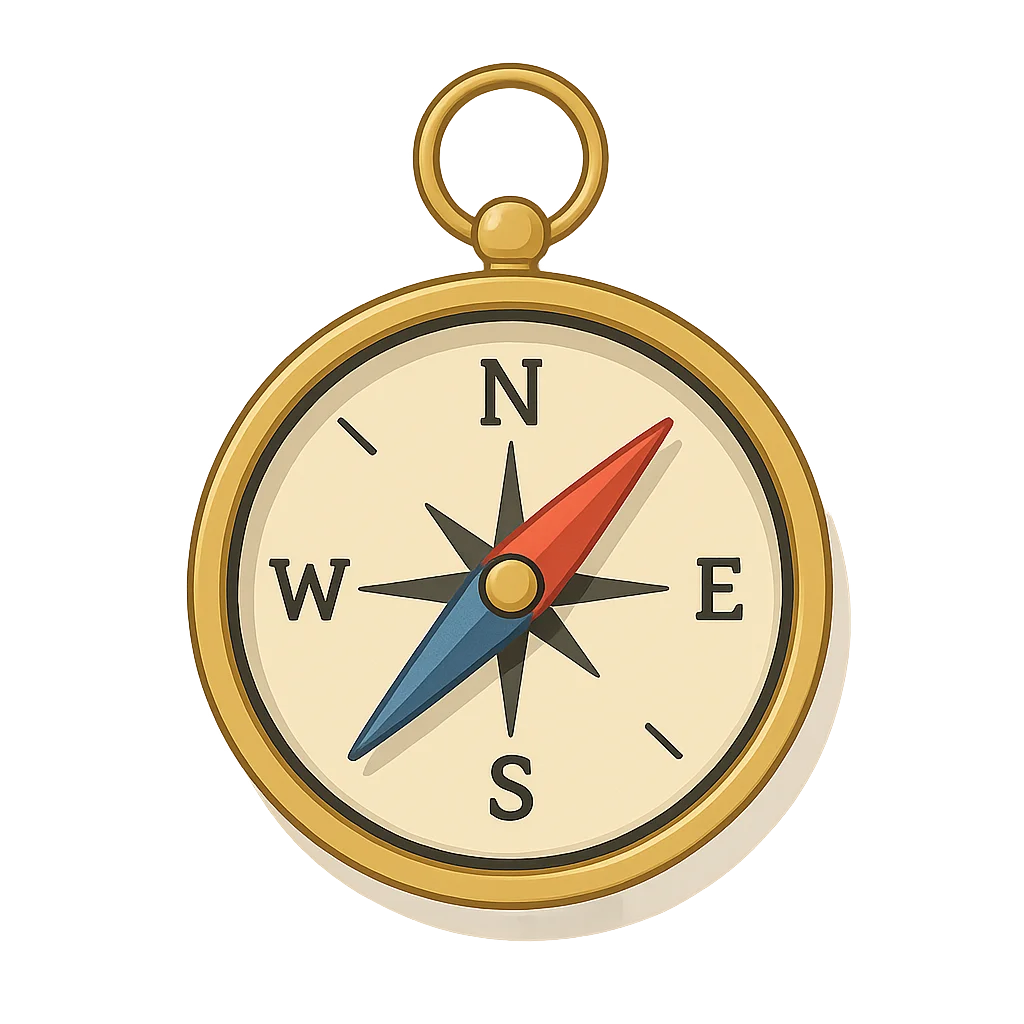
The Compass: My Journey from Magic to Maps
My Magical Beginnings
I was not born in a workshop of clanging hammers and sparking forges. My life began in silence and darkness, deep within the earth of ancient China during the Han Dynasty, over two thousand years ago. I am the Compass, but my first form was a special, heavy rock called a lodestone. This stone held a secret power, a mysterious pull that humans found both fascinating and useful. They carved me from this magnetic rock, not into a needle, but into the shape of a spoon. My handle was long and elegant, and my bowl was perfectly balanced. They would place me on a smooth, square bronze plate, a plate etched with constellations and symbols representing the heavens and the earth. With a gentle nudge, I would spin, dancing in a slow circle until, every single time, my handle came to rest pointing directly south. I wasn't used for finding directions to a new city. In those early days, I was an instrument of harmony. My purpose was to help people align their lives, their homes, and even their plans with the natural flow of the universe. I was a fortune-teller, a guide for architects, a tool to find balance. I was seen as magic, a direct connection to the unseen energies of the world, and I felt a quiet pride in my mystical job, unaware that a far greater adventure awaited me.
Finding My True North
For centuries, I served as a quiet oracle. But as dynasties rose and fell, clever minds began to see past my magic and into the science of my soul. During the Song Dynasty, around the 11th century, a brilliant scholar named Shen Kuo observed me closely. In his book, Dream Pool Essays, written around the year 1088, he described my unwavering ability to point south. He and others realized my power didn't have to come from a bulky lodestone spoon. They discovered that my magnetic essence could be transferred to a simple iron needle. This was the moment my true destiny began to unfold. My heavy stone body was gone, and I became light and nimble. At first, they floated me in a bowl of water, where I would spin freely before pointing the way. I was no longer bound to a heavy bronze plate; I was portable. This simple change was revolutionary. I could now be carried on journeys. Around the year 1119, records show I was being used by Chinese mariners to navigate the vast, featureless sea. I felt a thrill I had never known. Before, I pointed toward spiritual harmony; now, I was pointing the way home across treacherous waters. I helped travelers navigate deserts and sailors steer their ships when the sun and stars were hidden by clouds. I had found my true north, my ultimate purpose: to be a guide for humanity's great explorers.
A Sailor's Best Friend
My reputation as a reliable guide could not be contained within China. My secret traveled along the bustling Silk Road, passed from merchant caravans to seafaring traders. By the 12th and 13th centuries, I had made my way to the Middle East and then to Europe. There, I was welcomed into a world on the brink of great change. Before me, sailors were terrified of the open ocean. They hugged the coastlines, always keeping familiar land in sight. The sea was a terrifying, unknowable monster, and to lose sight of the shore was to be lost forever. I changed that. I gave them courage. I was a simple thing, just a magnetized needle dancing over a card marked with directions, but I was their constant, their sliver of certainty in a world of chaos. With me on board, they could sail into the blue unknown, confident that I would always know the way. This new confidence I provided helped spark the Age of Discovery. I was on the rolling decks of caravels and galleons that crossed the Atlantic and rounded the tip of Africa. When fierce storms raged and the stars hid for days behind a curtain of angry clouds, the sailors would gather around my flickering lantern light, their worried faces looking to me. Through it all, I remained steady, my needle quivering but always true. I was more than a tool; I was a silent, steadfast friend, promising that no matter how lost they felt, there was always a way forward.
My Modern Life
My journey of improvement didn't stop on the decks of those early ships. As the centuries passed, people found ways to make me even more reliable. Around the 16th century, I was placed inside a dry box with a glass cover, protecting me from the wind and sea spray that could knock me off course. Soon after, I was mounted on a gimbal, a clever set of rings that allowed me to stay perfectly level even as the ship pitched and rolled violently in the waves. I became the steady heart of the ship's binnacle, a trusted instrument that guided navies and explorers for hundreds of years. You might think that in your modern world of satellites and digital maps, my time is over. It is true that you no longer see many people navigating with a needle floating in water. But the invisible force that has always guided me—the Earth’s magnetic field—is the same fundamental principle that helps your family’s car or your parent’s phone know which way to go. I am the ancient ancestor of every GPS. My spirit of guidance lives on in the digital dot that moves across your screen. I am a reminder that sometimes the most profound discoveries begin with a simple observation of the natural world. My story is a testament to human curiosity and the timeless desire to explore, to find one's way, and to have the courage to venture into the unknown.
Activities
Take a Quiz
Test what you learned with a fun quiz!
Get creative with colors!
Print a coloring book page of this topic.















 Free for Educators