

 English

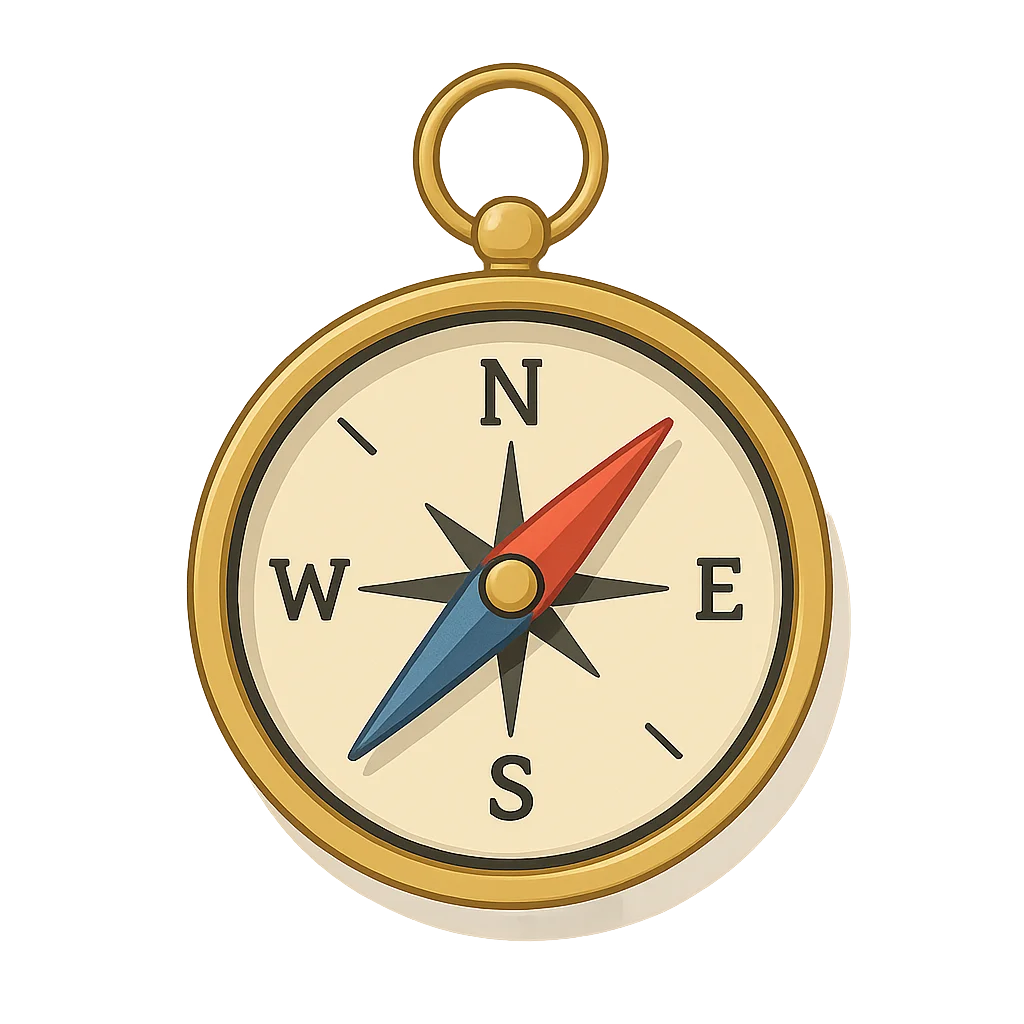
The Compass: My Pointing Story
Before I was a neat little circle held in your hand, I was just a chunk of rock with a secret. Hello, I am the Compass. My story begins thousands of years ago in ancient China, where I was known as a lodestone. I wasn't shiny or special to look at, just a dark, heavy stone. But when people picked me up, they felt a strange tingle, a mysterious energy humming inside me. The real magic happened when they placed me on a smooth surface or hung me from a thread. I would wiggle and dance, shivering with an invisible force, until I settled. And when I did, I always, always pointed south. Imagine their surprise. No matter how they turned me, I stubbornly pointed the way home for the sun. It was as if I was whispering a secret about the Earth itself, a secret that only I knew. They thought I was magical, a stone that could see the unseen. In a way, they were right. I could feel the planet's giant, invisible magnetic field, a superpower that would one day change the world. They didn’t understand how I worked, but they knew I was special. I was a puzzle waiting to be solved, a guide waiting for a journey.
My first real job wasn't at sea, but in homes and palaces during China's Han Dynasty, which started around 206 BC. In those early days, I was shaped like a big spoon and placed on a flat, bronze plate marked with directions and symbols. People believed I could find good energy. They would use me to decide the perfect way to build a house or arrange furniture so that good fortune would flow in. I was a tool for harmony and luck, a fortune-teller made of stone. For centuries, this was my life. Then, I got a makeover. Around the 11th century, during the Song Dynasty, people discovered they could pass my magnetic secret on to an ordinary iron needle just by rubbing it against me. I was reborn. I went from being a clunky spoon to a sleek, magnetized needle, light enough to float in a bowl of water or balance on a tiny pin. This was a huge change. Suddenly, I was small, simple, and easy to carry. It was then that a sailor with eyes as wide as the ocean had a brilliant idea. Life at sea was dangerous. When thick fog rolled in or dark clouds covered the night sky, a ship was like a blindfolded giant, lost and stumbling. The sun and stars, the sailors' only guides, would disappear. But I never disappeared. In my little bowl of water, my needle always pointed faithfully south. They took me aboard their ships, and for the first time, sailors could cross the vast, gray ocean with confidence. I was their secret weapon against getting lost, their constant, trustworthy friend on the lonely sea.
My biggest adventures were yet to come. Word of my amazing ability traveled along trade routes, and soon I was guiding ships all over the world. During the Age of Discovery, from the 15th to the 17th centuries, I was the most important tool an explorer could have. I sat in a wooden box on the rocking decks of tall ships, helping brave sailors cross the enormous Atlantic and Pacific oceans. I whispered “this way” when there was nothing to see but endless blue water in every direction. I helped connect continents, allowing people from faraway lands to meet, trade ideas, and share stories. In my own small way, I made the world feel a little smaller and friendlier. Now, you might not see me on a ship's deck very often. But my spirit, my secret power, is still with you. I am the great-great-grandparent of the GPS in your car and the map on your phone that tells you where to turn. Every time that little dot on the screen points you in the right direction, you are using my ancient magic. And I am still around in my classic form, helping hikers and campers find their way through quiet forests. My story shows that sometimes, a simple idea—a rock that always points the way—can lead to the greatest adventures of all.
Activities
Take a Quiz
Test what you learned with a fun quiz!
Get creative with colors!
Print a coloring book page of this topic.















 Free for Educators