

 English

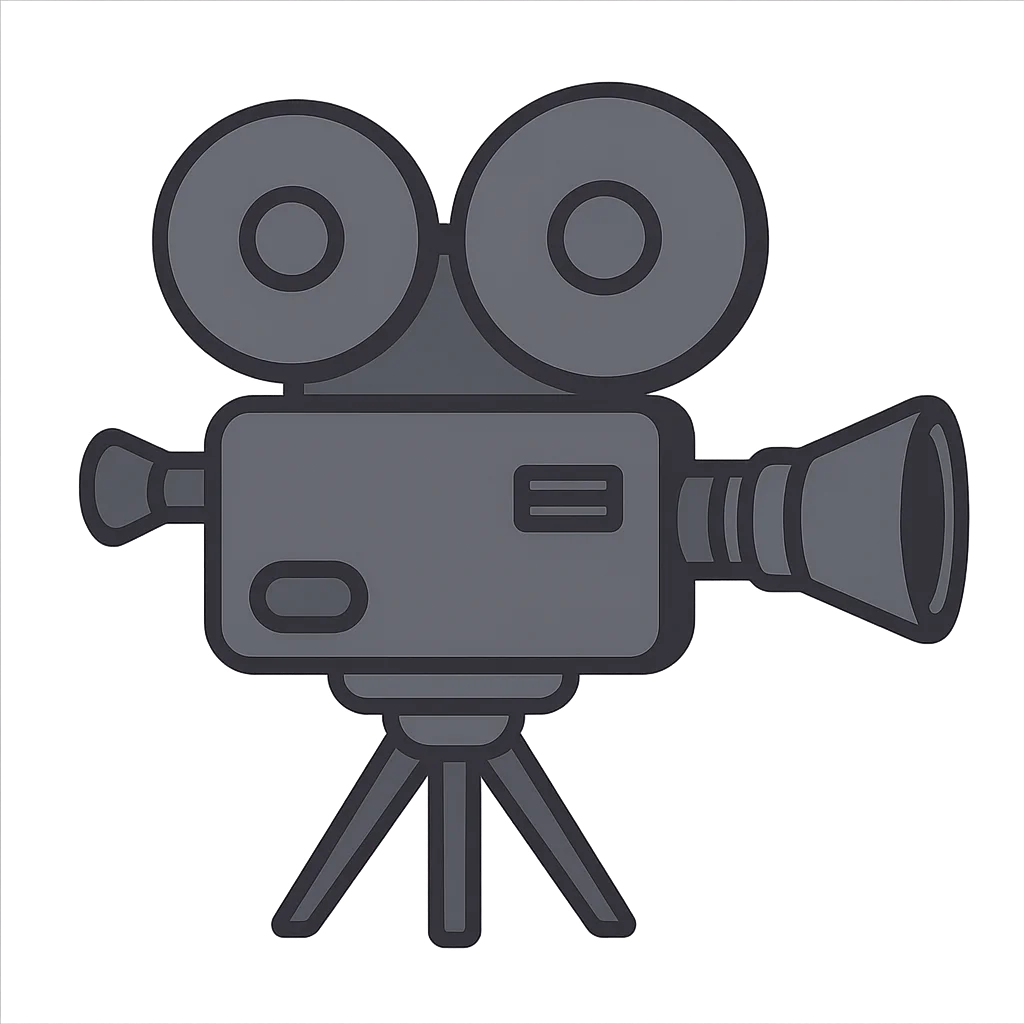
I Am the Motion Picture Camera
Hello. You might not recognize me in my oldest form, but I promise you know my descendants very well. I am the Motion Picture Camera, and before I existed, the world was a very still place. Imagine a world captured only in frozen moments. You could see a photograph of a smiling child, but you couldn't see the laugh that created it. You could see a painting of a great ship, but you couldn't see the waves crashing against its hull. For centuries, people dreamed of more. They yearned to capture life not as a single, silent instant, but as a flowing, moving river of events. This dream felt like magic, an impossible fantasy. But the seeds of my existence were being planted. One of the most important moments happened in 1878 with a man named Eadweard Muybridge and a horse named Sallie Gardner. He set up a line of special cameras to take pictures of the horse as she galloped past. When he displayed the images one after another in rapid succession, something incredible happened: the horse moved. It was just a flicker, a ghostly echo of life, but it was proof. It proved that a series of still pictures could trick the eye into seeing motion. That simple experiment lit a fire in the minds of inventors around the world. The question was no longer if pictures could move, but how to build a single machine that could capture that movement smoothly and continuously.
My true life began in a place buzzing with creative energy: the laboratory of the famous inventor Thomas Edison in West Orange, New Jersey. While Mr. Edison had the grand vision, my primary creator was a dedicated and brilliant man who worked for him, William K.L. Dickson. Between 1889 and 1892, he toiled endlessly to bring me to life. The early challenges were immense. They first tried recording images onto a wax cylinder, like the one used for Edison's phonograph, but it was clumsy and impractical. The breakthrough came from another brilliant mind, George Eastman, who had invented something revolutionary: a long, flexible strip of transparent material called celluloid film. This was the key. Mr. Dickson realized he could feed this ribbon of film through a device, stopping it for a fraction of a second to record an image, then quickly pulling it to the next blank frame. He added perforations, little holes along the edges of the film, so that gears could grip it and pull it along at a steady rate. I was born. My official name was the Kinetograph, which means “motion writer.” On January 7th, 1894, I captured my first famous subject. It wasn't a historic battle or a royal wedding. It was a short, simple scene of an Edison employee named Fred Ott taking a pinch of snuff and letting out a mighty sneeze. But to the people who saw it, it was a miracle. To see my work, Mr. Dickson also invented my sibling, the Kinetoscope, a large wooden cabinet. You had to pay a coin, lean forward, and peer into a small peephole to see the film loop flicker past a light bulb. It was a private show, a secret moment of wonder for one person at a time.
While the Kinetoscope was a sensation in arcades, its magic was a lonely experience. True magic, my creators soon realized, is meant to be shared. Across the Atlantic Ocean, in Lyon, France, two brothers named Auguste and Louis Lumière saw a Kinetoscope in 1894 and were deeply inspired. They believed they could improve upon my design. They envisioned a world where an entire room of people could watch a moving picture together, sharing the gasps, the laughter, and the awe. They worked tirelessly and created an invention that was a marvel of portable, multi-functional engineering: the Cinématographe. This device was lighter than I was and, incredibly, it could do three things: it could record the film, develop it, and then project it onto a large screen for everyone to see. I wasn't jealous of this new, more versatile version of myself; I was thrilled. My purpose was evolving. The grand debut of this new shared experience happened on a chilly evening, December 28th, 1895, in the basement of the Grand Café in Paris. A small, curious audience gathered, unsure of what to expect. The lights dimmed, and a beam of light shot across the room. On a simple white sheet, an image flickered to life: a train pulling into La Ciotat station. As the locomotive chugged forward, getting bigger and bigger on the screen, it seemed to be steaming directly toward the audience. People screamed. They ducked out of their seats, terrified the train would burst through the wall. Then, once the initial shock passed, came the applause and joyous laughter. In that moment, the cinema was truly born. It was no longer a personal peek into a box but a powerful, communal dream.
My journey from that heavy box in Edison’s lab to where I am today feels like one of the epic stories I would later help tell. I learned to speak when sound was added in the late 1920s, and I learned to paint with breathtaking color a few years after that. I have traveled to the highest mountains and the deepest oceans. I have captured the quiet moments of family life and the grand spectacle of human history. I have told stories that have shaped cultures, inspired change, and brought joy to billions. My body has changed, slimming down from a clunky, hand-cranked machine to the sleek digital cameras used on movie sets and, even more amazingly, the tiny, powerful lens built into the smartphone in your pocket. My purpose, however, has remained the same. I was created to capture and share life in motion, to connect people through the universal language of moving pictures. Every time you record a video of your pet, a family holiday, or a project for school, you are continuing my story. You are using the magic that began over a century ago to share your world with others. You are a storyteller, and I am the tool that helps your vision come to life.
Activities
Take a Quiz
Test what you learned with a fun quiz!
Get creative with colors!
Print a coloring book page of this topic.














 Free for Educators