

 English

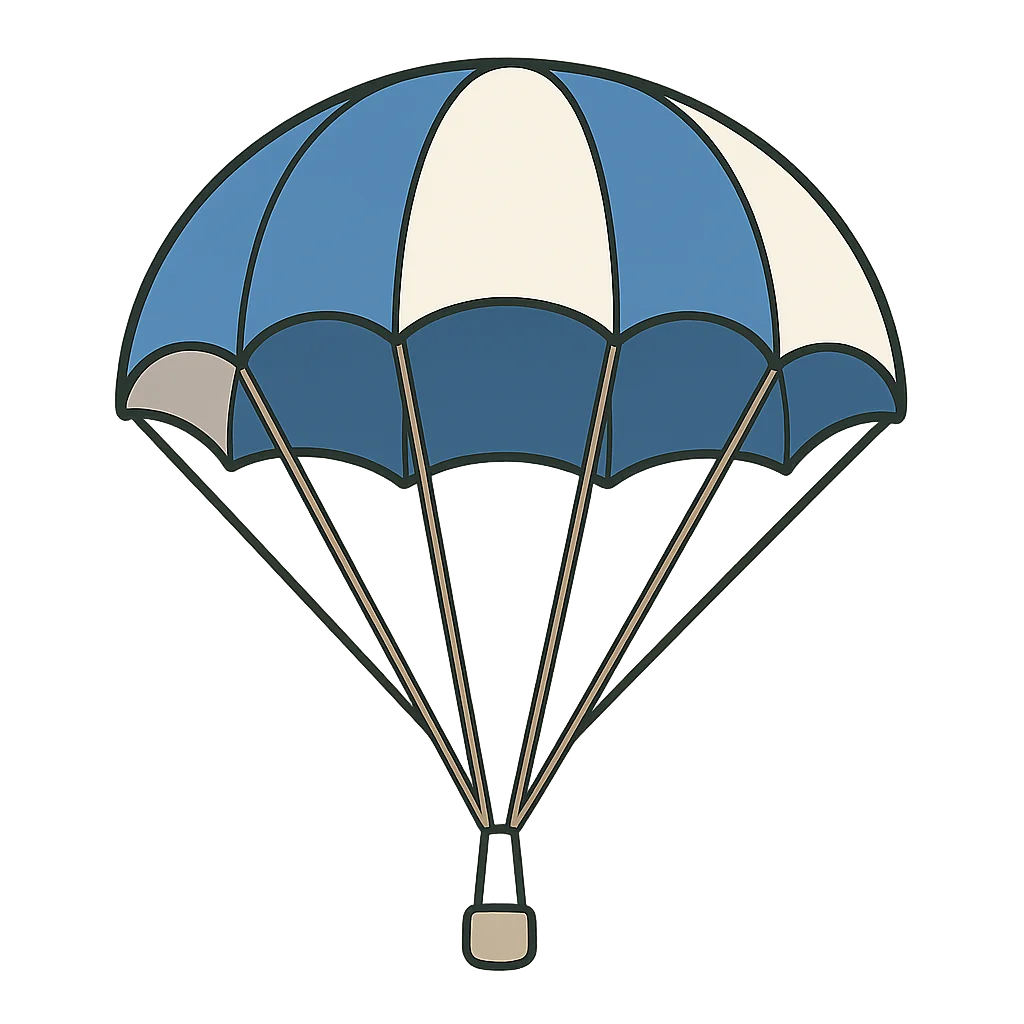
I Am the Parachute: A Story of Falling Gracefully
Before I existed, the sky was a beautiful but unforgiving place. To fall from a great height was to surrender to gravity, a force that always won. It was a final, terrifying thought. But then, an idea took shape in the minds of dreamers—an idea for me. Hello, I am the Parachute, and my purpose has always been to be a partner to the wind and a friend to those who fall. I am not a machine that defies gravity; I am a dancer who works with it. I catch the air in my wide, fabric embrace and turn a frightening plummet into a gentle, floating descent. I am a cloud dancer, a gravity tamer, designed to give humanity a second chance with the sky, transforming a moment of peril into one of breathtaking possibility. My story is one of turning fear into freedom, one graceful glide at a time.
My life began not in a workshop, but as a flicker of genius in a notebook. In the 1480s, a brilliant artist and inventor named Leonardo da Vinci sketched a curious pyramid of linen cloth. He imagined that if a person held onto it, they could leap from any height without injury. For centuries, I was just that—a drawing, a dream locked away on paper. I waited patiently until the world was ready. That moment finally arrived in the vibrant atmosphere of 18th-century France. A man named Louis-Sébastien Lenormand saw potential in that ancient dream. He wasn't just a thinker; he was a doer. On December 26th, 1783, he stood atop the Montpellier observatory tower, holding a version of me made from a rigid wooden frame. The crowd below held its breath as he leaped. I caught the air, and we floated safely to the ground. It was the first recorded public jump, a moment of triumph. It was Lenormand who gave me my beautiful name, 'parachute,' which elegantly combines the French words for 'to shield' and 'against a fall.' I finally had a name and a purpose.
My jump from the tower was a wonderful start, but my true destiny lay much higher, among the clouds themselves. My next great test came on October 22nd, 1797, with a daring showman and inventor named André-Jacques Garnerin. He believed I could save people from crashing hot-air balloons, which were the cutting edge of flight technology at the time. He took me higher than I had ever been, ascending in a balloon over Paris until the city looked like a map below. When he cut the rope connecting us to the balloon, a shiver of purpose ran through my silk fabric. I unfurled beautifully, a giant mushroom against the blue canvas of the sky. I was working. But the descent was far from gentle. Without a way for the air trapped inside me to escape, I began to swing back and forth wildly, like a pendulum. Garnerin was tossed about in his basket, and I felt a sense of panic. Though we landed safely, the experience was turbulent and frightening. That day proved I could save a life, but it also revealed a critical flaw. I was effective, but I was not yet perfected.
That wild, swinging ride with Garnerin was a vital lesson. Observers and inventors realized that the air trapped under my canopy was the culprit. To become truly stable, I needed to breathe. The solution was simple but ingenious: a vent at my very top, an opening that would allow some air to escape in a controlled stream. This small change made all the difference, transforming my violent oscillations into a smooth, steady descent. My evolution continued. I became stronger with the use of silk instead of linen, and my design grew more sophisticated. One of my most important transformations came from a pioneering German inventor and daredevil performer named Käthe Paulus. In the early 20th century, she realized I needed to be portable and easy to deploy. She experimented tirelessly, figuring out the best way to meticulously fold and pack me into a compact bag. Her invention of the 'pack' parachute meant I could be worn as a backpack, ready to be deployed at a moment's notice. Thanks to her brilliance, I became a reliable piece of safety equipment, a guardian angel for early aviators and balloonists.
My journey from a simple concept to a reliable device prepared me for some of the most important jobs in the world. During times of conflict, I carried soldiers, known as paratroopers, safely behind enemy lines and delivered critical supplies and medicine to people in need. I became a symbol of hope dropping from the sky. My work evolved with technology. I began working with space agencies, becoming an essential part of returning precious cargo and brave astronauts to Earth. When a space capsule re-enters the atmosphere, it relies on a series of me, opening in sequence, to slow its fiery descent for a gentle splashdown in the ocean. But my story isn't all about duty and danger. Today, I also bring incredible joy. I am at the heart of the sport of skydiving, where I give people the chance to experience the ultimate thrill of freefall before I open to grant them a peaceful, scenic flight back to the ground. My journey began as a dream to conquer the fear of falling. Now, I help humanity touch the sky and return safely, proving that with courage and ingenuity, we can turn our greatest fears into our most exhilarating adventures.
Activities
Take a Quiz
Test what you learned with a fun quiz!
Get creative with colors!
Print a coloring book page of this topic.







 Free for Educators