

 English

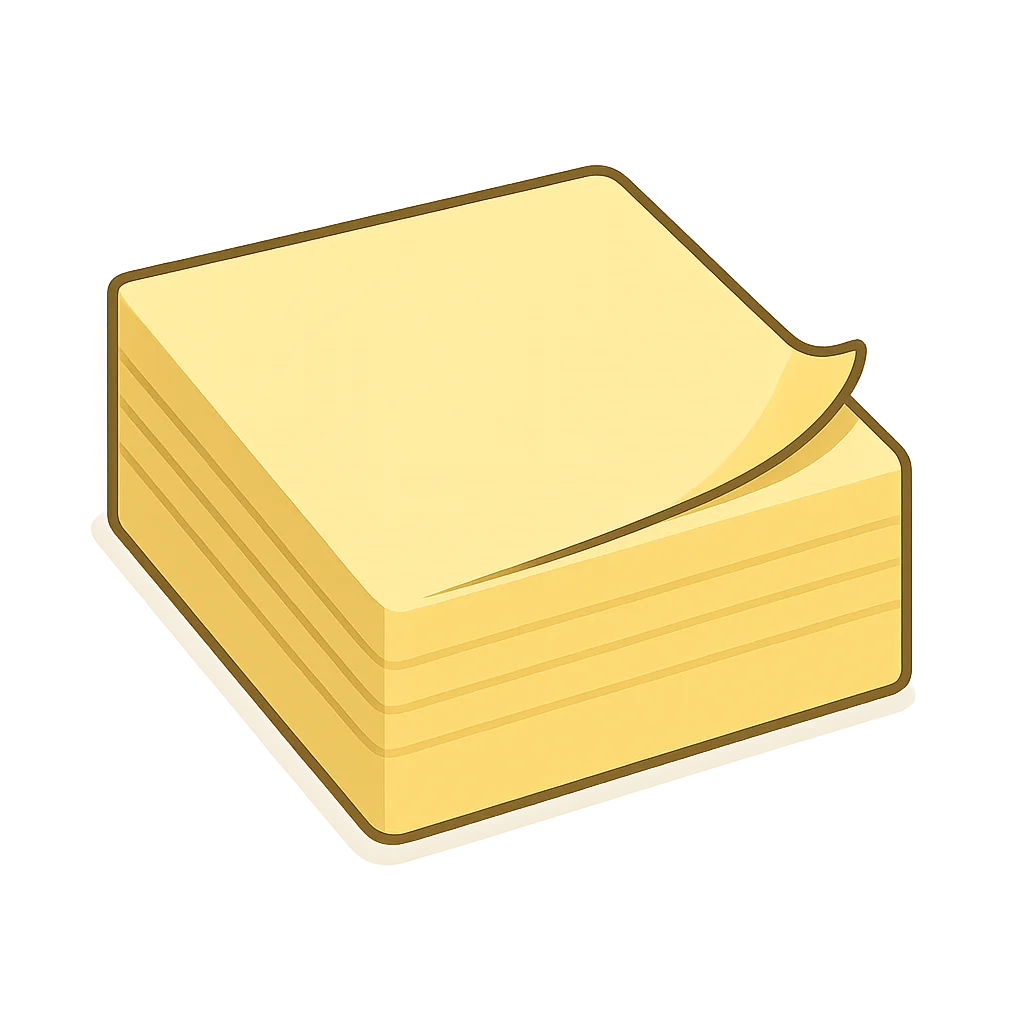
The Note That Stuck
You probably know me. I am that cheerful square of paper, often a bright canary yellow, that you see clinging to refrigerators, computer monitors, and textbooks. My name is the Post-it Note, and I am a quiet but loyal friend to anyone with a thought worth remembering. I hold onto your grocery lists, your study notes, and your secret messages without being permanent or pushy. You can stick me almost anywhere, and when you’re done with me, I peel away without a fuss, leaving no trace behind. My job is simple: to help you remember. But the story of how I came to be is anything but simple. It wasn't a grand plan or a stroke of genius in the traditional sense. In fact, my entire existence is owed to a wonderful, sticky accident—a beautiful mistake that refused to be forgotten.
My story begins long before I was a neat little pad of paper. It starts back in 1968, inside the bustling laboratories of a company called 3M. A very smart scientist named Dr. Spencer Silver was working on a project with a big goal: to create a super-strong, tough-as-nails adhesive. He imagined his glue would one day be used to build airplanes, holding them together high in the sky. He mixed chemicals and ran tests, hoping for a powerful bond. But what he created was the exact opposite of his goal. He had invented a very peculiar, very weak adhesive. It was made of microscopic, indestructible acrylic spheres that were sticky, but not permanently so. You could press something with this adhesive onto a surface, and it would hold lightly. Then, you could peel it right off and stick it somewhere else, over and over again. For years, this strange invention was considered a failure. Dr. Silver showed it to his colleagues, but no one could figure out what to do with a glue that barely stuck. I was a solution just waiting for a problem to solve.
That problem finally appeared six years later, in 1974, thanks to another 3M scientist named Art Fry. Outside of his work in the lab, Art was a devoted singer in his church choir. Every week during practice and services, he faced a small but persistent annoyance. He used little slips of paper to mark the upcoming hymns in his songbook, but by the time he stood up to sing, the slips would have fluttered to the floor. It was frustrating to lose his place right before a performance. One day, while sitting through a particularly long company seminar, his mind drifted back to his choir problem. And then, like a flash of inspiration, he remembered Dr. Silver's odd invention from years before—the weak, reusable adhesive that everyone had dismissed. A brilliant idea began to form in his mind. What if he could apply that not-so-sticky glue to the back of his bookmarks? This was my true beginning, the moment a choir singer's frustration met a chemist's 'failed' experiment.
Art Fry’s mind raced with excitement. He couldn’t wait to test his idea. He found Dr. Silver, got a sample of the adhesive, and went back to his own lab to experiment. He carefully coated a small piece of paper with the unique, microsphere-filled glue and let it dry. Then, he took it over to a book and pressed it onto a page. It held firm. He turned the book upside down and shook it, but I stayed right where I was. Then came the most important test: he gently peeled me off. I came away cleanly, without tearing the page or leaving any sticky residue behind. It was perfect. Art knew he had solved his bookmark problem, but he quickly realized I could be so much more. He started making little sticky notes and using them to write comments and questions for his colleagues, sticking me directly onto reports and documents. It was a revolutionary way to communicate. People could add a note without permanently marking up the original paper. The idea was a huge hit within the company, and soon, everyone at 3M wanted their own pad of my sticky, removable notes.
Getting me from the offices of 3M into the hands of the world, however, was my next big challenge. In 1977, the company decided to test-market me in four cities under the name 'Press 'n Peel'. But the launch was a disappointment. People saw the pads in stores, but they didn't understand what made me special just by looking at the package. They didn’t realize I was reusable or that I wouldn’t damage their papers. The marketing team knew they had to show people how I worked. So, they came up with a bold new plan they called the 'Boise Blitz'. They chose the city of Boise, Idaho, and flooded the offices there with free samples of me. They put a pad on nearly every desk and let people try me for themselves. The strategy worked brilliantly. Once people used me, they fell in love. They found endless uses for me and couldn't imagine their work lives without me. With this success, the company prepared for a national launch. On April 6th, 1980, I was officially introduced to the United States with my new, much catchier name: the Post-it Note.
From that day forward, my journey has been incredible. I am no longer just a simple yellow square. I come in a rainbow of colors, a zoo of fun shapes, and even super-sticky versions that can hold on to brick walls and computer monitors. I have traveled from office cubicles to school classrooms, from artists' studios to scientists' labs. Students use me to organize their research, writers use me to plot their novels, and creative teams use me to brainstorm world-changing ideas. I have become a small but essential tool for organization, communication, and creativity all over the globe. My story is a powerful reminder that there is no such thing as a failed experiment. Sometimes, the most wonderful discoveries are simply hiding, waiting for the right problem to come along. I am proof that even a little mistake, when viewed with an open and curious mind, can stick around and change the world in a small but mighty way.
Activities
Take a Quiz
Test what you learned with a fun quiz!
Get creative with colors!
Print a coloring book page of this topic.













 Free for Educators