

 English

The Pressure Cooker's Tale
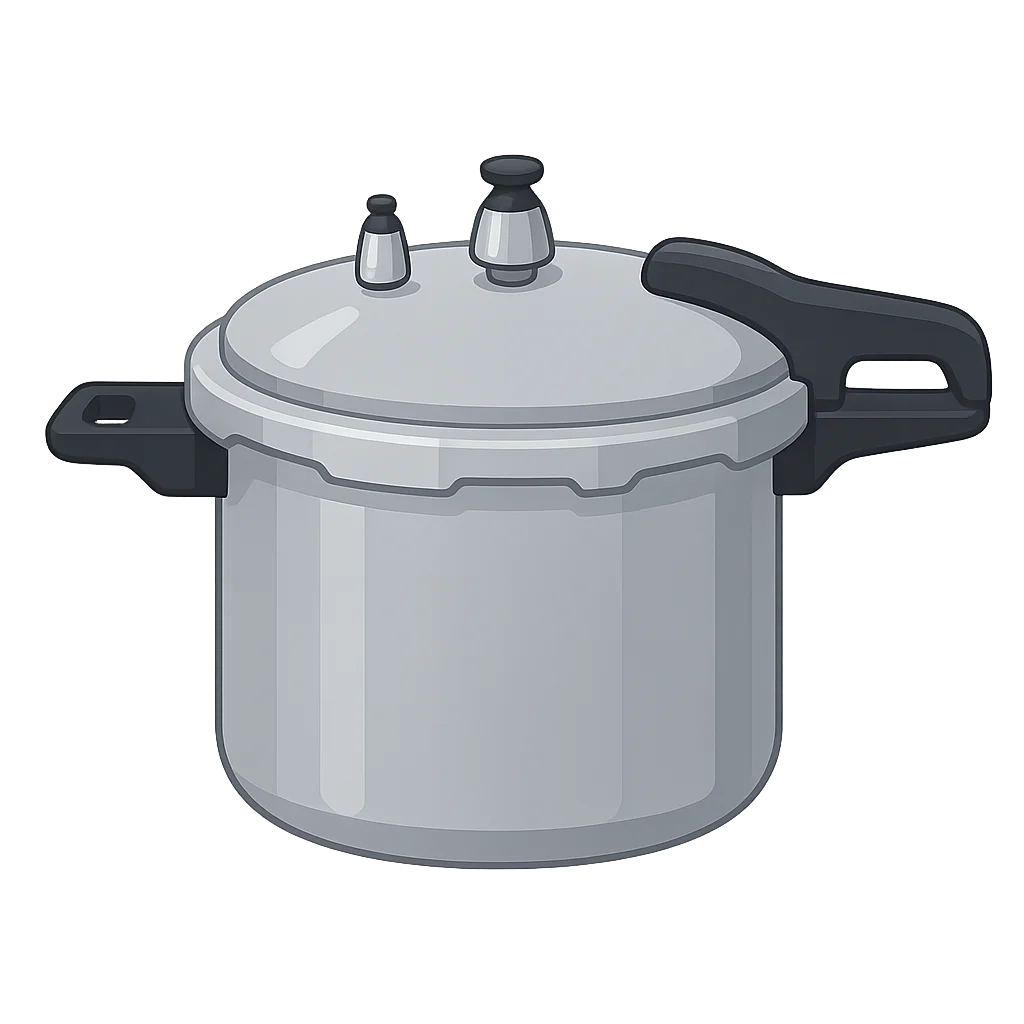
Hiss. Sssshhhh. That’s the sound I make when I’m working my magic, a gentle whisper that promises a delicious meal is on its way. From my spot on the kitchen counter, I can smell the rich aroma of beef stew mingling with carrots and herbs, all tenderizing inside me in a fraction of the time it would normally take. I am a modern pressure cooker, a sleek, stainless steel vessel with a digital brain. But my story didn’t begin with buttons and timers. To understand who I truly am, we must travel back in time, over three hundred years, to a world lit by candles and powered by muscle. It was a time when cooking was a slow, laborious process, and a brilliant man was about to discover the powerful secret of steam.
My inventor was a French physicist named Denis Papin, a man whose mind was always buzzing with questions about the forces of nature. In the late 17th century, he was fascinated by the incredible power of steam. He saw how it could lift the lid on a boiling pot and wondered what would happen if that power were contained. The world around him was on the cusp of great change, and the need for new, efficient technologies was growing. People spent hours tending fires and stirring pots to soften tough cuts of meat and hardy vegetables. Denis imagined a device that could harness the might of trapped steam to cook food faster than ever before, unlocking nutrients and saving precious fuel. It was from this powerful idea, born of curiosity and necessity, that I first took shape. I wasn't just a new pot; I was a new way of thinking about energy itself.
A Steamy Introduction
I was born on a chilly day in 1679. Denis Papin did not call me a pressure cooker; he gave me a much grander title: the 'Steam Digester.' And I was indeed a digester of the highest order. Forget the lightweight steel you see today. I was a formidable creation, forged from thick, heavy cast iron that took two strong men to lift. My body was a large, cylindrical pot, and my most important feature was my lid, which was clamped down with a powerful screw mechanism to create a perfect, airtight seal. Nothing could escape. Denis knew that to harness steam, he had to first trap it completely. He had discovered a fundamental principle of physics: when you increase the pressure inside a sealed container, the boiling point of water rises significantly. Instead of boiling at 100 degrees Celsius, the water inside me could reach 121 degrees Celsius, a superheated state that could break down tough food fibers with astonishing speed.
My grand debut took place before the esteemed members of the Royal Society of London, a gathering of the most brilliant scientific minds of the age. I can still picture their skeptical faces as Denis presented me. To demonstrate my power, he placed tough, inedible bones inside me, clamped my lid shut, and set me over a fire. The hissing began, and the pressure inside me built to an incredible level. The scientists watched, a mix of fascination and fear in their eyes. When the cooking was done and the steam was released, Denis opened my lid to reveal not bones, but a soft, gelatinous jelly. The men were astounded. I had done the impossible. But this incredible power came with a great risk. Without a way to manage the pressure, I was essentially a bomb. Recognizing this danger, Denis created my most crucial component: a safety valve. It was a simple weighted lever that would lift and release a jet of steam if the pressure inside me became too great. It was my voice, a whistle that saved me from self-destruction and made my power controllable.
My First Life as a 'Steam Digester'
Though my debut at the Royal Society was a success, my journey into the heart of the home was a long and slow one. For nearly two and a half centuries, I remained more of a scientific curiosity than a practical kitchen tool. My original iron form was too heavy, too expensive, and, frankly, too intimidating for the average household. The idea was brilliant, but the technology and materials needed to make me safe and accessible simply didn't exist yet. So, I waited patiently, simmering on the back burner of history as the world caught up to Denis Papin’s vision. Generations passed, and other inventions took the spotlight. The steam engine, a distant cousin of mine, transformed industry and transportation, all while I remained a niche device used mostly in laboratories and large-scale canning operations.
My transformation truly began in the early 20th century. Metallurgy had advanced, and inventors started crafting me from lighter materials like aluminum, which made me far more manageable. But the real breakthrough came in 1938 from a man named Alfred Vischler in New York. He looked at my design and saw that the old weighted valves were still not foolproof. He invented a spring-loaded mechanism for my lid, a 'Flex-Seal' that was far more reliable and easier to use. This innovation was the key that unlocked the kitchen door for me. Suddenly, I was not a dangerous scientific instrument but a modern convenience. Alfred named his creation the 'Flex-Seal Speed Cooker,' and soon, under brand names like Presto, I became a star. I was finally ready to fulfill my destiny as a helper in kitchens around the world.
A Long Simmer to Perfection
And now, here I am. From a hulking iron pot in 1679 to the sleek, intelligent multi-cooker of the 21st century, my evolution has been remarkable. I am no longer just a pressure cooker; I am an all-in-one kitchen marvel. With the touch of a button, I can sauté, slow cook, steam, make rice, and even bake a cake. My digital interface allows for precise control, and my multiple safety features make me one of the safest appliances in the home. I help busy families put a healthy, home-cooked meal on the table in minutes, not hours. I bring the flavors of the world into kitchens everywhere, from savory Indian curries to hearty Latin American beans.
My journey is a testament to the power of a single, brilliant idea. It all began with Denis Papin’s curiosity about the simple force of steam. His desire to solve a problem—how to cook food more efficiently—led to an invention that has nourished and supported people for centuries. Every time I begin to hiss and build pressure, I am carrying on his legacy, proving that human ingenuity, perseverance, and a little bit of science can create something truly wonderful that brings people together, one delicious meal at a time.
The Heart of the Modern Kitchen
Activities
Get creative with colors!
Print a coloring book page of this topic.















 Free for Educators