

 English

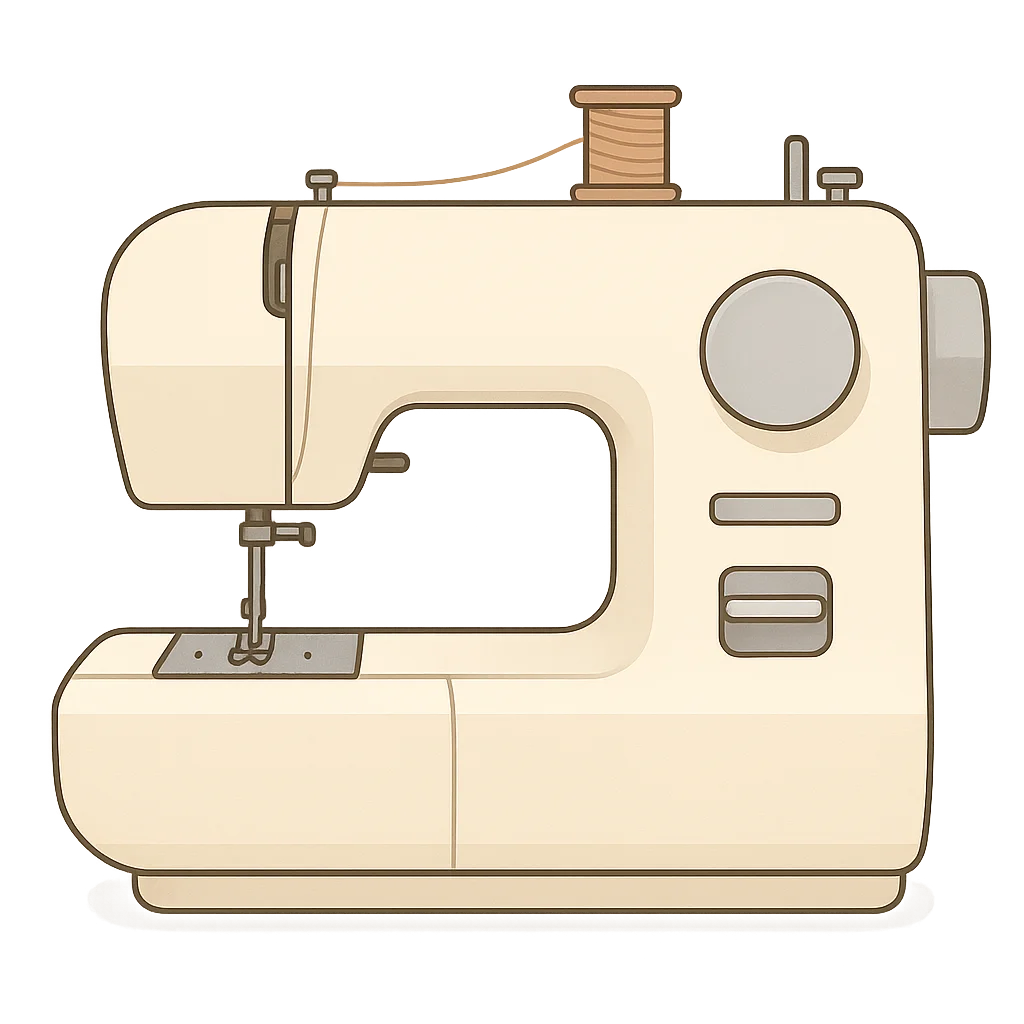
The Story of the Sewing Machine
Before I could whirr and hum, the world was a much slower place, stitched together one careful poke at a time. Hello, I am the Sewing Machine, and for centuries, I was just a dream in the minds of tired seamstresses and tailors. Imagine every shirt on your back, every curtain in your window, every sail on a ship being created by a single hand pushing a needle through cloth. It was a craft of immense skill and patience, but it was also incredibly laborious. A simple dress could take days to complete. Mending was a constant chore. For generations, people wished for a way to speed up this essential task. Inventors tinkered with ideas, trying to mimic the motion of the human hand, but the secret to creating a strong, fast stitch remained elusive. The world was waiting for a spark of ingenuity, for someone to see the problem not from the top of the needle, but from its very point. I was the solution waiting to be born, a promise of a future where creating with fabric could be a joy, not just a necessity.
My birth was not a single event but a long and complicated labor, with many minds contributing to my design. One of my earliest forms took shape in France in 1830. A man named Barthélemy Thimonnier created a workshop filled with my wooden ancestors, all clacking away to make army uniforms. But his success was met with fear. A mob of angry tailors, terrified that I would take away their livelihood, stormed his factory and destroyed every last one of my early bodies. It was a heartbreaking setback. My true potential, however, was unlocked across the ocean in America. A man named Elias Howe was wrestling with the same problem. Legend says that the solution came to him in a nightmare. He dreamed of being forced to create a sewing machine, and he noticed that the spears of his captors had holes near their tips. On September 10th, 1846, he patented the idea that would define me: a needle with its eye at the very point. This was the revolution. This needle could push a thread through the fabric and form a loop on the other side. Then, a second thread, carried by a small device called a shuttle, would pass through that loop. This created the lockstitch, a bond so strong and secure it wouldn't unravel. I was no longer just making a chain of flimsy loops; I was weaving threads together, creating a seam as resilient as the fabric itself. That was the moment I truly came to life.
While Elias Howe gave me my soul—the lockstitch—it was another man who gave me my voice and put me in the hands of the world. His name was Isaac Singer. Howe’s design was brilliant, but it was still clunky and difficult to operate. Singer, an actor and a born showman with a mind for mechanics, saw my potential in the early 1850s. He didn't invent me, but he perfected me. He made my needle move straight up and down, not sideways in an arc. He added a presser foot to hold the fabric firmly in place, giving the user control. Most importantly, he designed a foot treadle, a pedal that allowed the operator to power me with their feet. This simple change was liberating. For the first time, a sewer’s hands were completely free to guide the fabric with precision and speed. But Singer’s genius didn't stop with engineering. He was a brilliant businessman. He knew that most families couldn't afford to buy me outright. So, he introduced the world’s first installment plans, allowing people to pay a small amount each month. Suddenly, I wasn't just a machine for a factory; I was a tool for the home. I became a star, a symbol of modern domestic life.
From those heavy, ornate, black iron bodies of the 19th century, I have evolved in ways my first creators could never have imagined. I became sleeker, lighter, and powered by the quiet hum of electricity instead of the rhythmic pumping of a treadle. Today, some of my descendants are dazzlingly complex, with computers that can embroider intricate patterns at the touch of a button. My impact has been woven into the very fabric of society. I made clothing affordable for everyone, helping to create the ready-to-wear fashion industry. I gave people a way to express their creativity, to mend what was broken, and to build businesses from their own homes. My journey shows that an invention is more than just a single idea; it is a collaboration across time, a blend of brilliant engineering and clever improvements that help it find its place in the world. I am still here, a quiet and constant presence in homes, schools, and studios, ready to help the next generation stitch their dreams into reality.
Activities
Take a Quiz
Test what you learned with a fun quiz!
Get creative with colors!
Print a coloring book page of this topic.














 Free for Educators