

 English

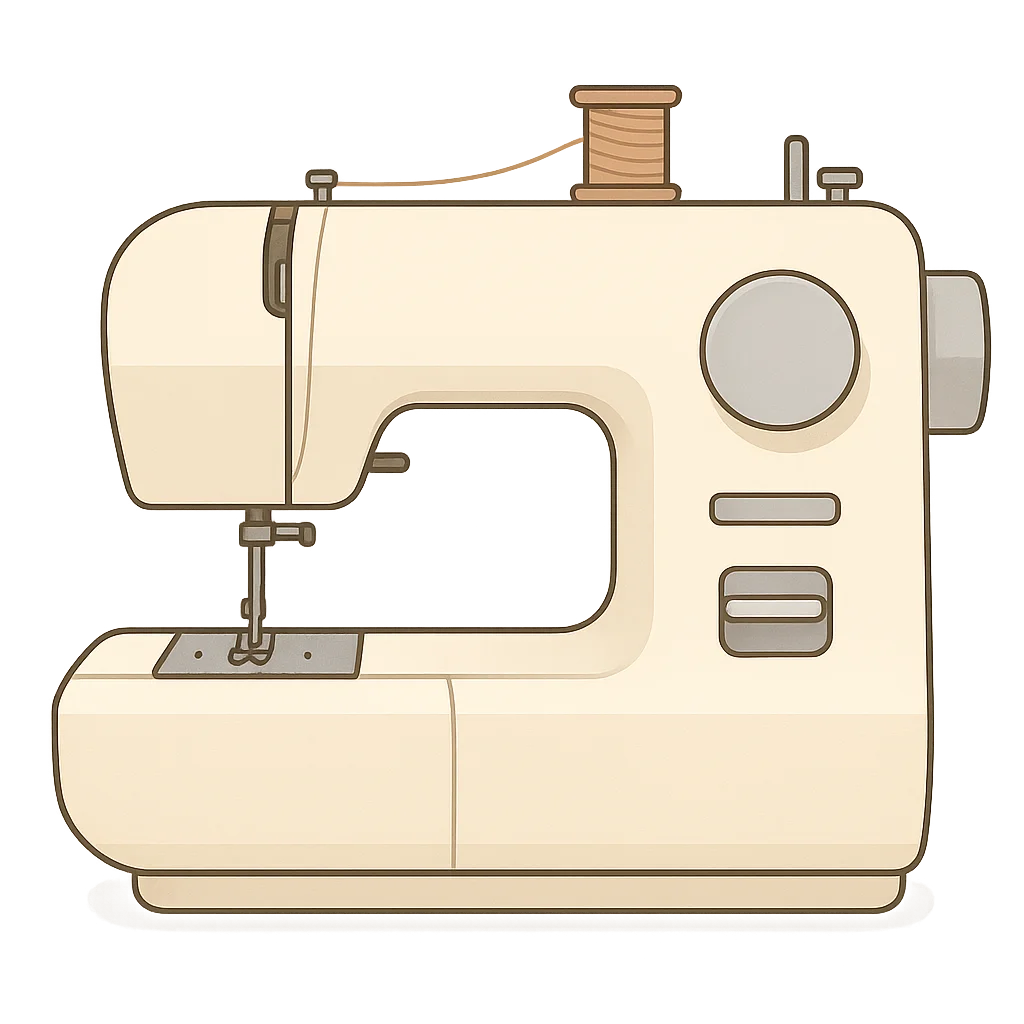
The Sewing Machine's Story: A Stitch in Time
Before I was born, the world was a much slower place, especially when it came to making clothes. Hello, I am the Sewing Machine, and I want to tell you my story. Imagine your favorite shirt. Now, imagine someone having to push a tiny needle and thread through the fabric for every single stitch by hand. It would take hours, even days! Fingers would get sore and pricked, and eyes would grow tired from focusing on such tiny work. People owned very few clothes because making them took so much time and effort. Mending a simple tear was a long chore. The world was full of slow, careful stitches, and everyone was waiting for a better, faster way. They needed someone like me to come along and speed things up.
Many clever people tried to bring me to life. A man in France named Barthélemy Thimonnier even made a version of me out of wood. But the person who truly solved my biggest puzzle was an American inventor named Elias Howe. He spent years tinkering in his workshop, trying to figure out how a machine could possibly sew like a human. He tried to make a needle that worked like a regular hand-sewing needle, with the hole at the top, but it just wouldn’t work. He was ready to give up. Then, one night, on September 10th, 1846, he had a strange and wonderful dream. In his dream, warriors were chasing him with spears that had holes near the sharp, pointy tip. When he woke up, he shouted with joy. That was the answer! My needle needed an eye at the point, not the top. With this new needle, he created my amazing 'lockstitch.' It used two threads, one from the top and one from a small bobbin below, that twisted together in the middle of the fabric. This created a strong, secure stitch that wouldn't pull apart. I was finally born.
Even though Elias Howe had invented me, not many people knew about me at first. I was clever, but a little clumsy to use. That's when another smart man, Isaac Singer, entered my life. He saw my potential and knew he could make me better. Isaac didn't invent me, but he gave me some fantastic upgrades. He designed a straight needle that moved up and down, instead of in a curve. Most importantly, he gave me a foot pedal, called a treadle. This was a brilliant idea because it meant people could use both of their hands to guide the fabric, making sewing smooth and easy. On August 12th, 1851, he received a patent for his improvements. But his biggest idea was how to share me with the world. He created a plan where families could pay a little bit of money each month to own me. Suddenly, I wasn't just a machine for big factories. I was moving into homes, sitting in living rooms, and ready to help families everywhere.
My arrival changed everything. With my steady, speedy stitching, a shirt that once took a whole day to make by hand could be finished in just an hour. This meant clothes became much less expensive. For the first time, ordinary people could afford to have more than just a few outfits. I was busy stitching all sorts of things. I helped make tough, sturdy blue jeans for workers and miners. I stitched together beautiful, fancy dresses for parties and celebrations. I created uniforms for soldiers and school children. Because of me, a whole new world of fashion began to grow. Designers could quickly turn their ideas into real clothes, and new styles could be shared across the country. I was stitching the very fabric of modern life together.
My story is still being written, with a thread that never seems to end. Today, I am powered by electricity and some of my younger relatives are even guided by computers. You can find me in classrooms, where I teach students how to be creative. I am in homes, helping people mend their favorite jeans or design a cool costume. I am in huge factories, of course, but I also help designers create amazing clothes for astronauts to wear in space. It all started with a dream about a pointy needle. It just goes to show you that one clever idea, stitched together with hard work and determination, can truly change the world.
Activities
Take a Quiz
Test what you learned with a fun quiz!
Get creative with colors!
Print a coloring book page of this topic.













 Free for Educators