A Partner in Time: The Story of the Smartwatch

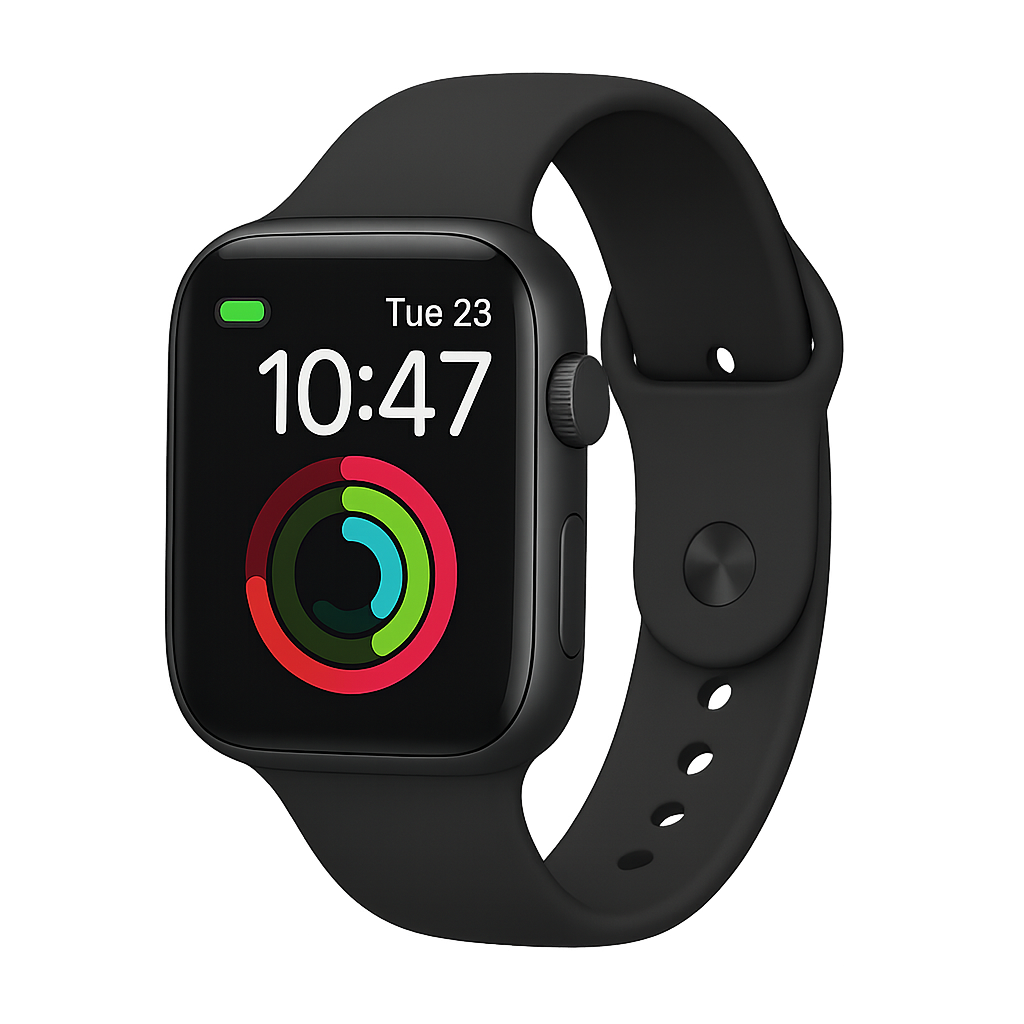
Hello from your wrist. That’s me, the smooth, cool glass that lights up with a friendly greeting when you turn your arm. I’m your Smartwatch, and I spend my days right here with you, a quiet but busy companion. I can give you a gentle buzz to let you know a friend has sent a message, show you a picture of your family, or play your favorite song to get you energized for a run. I count every step you take on an adventure and can even remind you to stand up and stretch. I feel sleek, modern, and full of endless possibilities. You might think I just magically appeared a few years ago, a direct descendant of the smartphone in your pocket. But my family tree has much deeper, and far more awkward, roots.

My story doesn’t begin in a high-tech lab with wireless signals, but in a time of clunky gadgets and bold ideas. Before I could track your heart rate, my earliest ancestors were just trying to solve math problems or show a grainy television program on a screen no bigger than a postage stamp. They were pioneers, dreaming of a future where technology could live on a person’s wrist. They were a bit clumsy and not always practical, but without their brave first steps, I would never have been born. Their story is my story, a long journey of trial, error, and imagination that brought me here, to you.

Reading Comprehension Questions

Click to see answer

Answer: The smartwatch's history began with its clunky ancestors. In 1975, the Pulsar calculator watch could do simple math but had tiny buttons. In 1982, the Seiko TV Watch could show TV but needed a large, wired receiver. For a long time, the idea waited for better technology. Finally, after tiny chips, better batteries, and the smartphone were invented, the Pebble smartwatch was launched on January 23rd, 2013, proving people were ready. The Apple Watch on April 24th, 2015, made the smartwatch a worldwide star.

Answer: In this context, a pioneer is one of the first to explore a new idea, even if they don't perfect it. The Pulsar and Seiko watches were pioneers because they were the first to try putting complex technology like a calculator or a TV on a wrist. This was an important step because it showed inventors and the public what was possible and planted the seed of the idea for a truly smart, all-in-one wrist device, inspiring future creations.

Answer: The three key ingredients the smartwatch needed were tiny, powerful computer chips, better batteries that could last all day, and its partner, the smartphone. The smartphone solved a major challenge by acting as the main 'brain.' It handled the difficult processing, so the watch itself didn't need a huge, power-hungry processor, allowing it to be small, efficient, and have a longer battery life.

Answer: In its early phase, the smartwatch describes its ancestors as feeling 'awkward' and 'tethered' by wires and clunky accessories. Now, as a modern device, it feels like a 'partner,' a 'guardian,' and a 'companion.' Its purpose has shifted from just showing information to actively helping people by monitoring their health, keeping them safe by detecting falls, and guiding them through the world, showing a much deeper sense of purpose and connection to its user.

Answer: The story teaches us that important inventions rarely happen all at once. They are often the result of a long journey of perseverance, built upon the successes and failures of earlier, imperfect ideas. It shows that a big idea might seem impractical at first, but with continued innovation, patience, and the development of other technologies, it can eventually become something that changes the world.