

 English

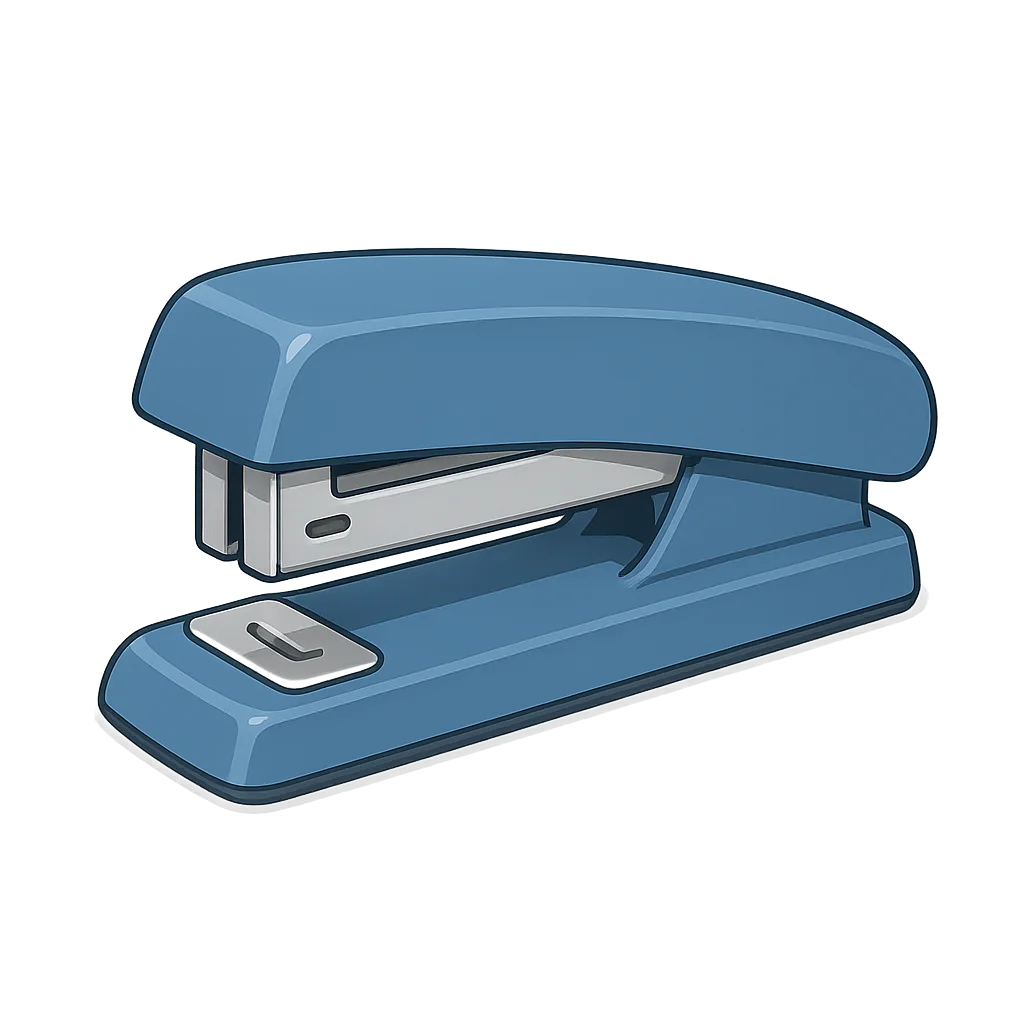
The Story of the Stapler
Hello. You probably see me sitting on your desk, a humble and helpful friend. I am the stapler. My purpose is simple but important: with a satisfying ka-chunk, I bind loose pages into a neat, orderly stack. My metal arms press a tiny wire staple through the paper, and my base plate neatly folds the ends, creating a secure bond. I hold together your homework, your parents’ reports, and the storybooks your teacher prints out. But have you ever imagined a world without me? Picture it: a gust of wind from an open window sending important papers flying everywhere. Imagine trying to hold a report together with a clumsy ribbon that always comes untied, or a blob of sticky wax that gets brittle and cracks. For a long time, people even used straight pins, which were sharp and could easily poke an unsuspecting finger. It was a world of paper chaos, a jumble of loose ideas and scattered thoughts. That messy, disorganized world was precisely why I was so desperately needed. Someone had to find a better way to hold things together, and that is where my long and fascinating story begins.
My story doesn't start in a busy office or a modern factory, but in a place of incredible luxury and power: the royal court of 18th-century France. My earliest known ancestor was created in the 1700s, not for the masses, but for the exclusive use of one person: King Louis XV. This was no ordinary office supply. It was a magnificent, handcrafted device, likely made of silver and adorned with intricate carvings. It was less of a tool and more of a royal gadget, a symbol of status. Each staple was loaded one at a time, and these weren't simple metal wires. They were often made of precious metals and sometimes even bore the insignia of the royal court, like a tiny, official stamp on every document the king fastened. This ancestor of mine didn’t bind lengthy reports or school projects; it likely fastened the king’s personal decrees or court correspondence. It established the very first spark of my existence, the idea that a mechanical device could neatly pierce and bind paper. But at this point, I was a secret of the wealthy and powerful, a far cry from the democratic, everyday tool I would one day become.
To become the stapler you know today, my story had to cross the Atlantic Ocean and leap forward into a new era of innovation. It was in America during the 19th century that I truly began to take shape, thanks to a clever inventor named George W. McGill. He was fascinated with finding better ways to connect things. His first major breakthrough came on August 24th, 1866, when he received a patent for a small, bendable brass paper fastener. You might have seen these before—the little metal brads with two legs you push through paper and fold flat. This wasn't quite a staple, but it was a revolutionary step toward a single, machine-applied fastener. Mr. McGill didn't stop there. He continued to refine his idea, and on February 18th, 1879, he patented the device that was my most direct predecessor: the McGill Single-Stroke Staple Press. It was a heavy, cast-iron machine that could drive a single staple through several sheets of paper. An operator would have to feed one U-shaped staple into the machine, position the papers just right, and then press down firmly on a plunger. Clack! The staple was set. While it was still a slow process, it was a miracle of efficiency for businesses, publishing houses, and writers of the time, who were finally free from the tyranny of pins and wax.
Mr. McGill's invention was brilliant, but it had one significant drawback: the process of loading each staple individually was tedious and slow. Imagine trying to assemble a fifty-page book, stopping to insert a new staple for every single copy. It was better than the old ways, but it wasn't fast enough for the rapidly growing world of business and publishing. The final piece of the puzzle, the innovation that transformed me into the rapid-fire tool I am today, was the staple strip. The idea was simple but genius: instead of handling tiny, individual staples, why not glue a long row of them together? Around the turn of the 20th century, inventors perfected machines that could produce these coherent strips of staples. Now, a user could open my hinged top, drop in a full strip of fifty or more staples, and close me back up. I was ready for action. The satisfying ka-chunk could now be repeated over and over again in quick succession, turning a slow, deliberate task into a swift, effortless one. This was the moment I evolved from a novelty into a truly indispensable machine, capable of taming vast mountains of paperwork with speed and ease.
From those royal beginnings and the slow, methodical presses of the 19th century, I have grown and diversified in ways my earliest creators could never have imagined. Today, I exist in countless forms. I am the tiny, colorful stapler that fits neatly inside a student’s pencil case, ready to fix a torn page. I am the sturdy, reliable workhorse on an office desk, assembling critical reports day after day. I am the powerful electric stapler in a busy mailroom, binding thick booklets with a quiet whirr-chunk. I am even the heavy-duty staple gun used in construction and upholstery, fastening materials with incredible force. My fundamental purpose has never changed: I bring order to chaos. I hold things together. Whether it’s a child’s very first story, a scientist’s groundbreaking research, or the plans for a new skyscraper, I play a small but vital role. I am proof that a simple idea, refined with persistence and creativity over centuries, can make a huge impact on keeping our world connected and organized. I hold our ideas together, one staple at a time.
Activities
Take a Quiz
Test what you learned with a fun quiz!
Get creative with colors!
Print a coloring book page of this topic.













 Free for Educators