

 English

The Ghost in the Photograph
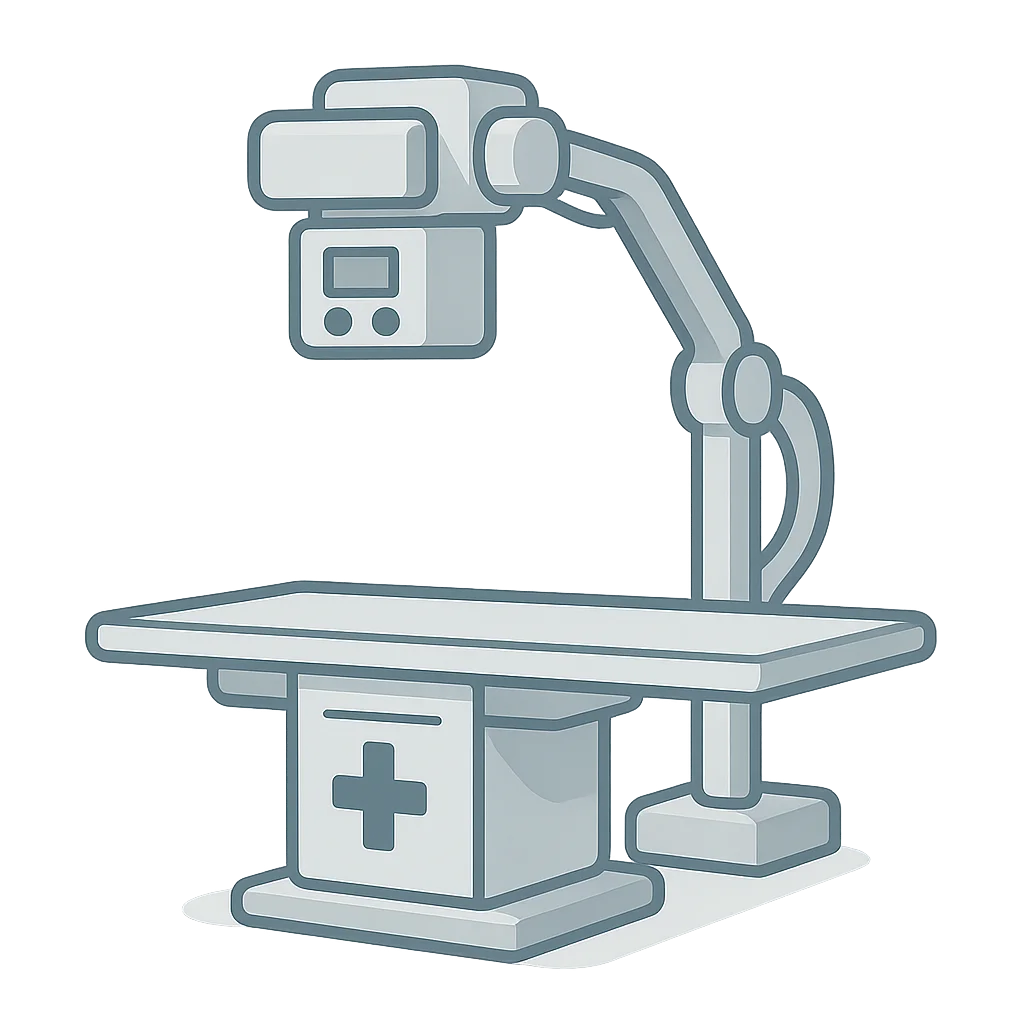
You might know me from a doctor's office or a hospital, where I stand tall and quiet. My name is the X-ray Machine, and I have a very special talent: I can see through things. Not with eyes, of course, but with invisible rays that create pictures of what's hidden inside. I can show you the sturdy bones inside your arm or the coin you accidentally swallowed. But my story didn’t begin in a bright, clean hospital. It began in the deep shadows of a German laboratory, with a curious scientist and a faint, mysterious glow that no one had ever seen before. It was a place where a single spark of light in the darkness was about to change the world forever, revealing a universe that had always been there, just beyond the limits of human sight.
My entire existence began on the evening of November 8th, 1895. In a laboratory in Würzburg, Germany, a brilliant physicist named Wilhelm Conrad Röntgen was hard at work. The room was dark, perfect for his experiments with something called a cathode-ray tube, a glass tube that glowed when electricity passed through it. He had covered his tube with thick black cardboard so that no visible light could escape. He was focused on the electrical currents, not the light. But then, something caught his eye. Across the room, a small screen coated with a chemical called barium platinocyanide began to shimmer with a faint, greenish light. He was puzzled. How could the screen be glowing if the tube was completely covered? He turned the tube off, and the glow vanished. He turned it on again, and there it was, a ghostly shimmer in the darkness. He realized that some unknown, invisible ray must be escaping the tube, passing right through the cardboard, and striking the screen. He didn't know what these rays were, so he called them 'X-rays,' with 'X' being the symbol for the unknown.
For weeks, Röntgen was consumed by his discovery. He worked in secret, barely leaving his laboratory, trying to understand the properties of these strange new rays. He found they could pass through paper, wood, and even thin sheets of metal. He was filled with a sense of wonder and urgency. Then, on December 22nd, 1895, he had an idea that would make me famous. He asked his wife, Anna Bertha, to come into the lab. He positioned a photographic plate on a table and asked her to place her hand over it. For fifteen long minutes, he aimed the rays from his cathode tube at her hand. When he developed the photographic plate, the image that emerged was astounding. It was a ghostly picture of the delicate bones inside her hand. The flesh was a faint shadow, but the bones were clear and white. And there, on her ring finger, was a dark, solid circle—her wedding ring, which the rays could not pass through. When Anna Bertha saw the image, she was both amazed and a little spooked, exclaiming that she had seen her own death. But it wasn't a picture of death; it was a picture of life, in a way no one had ever witnessed before.
That single photograph changed everything. Röntgen published his findings on December 28th, 1895, and the news spread like wildfire across the globe. Scientists, doctors, and the public were fascinated. It felt like magic, a genuine superpower brought to life. Before I came along, if you broke your arm, a doctor could only guess at how the bones were aligned. They would poke and prod, relying on skill and luck to set the fracture correctly. But with me, they could see the break clearly. Suddenly, medicine had a powerful new tool. During wartime, surgeons used me to find bullets and shrapnel lodged inside wounded soldiers, saving countless lives. Doctors could diagnose diseases like tuberculosis by seeing shadows on the lungs. I gave healers a window into the human body, turning guesswork into certainty and bringing light to places that had always been hidden in darkness.
Of course, I wasn't perfect at first. The early versions of me were a bit clumsy, and it took a long time to learn that my rays, while helpful, needed to be used carefully and with protection. Over the decades, brilliant scientists and engineers worked to make me safer, faster, and more powerful. My images became sharper, and the process became much quicker than the fifteen minutes Anna Bertha had to hold still. I also found new jobs outside the hospital. At airports, I help keep people safe by peering inside luggage to make sure nothing dangerous is hidden. Art historians use me to look beneath the surface of famous paintings, discovering forgotten sketches or changes made by the artist centuries ago. My fundamental idea even inspired my more advanced relatives, like CT scanners, which can create detailed 3D images of the entire body. I had grown from a laboratory curiosity into a vital tool for health, safety, and discovery.
So, the next time you see one of my pictures—a clear, sharp image of the bones that support you—remember where I came from. I was born from a moment of pure curiosity, from a scientist who noticed a faint glow in a dark room and asked, 'Why?'. My story is a reminder that sometimes the greatest discoveries aren't found by looking for something specific, but by being open to the unexpected. I am proud to be a window to the world within, a tool that continues to help and heal. And it all started because one person decided to investigate a mysterious light, proving that a little bit of curiosity can illuminate the entire world.
Activities
Take a Quiz
Test what you learned with a fun quiz!
Get creative with colors!
Print a coloring book page of this topic.












 Free for Educators