

 English

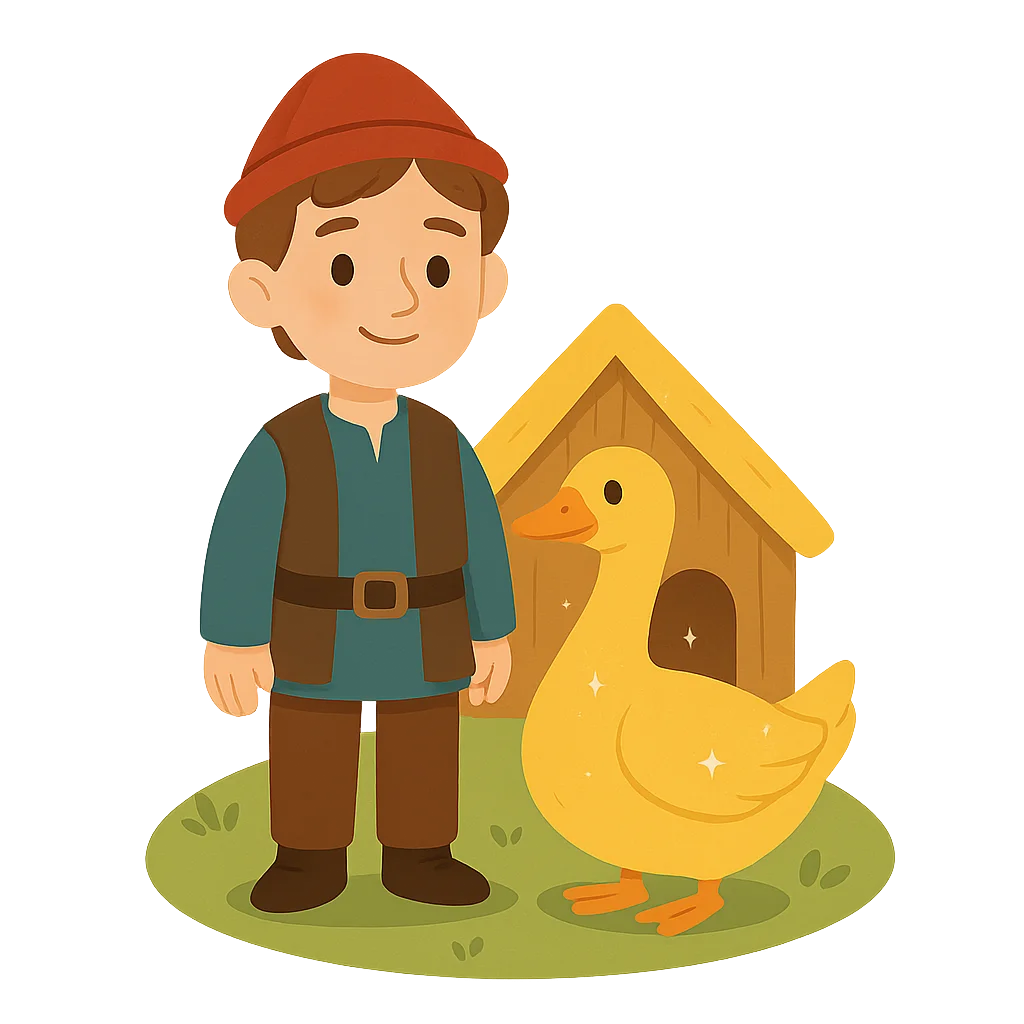
The Golden Goose
My brothers always called me Dummling, the Simpleton, and perhaps I was, but I always found more joy in the quiet rustle of the forest leaves than in their clever schemes. I am the youngest of three, and while my older brothers were given fine cakes and wine to take with them when they went to chop wood, I was sent off with a dry, ash-baked cake and a bottle of sour beer. It was on one of these lonely trips into the woods that my life changed forever, all because of a simple act of kindness. This is the story of how I found The Golden Goose. It begins with me, sitting on a stump, about to eat my meager lunch when a little old man with gray hair appeared from behind a tree, his eyes twinkling as he asked for a bite to eat. My brothers had refused him, but how could I? I immediately offered him half of my dry cake and some of my sour beer. To my astonishment, the moment he took it, the cake transformed into a delicious, sweet pastry and the beer became the finest wine. We shared my humble meal, and what happened next was pure magic.
After we finished eating, the little man pointed to an old tree. 'Chop that down,' he said, 'and you will find something at its roots.' I did as he said, and there, nestled among the roots, was a magnificent goose with feathers of pure, shimmering gold. I tucked it under my arm and headed for the nearest town, deciding to spend the night at an inn. The innkeeper had three daughters who were overcome with curiosity about my golden bird. That night, the eldest daughter thought, 'I must have one of those golden feathers.' When she thought I was asleep, she crept into my room and reached for the goose, but the moment her fingers touched a wing, she was stuck fast. Soon after, her sister came in with the same idea, but as she tried to pull her sister away, she too became stuck. Finally, the third sister arrived and, trying to free the other two, found herself stuck to them as well. The next morning, I left the inn, completely unaware of the three girls trailing behind me, stuck to my goose. A parson saw us and, shouting about the impropriety of it all, tried to pull the girls away, only to get stuck himself. His sexton followed, grabbing the parson's sleeve, and he too was stuck. Then two laborers with their hoes joined the ridiculous, unwilling parade. It was the strangest sight you could ever imagine, a comical chain of people all attached to my golden goose.
My strange procession and I traveled onward until we reached a great city. The king of this city had a daughter who was so serious, so solemn, that she had never once laughed in her entire life. She was surrounded by every luxury, but a deep melancholy had settled over her. The king, desperate to see his daughter happy, had made a royal decree: whoever could make his daughter laugh would win her hand in marriage. Many had tried and failed, from the funniest jesters to the most famous comedians. When I arrived at the castle with my goose and the seven people trailing behind me, all tugging and stumbling and shouting, the princess was watching from her window. The sight of the frantic parson with his robes askew, the flustered sexton, and the bumbling laborers all stuck together was too much for her. A small smile touched her lips, then a giggle, and then she burst into a full, hearty laugh that echoed through the entire courtyard. I had succeeded. But the king, looking down at my simple clothes and seeing the boy everyone called 'Dummling,' was not ready to keep his promise. He set three impossible tasks before me, convinced I would fail.
First, the king demanded I find a man who could drink an entire cellar of wine. Just as I began to despair, I saw the little gray man from the forest, who looked terribly thirsty. 'I have a great thirst that I cannot quench,' he said. I led him to the cellar, and he drank every last drop from the barrels in a single day. Next, the king ordered me to find a man who could eat a mountain of bread. Again, the little gray man appeared, looking famished, and devoured the entire mountain without trouble. For the final task, I had to bring the king a ship that could sail on land as well as on sea. My friend, the little gray man, revealed that because I had been kind to him, he would grant me this final wish. He presented me with a magnificent ship that sailed over the fields as smoothly as it did on the water. With all three tasks complete, the king had no choice but to honor his word. I married the princess, and when her father passed, I inherited the kingdom and ruled wisely for many years. My story, first written down by the Brothers Grimm on December 20th, 1812, isn't just about a magical goose. It's a reminder that a kind and generous heart is a treasure far greater than gold. It shows that you should never judge someone by their appearance or what others call them, because even the simplest person can achieve the greatest things.
Activities
Take a Quiz
Test what you learned with a fun quiz!
Get creative with colors!
Print a coloring book page of this topic.
















 Free for Educators