

 English

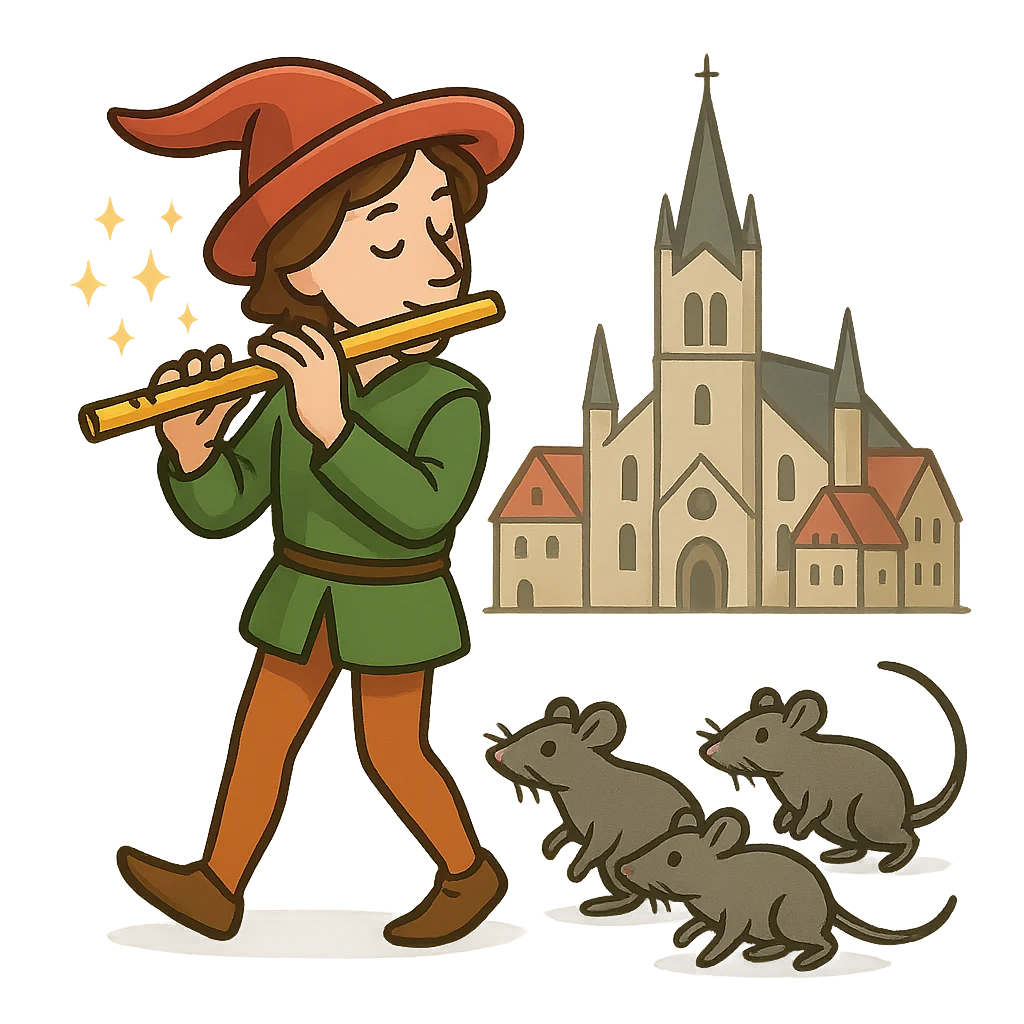
The Pied Piper of Hamelin
My name is Lisbet, and I remember the rats. Before the music came, our town of Hamelin smelled of dust and decay, and the scuttling sound of a thousand tiny claws was the only song we knew. I lived in a cozy house with a thatched roof, but even there, we were never truly alone, and I often wondered if we would ever be free from the plague of rodents. This is the story of the Pied Piper of Hamelin, and how a promise, once broken, changed our town forever. The year was 1284, and our town, nestled by the Weser River in Germany, was in a state of absolute crisis. Rats were a relentless, creeping tide of fur and teeth. They scurried through the bakeries, their beady eyes glinting as they stole freshly baked bread. They gnawed at the wooden spoons in our kitchens and nested in the warm linen of our beds. In the streets, they were as bold as brass, swarming over cobblestones and barely scattering for our carts. The grown-ups were desperate. The Mayor, a portly man who loved the clink of gold coins far more than the well-being of his people, wrung his hands and made grand speeches but did nothing effective. Our parents set traps, which the clever rats avoided. They brought in cats, who were so outnumbered they hid under porches, trembling. The rat population only grew, and with it, the town's fear and misery thickened like the river fog, choking our hope.
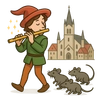
One bright afternoon, a peculiar stranger walked into town. He was tall and thin as a reed, and his clothes were a spectacle of vibrant color—a coat stitched together from patches of brilliant red and sunshine yellow. We children peeked from our windows, whispering that he must be a magician. He carried nothing but a simple wooden pipe. We called him the Pied Piper, and he strode directly to the Mayor's office with an air of unshakable confidence. "For a thousand gold guilders," the Piper said, his voice as smooth as flowing water, "I will rid Hamelin of every single rat." The Mayor, whose greed was momentarily overshadowed by his desperation, saw a swift end to his troubles. He eagerly agreed, promising the payment without a second's hesitation. "A thousand guilders it is!" he declared for all to hear. The Piper simply nodded, then stepped into the main square. He raised the pipe to his lips, and a strange, enchanting melody began to drift through the air. It was a sound unlike any other, a tune that seemed to have a life of its own, weaving through the alleyways and seeping into every nook and cranny of Hamelin. From the cellars and attics, from behind walls and beneath floorboards, the rats began to emerge. Their eyes were glazed over, their whiskers twitched in time with the music, and they were utterly mesmerized. They poured into the streets, a great, furry river flowing behind the Piper as he marched slowly toward the river. He didn't stop at the water's edge but waded right in, and every last rat followed him into the swift current and was swept away. In a single afternoon, Hamelin was free.
The town erupted in celebration. People danced in the streets, and the Mayor puffed out his chest, taking credit for his decisive action. But when the Piper returned to the town hall to collect his promised fee, the Mayor's cheerful demeanor vanished. With the rats gone, his greed returned tenfold. He laughed a short, ugly laugh. "A thousand guilders? For a bit of whistling?" he scoffed. "The danger is gone, and so is our deal. I will give you fifty guilders for your trouble, and you can be on your way." The Pied Piper’s smile faded, and his eyes grew as cold and gray as the river that had swallowed the rats. "I play a different kind of tune for those who break their word," he warned, his voice low and chilling. "You will regret this." He turned and left without the fifty guilders, his colorful coat a final splash of brightness before he disappeared. The townspeople, relieved to be rid of the rats and secretly happy to keep their money, quickly forgot the Piper's ominous warning. Life returned to normal, or so they thought. But the Piper did not forget. On the morning of June 26th, the day of Saint John and Paul, while all the adults were gathered in the church, he returned. He stood in the same square, but this time, he played a new melody. It was a tune even more beautiful and irresistible than the first, a sweet, lilting song that promised adventure and endless joy. It wasn't rats that answered his call this time. It was us.
From every home, all the children of Hamelin poured into the streets. I heard the music from my room and felt a pull I couldn't explain. My friends and neighbors felt it too, and soon we were all dancing in a long, laughing line behind the Piper. We were one hundred and thirty boys and girls, completely captivated by the magical music. We could faintly hear our parents calling our names as they rushed out of the church, but their voices sounded distant and unimportant compared to the enchanting song. The Piper led us out of the town gate and towards a lush green mountain called Koppen Hill. As we reached the mountainside, a doorway of shimmering light appeared in the solid rock, opening like a secret passage. The Piper walked inside, and we followed without hesitation, still dancing. As the last child stepped through, the magical door closed behind us, sealing us from the world we knew. Our town of Hamelin was left in a stunned, heartbroken silence. What happened to us? Some versions of the story say we were led to a beautiful new land, a paradise where we could play forever. Others whisper that we were lost in the mountain, never to be seen again. The story of the Pied Piper became a powerful cautionary tale, a stark reminder etched into the town's history about the critical importance of keeping a promise. Today, the legend lives on, not just in Hamelin, where a street is named in its memory and no music is ever allowed to be played, but all over the world. It reminds us that actions have consequences and that a broken promise can echo through generations, leaving behind only a question, like the faint, lingering notes of a piper's song.
Activities
Take a Quiz
Test what you learned with a fun quiz!
Get creative with colors!
Print a coloring book page of this topic.











 Free for Educators