

 English

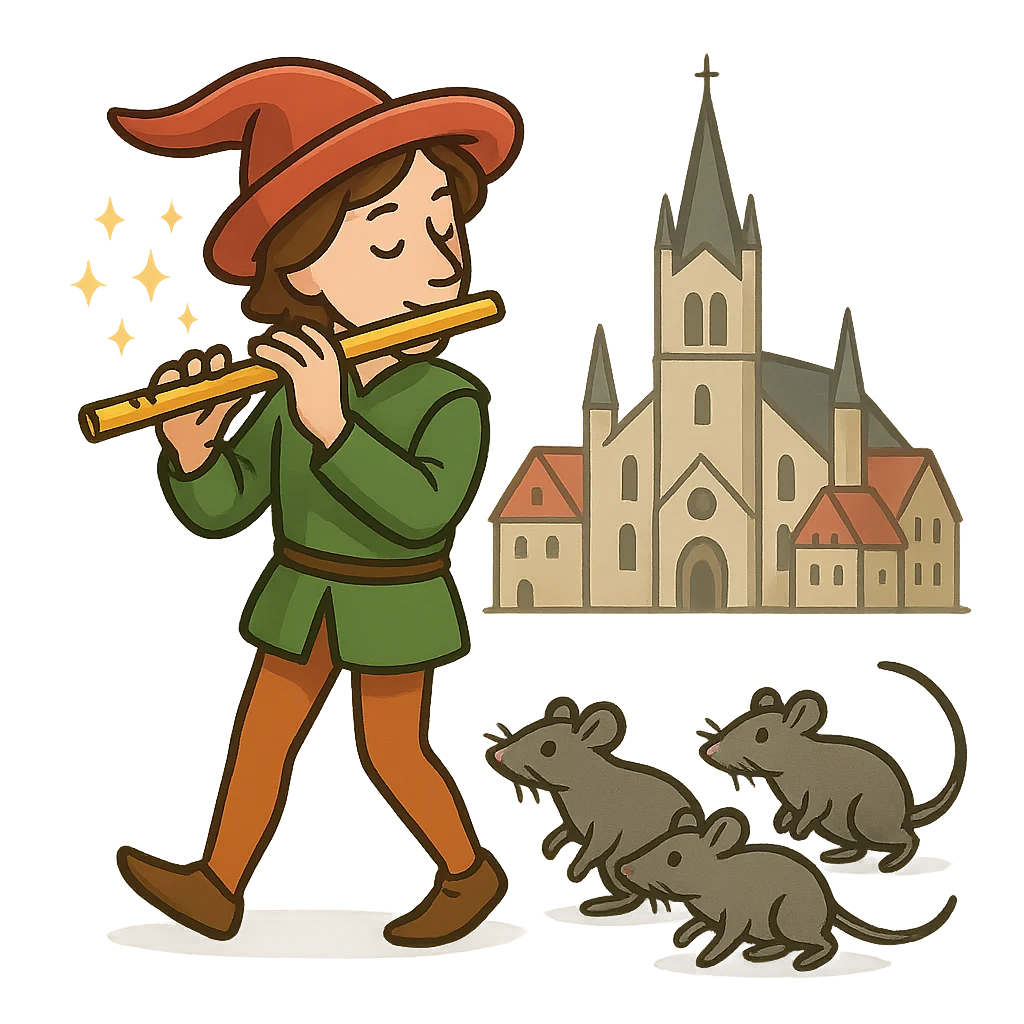
The Pied Piper of Hamelin
My name is Hans, and I remember when my town, Hamelin, was filled with whispers and scurrying sounds. Long ago, on the winding Weser River, our cobblestone streets weren't filled with laughter, but with rats! They were everywhere, a furry, squeaking tide that nibbled our bread and danced in our cupboards. They were so bold they’d snatch cheese right from the kitchen table and even nap in our shoes. I was just a boy, and I remember the worried faces of the grown-ups, their brows furrowed with constant anxiety. They tried everything from traps to cats, but the army of rats only grew larger and more daring. The Mayor promised a great reward, anything, to the person who could free our town from the plague of rodents. This is the story of how a promise was broken and how music changed our town forever; it is the legend of the Pied Piper of Hamelin.
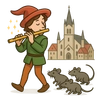
One day, a stranger appeared as if from thin air. He was tall and thin, dressed in a fantastic coat of patched red and yellow cloth that swirled around him like a sunset. In his hands, he carried a simple wooden pipe. He walked straight to the Mayor and introduced himself as a rat-catcher, a master of his trade. "For a thousand gold coins," he said, his voice as smooth as flowing water, "I will rid this town of every single rat." The Mayor, desperate and seeing the hopeful faces of the townspeople, eagerly agreed to the price. The Piper stepped into the main square, raised the pipe to his lips, and began to play. It was the strangest music I had ever heard—a melody that seemed to tickle your ears and pull at your feet, a magical, irresistible tune. From every house, cellar, and alley, the rats came pouring out, their eyes glazed over as if in a trance, completely mesmerized. The Piper walked slowly toward the river, his music never stopping, and the entire army of rats followed him. They tumbled into the water and were swept away by the current, disappearing forever. Hamelin was free! But when the Piper returned for his payment, the greedy Mayor laughed. "For a simple tune?" he scoffed, offering him only fifty coins. The Piper’s smile vanished. His eyes grew dark, and he warned, "I know another tune, one for a different kind of pest."
On the morning of June 26th, 1284, while all the adults were gathered in the church, the Piper returned. He stood once more in the town square, but this time he played a new song, sweeter and more beautiful than the first. It drifted through the open windows like a summer breeze, a melody so enchanting it felt like a dream. It called to us children, and one by one, we left our homes, drawn by the irresistible music. I tried to follow, my heart pounding with a strange joy, but my leg had been injured in a fall, and I couldn't keep up with the others. I watched, helpless, as my friends, one hundred and thirty boys and girls, followed the Piper out of the town gates and toward a large hill called Koppen Hill. As they reached the base of the hill, a shimmering door opened in the side of the mountain. They all danced inside, their laughter echoing for a moment before the door closed behind them, sealing them within the rock. I was the only one left to tell the tale. The town was suddenly, terribly silent, filled with a sorrow that a thousand gold coins could never fix.
A Story's Echo
For centuries, people have told our story, a somber reminder passed down through generations. It was written down by famous storytellers like the Brothers Grimm, who wanted to make sure no one forgot the lesson of Hamelin: a promise is a promise, no matter who you make it to. The story of our lost children and the Mayor's broken vow has been turned into poems, plays, and beautiful, haunting paintings that capture the Piper's colorful coat and the children's dancing feet. Even today, the tale of the Pied Piper reminds us of the power of art and the importance of being true to our word. It lives on, not just to scare us, but to make us wonder about the magic in a song and the heavy weight of a promise, its melody echoing from my little town across the entire world.
Activities
Take a Quiz
Test what you learned with a fun quiz!
Get creative with colors!
Print a coloring book page of this topic.












 Free for Educators