

 English

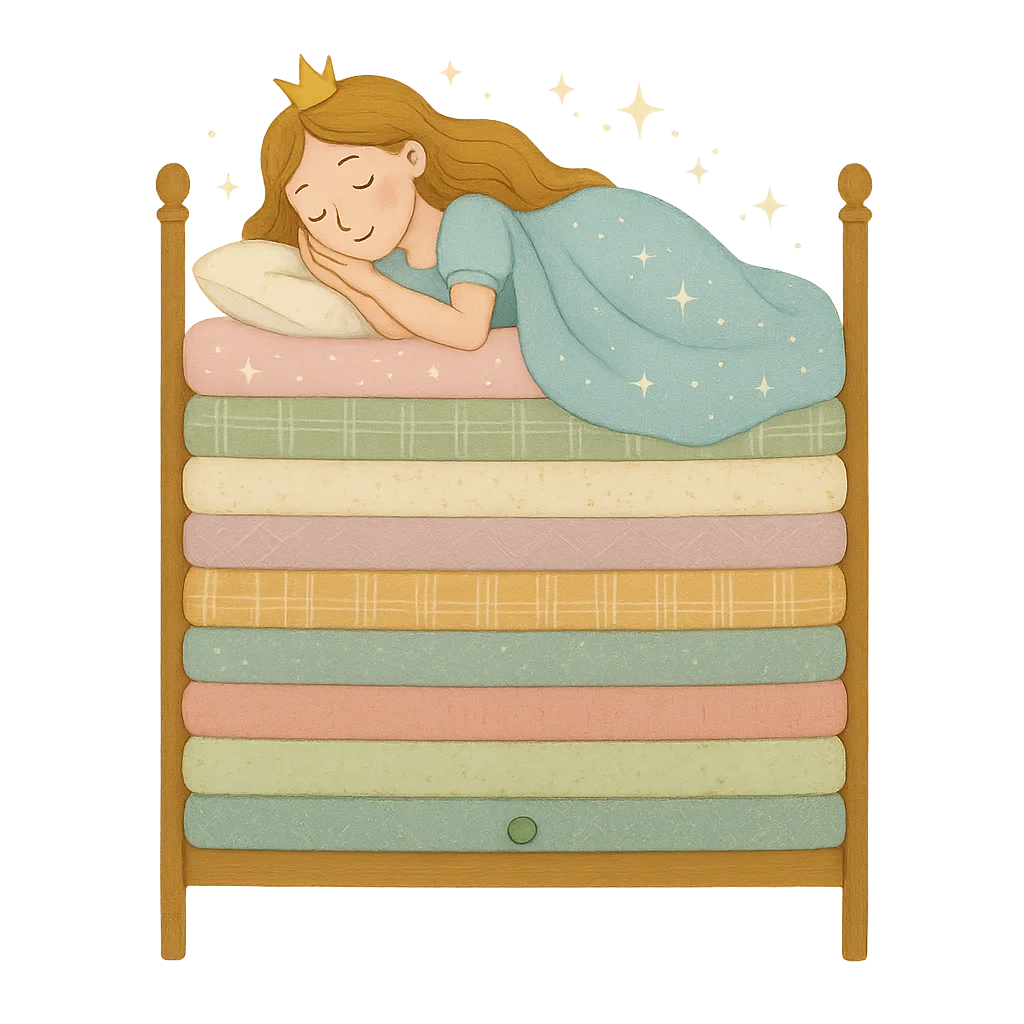
The Princess and the Pea
The wind howls around the turrets of my castle on a dreary evening, a sound I know well. My name is Queen Inger, and for months, my greatest concern has been my son, the Prince, who traveled the world to find a wife but returned disheartened, unable to find a 'real' princess. This is the story of how a stormy night and a simple vegetable solved our royal predicament, a tale you might know as The Princess and the Pea. My son insisted on marrying a true princess, someone whose nobility was not just in her title but in her very being. He met countless ladies with impeccable pedigrees and dazzling gowns, but he always returned with a sigh, sensing something was amiss. 'They are not real princesses, Mother,' he would say, his shoulders slumped. I understood his meaning; true royalty is a matter of delicate sensitivity, an innate quality that cannot be faked. It's a certain grace, a perception so fine that it sets one apart. He wasn't looking for arrogance or entitlement, but for a profound authenticity that ran deeper than silks and jewels. As the ruler of this kingdom, I knew that appearances could be deceiving, and a genuine heart was more precious than any crown. I had seen enough posturing and pretense at court to last a lifetime. I resolved to devise a test, one so subtle and clever that only a person of the most refined sensibility could pass it. Little did I know that the perfect candidate would soon arrive, drenched and shivering, at our castle gates, brought to us by the very fury of the heavens.
That night, the storm was ferocious, with thunder that shook the castle's ancient stones and rain that fell in blinding sheets. It was a tempest of epic proportions, a true tantrum from the sky. Amidst the chaos, we heard a frantic knocking at the main gate. My guards, skeptical and grumbling about the weather, opened it to find a young woman standing alone, her hair and clothes dripping, with water streaming from the tips of her shoes. She claimed to be a princess, though she looked more like a traveler who had lost a battle with a waterfall. The court whispered amongst themselves, their eyes filled with doubt. 'A princess in that state?' I heard one lady murmur. But as I looked at her, past the sodden dress and tangled hair, I saw a flicker of something genuine in her tired eyes, a quiet dignity that the storm could not wash away. I welcomed her warmly, ignoring the snickers of the courtiers, and offered her dry clothes and a warm meal, all while my plan began to form in my mind. 'She shall have a comfortable bed for the night,' I announced, and I went to the guest chamber myself to prepare it. I ordered the servants to bring mattresses, twenty of them, and twenty of the finest eiderdown quilts, each one softer than a cloud. But before they began stacking them, I went to the kitchen and retrieved a single, small, dried pea. I placed it directly on the wooden bedstead. Then, one by one, the mattresses and quilts were piled on top, creating a bed so high the princess needed a small ladder to climb into it. No one but me knew the secret hidden at its foundation. It was the ultimate test of sensitivity, a challenge so absurd that if she noticed it, her claim to royalty would be undeniable.
The next morning, I greeted the princess at breakfast, my heart pounding with anticipation. 'Did you sleep well, my dear?' I asked, trying to keep my voice steady and my expression neutral. She looked exhausted, with faint circles under her eyes, and she stifled a yawn behind her hand. 'Oh, wretchedly!' she replied with a sigh. 'I barely closed my eyes all night. Heaven only knows what was in that bed, but I was lying on something so hard that I am black and blue all over. It was simply dreadful!' A smile spread across my face, and the Prince, who had been listening from across the table, looked at her with newfound admiration and wonder. My test had worked! The court fell silent, their earlier skepticism melting away into astonishment. Only a true princess, with skin so tender and a sense of perception so refined, could have felt a single pea through twenty mattresses and twenty eiderdown quilts. The Prince was overjoyed; he had finally found his real princess. They were married soon after, and the pea was placed in the royal museum, where it can still be seen today, a testament to this remarkable event. This story, first penned by the great Danish storyteller Hans Christian Andersen on May 8th, 1835, was inspired by old folk tales he heard as a boy. It teaches us that true worth isn't always about what you can see on the outside—the fancy clothes or grand titles. Sometimes, the most important qualities, like sensitivity, kindness, and authenticity, are hidden deep within. The tale of 'The Princess and the Pea' continues to capture our imaginations in books, plays, and films, reminding us that even the smallest details can reveal the greatest truths about a person's character.
Activities
Take a Quiz
Test what you learned with a fun quiz!
Get creative with colors!
Print a coloring book page of this topic.
















 Free for Educators