

 English

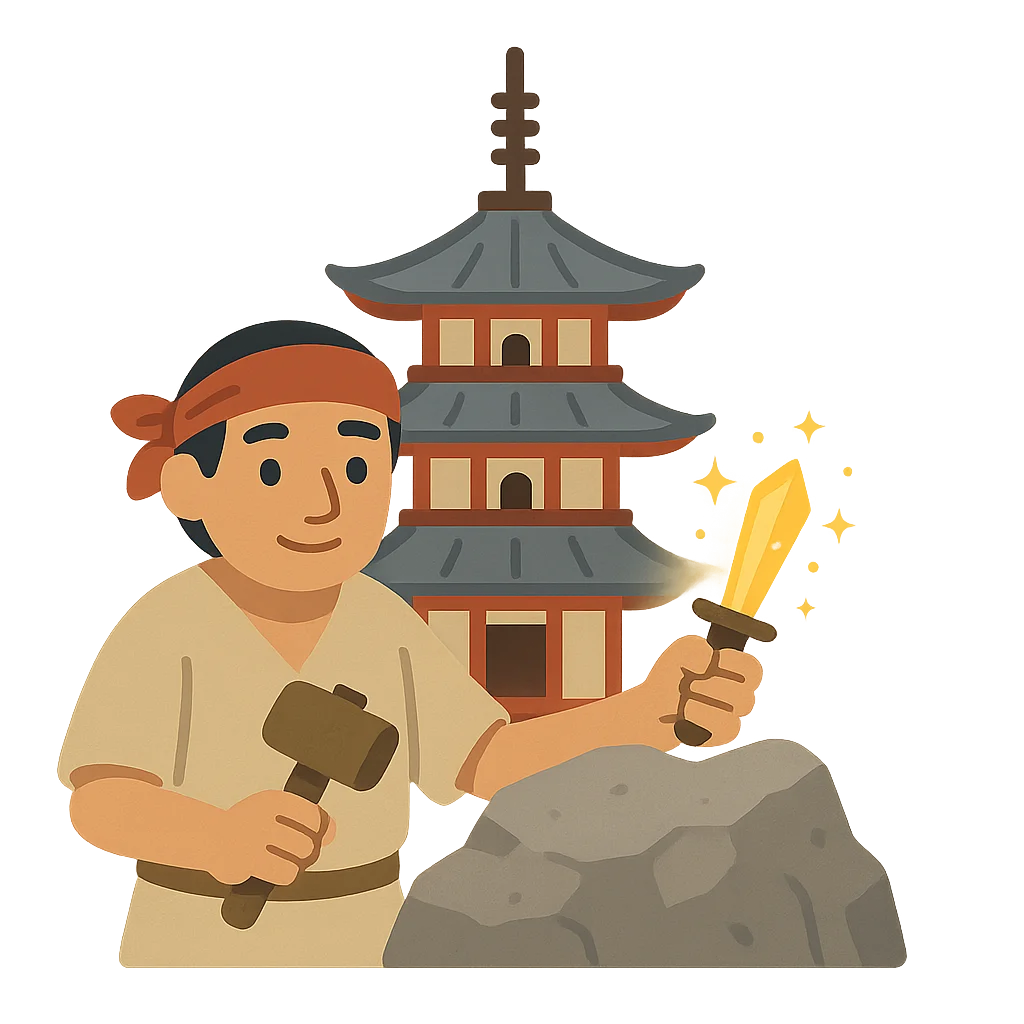
The Stonecutter's Wish
My name is Isamu, and for as long as I can remember, the mountain has been my companion. It was my workplace, my provider, and my silent friend. I woke to the sound of my hammer and chisel, a rhythmic tap-tap-CRACK that was the music of my life, chipping away at the great stone cliffs under the vast blue sky. My days were measured not by clocks, but by the slow crawl of the sun and the progress I made carving great blocks for temples and ornate lanterns for the gardens of the wealthy. I was content, or so I thought. I found a certain pride in the strength of my arms and the skill in my hands. But one sweltering afternoon, a shadow fell over my work, and I saw a sight that planted a seed of discontent deep in my heart. A procession, glittering like a river of jewels, was making its way down the mountain. At its heart, carried in a magnificent palanquin of polished lacquer and shimmering gold, sat a prince. Servants surrounded him, one holding a delicate paper parasol to shield him from the sun I endured, another fanning his face with exotic feathers. He looked so serene, so utterly untouched by the world's hardships. In that moment, my own life seemed unbearably harsh. The sun felt like a furnace on my back, the dust caked my throat, and my muscles ached with a weariness I had never truly minded before. "To be a prince," I murmured to myself, "to have such ease, such luxury... that must be true power." That night, I made a wish to the ancient spirit of the mountain, a wish born of envy and a new, unfamiliar longing. This is the story of how I learned the true meaning of power, a tale that has been passed down through generations in Japan, known simply as The Stonecutter.
No sooner had the wish left my lips than a strange, shimmering light enveloped me. The world swirled, and when it settled, the rough stone was gone. I was reclining on cushions of the finest silk, the scent of incense filling the air. My coarse work clothes were replaced by flowing robes, and servants were bowing, offering me sweet fruits and cool drinks. I was the prince. I laughed, a sound that felt foreign in my own throat. This was power. For days, I reveled in my new life. I never felt the sun's sting or the ache of labor. Yet, one afternoon, as my procession moved through the city, I noticed something. The sun, that relentless golden orb in the sky, beat down on my palanquin. It faded the brilliant colors of the silk canopy and made the metal decorations too hot to touch. My servants wilted in its heat, and I, the prince, could do nothing to command it. I felt a flicker of my old frustration. "What good is being a prince," I thought, "if I am still subject to the sun's tyranny? The sun is truly the most powerful thing in the world. I wish I were the sun.". The spirit of the mountain must have heard my discontented heart, for in an instant, I was no longer in the palanquin. I was the sun. I blazed in the heavens, a colossal ball of fire. I was magnificent, omnipotent. I could scorch the fields of arrogant farmers and dry up the rivers of ungrateful towns. I shone down on the prince—the man I used to be—and watched his servants struggle to keep him cool. A sense of immense satisfaction filled me. I was power incarnate. But my triumph was short-lived. A dark, brooding shape drifted between me and the earth. A cloud. It fearlessly blocked my rays, casting a cool shadow over the very lands I sought to dominate. My light, my heat, my power—all of it was rendered useless by this insolent patch of vapor. Rage burned within me. "This cannot be." I roared, a soundless fury that shook the cosmos. "To be blocked so easily? Then the cloud is stronger than I. I wish to be the cloud.". The transformation was immediate. I was no longer a sphere of fire but a vast, swirling mass of mist and shadow. I gathered my strength and unleashed a torrential downpour, flooding the fields I had once scorched. I thundered and flashed with lightning, delighting in the fear I caused. I blotted out the sun, my old rival, and gloated. But then I felt a force, an invisible, persistent pressure pushing me. It was the wind. It shoved me across the sky, tearing at my edges, compelling me to go where it willed. I was a puppet on its strings, powerless to resist its relentless might. "This is infuriating." I bellowed. "To be so vast yet so helpless. The wind is the true master of the sky. I wish I were the wind.". And so I became the wind. I was an unseen force of pure energy. I howled through mountain passes, flattened crops in the fields, and ripped tiles from the roofs of palaces. I was freedom and destruction combined. I bent the mightiest trees to my will and drove the clouds, my former self, before me like a flock of sheep. Nothing could stand against me. Nothing, that is, until I hurled myself against the great, silent mountain—my old home. I pushed with all my might, I screamed and raged, but the mountain did not budge. It stood impassive, ancient, and utterly immovable. My greatest efforts were nothing more than a whisper against its stony face. It was then I knew. The mountain was the ultimate power. Silent, patient, and indomitable. "Finally," I sighed, my energy spent. "I see the truth. I wish to be the mountain."
The spirit granted my final wish. I was the mountain. The transformation was not a flash of light but a slow, deep settling into the earth. I was immense, solid, and eternal. The wind, my previous form, howled against my cliffs and was broken. The clouds I had once been clung to my peaks. The sun beat down on me, but I merely absorbed its warmth. The processions of princes were like tiny ants crawling on my skin. I felt a profound sense of peace. At last, I was the most powerful thing in existence. Nothing could change me. Nothing could move me. I was absolute. But then, I felt it. A strange, persistent sensation near my base. A tiny vibration, a rhythmic tick, tick, tick. It was irritating, like a fly buzzing in a silent room. I focused my vast consciousness downward to find the source of the disturbance. There, at the foot of my great stone body, was a small, determined figure. He was dusty and dressed in coarse clothing, his muscles tense with effort. In his hands, he held a hammer and a chisel. It was a stonecutter. He was chipping away at my base, carving a piece of me away. In that moment, a realization struck me with more force than any wind I had ever been. This tiny man, with his simple tools and unwavering purpose, had the power to change me. He could reshape the very foundation of my being. The prince, the sun, the cloud, the wind—none of them could alter the mountain. But this humble stonecutter could. I understood then that true strength was not in being the biggest or the loudest or the most untouchable. Power was in the purpose you held, in the skill you wielded. The happiness I had at the beginning, the pride in my work, that was my power. A deep longing filled me, not for something greater, but for what I had once been. "I wish," I whispered into the core of my being, "to be a stonecutter again." The world dissolved, and I found myself standing on the familiar dusty ground, my own hammer and chisel in my hands. I looked at the mountain, my old friend, and then at my tools. I was just Isamu again, and I had never felt more content. This story has been told in Japan for centuries, often as a Zen parable, to remind us that happiness isn't about becoming something else, but about appreciating the value and strength we already have. It continues to inspire art and stories that explore the ideas of humility, contentment, and finding our own place in the world, showing that even the simplest life can hold the greatest power.
Activities
Take a Quiz
Test what you learned with a fun quiz!
Get creative with colors!
Print a coloring book page of this topic.
















 Free for Educators