

 English

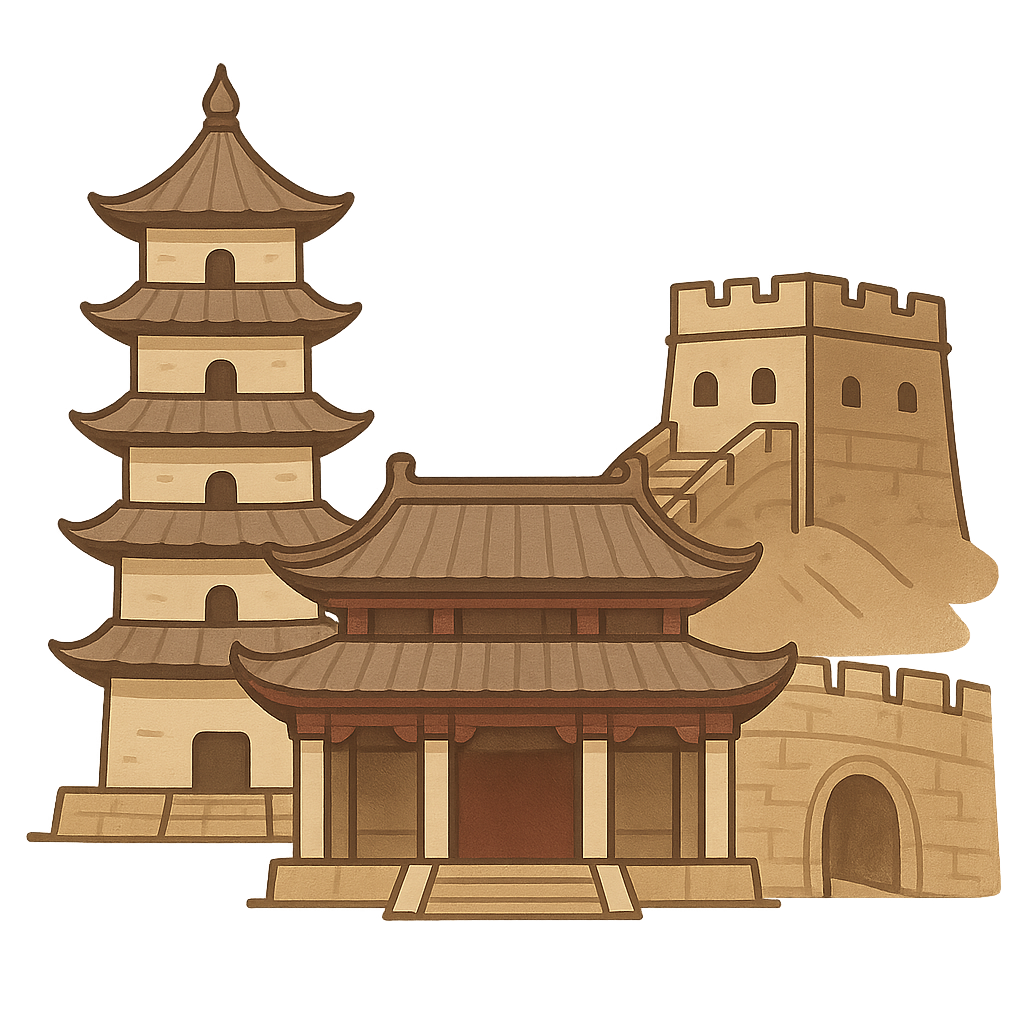
The Whispering Land of Dragons and Dynasties
I stretch across vast lands where a great river, as yellow as shimmering gold, flows like a life-giving artery. People call it the 'mother river,' for it has nourished my children for thousands of years. My mountains rise into the clouds, their misty peaks curling like the backs of sleeping dragons, guarding secrets from long ago. My story is not written in a single book, but in the stone of my great walls, the silk of my flowing robes, and the stars that have watched over me forever. I am the land of Ancient China, and my history is a long, winding river of its own, waiting for you to journey along with me.
My life is measured in dynasties, which are like long chapters, each ruled by a powerful family. Some of the first were families like the Shang, who learned to write messages on bones. For a long, long time, my lands were divided into many kingdoms. But then, a powerful ruler named Qin Shi Huang decided to bring everyone together. Around the 221st year BCE, he became my first emperor, uniting all the lands into one big family. To keep everyone safe from invaders from the north, he had a grand idea. He wanted to connect all the smaller walls that different kingdoms had built into one enormous one. This became the Great Wall. It wasn't just a pile of stones; it was a giant stone ribbon that stretched over mountains and valleys, a symbol that we were now one people, protected and strong. It was a project that showed the world what my people could achieve when they worked together.
After the time of the first emperor, the Han Dynasty began, and it was a golden age of peace and brilliant ideas. The most amazing path was opened, called the Silk Road. It wasn't a road made of silk, but a long trail where brave merchants led camels loaded with precious goods. They carried my beautiful, soft silk all the way to faraway lands and brought back spices, glass, and wonderful new ideas. This path connected me to the rest of the world. During this peaceful time, my clever people created things that would change everything. Around the 105th year CE, a smart official named Cai Lun figured out how to make paper from tree bark and old rags. Suddenly, stories and knowledge weren't just for the rich; they could be shared easily. My people also invented a magnetic compass, a little needle that always pointed south, which helped sailors bravely explore the vast, unknown seas. And with woodblock printing, we could copy whole pages of a book much faster than anyone could write by hand. These were not just my inventions; they were my gifts to the whole world.
It wasn't just inventions that grew on my soil, but also great wisdom. A kind and thoughtful teacher named Confucius lived long before the first emperor. He didn't rule with an army; he ruled with ideas. He taught people that the most important things in life were to be kind to one another, to respect your family and elders, and to never stop learning. His simple lessons about how to live a good life are still studied today. But my people's creativity was also shown in other amazing ways. After Emperor Qin Shi Huang passed away, he was not buried alone. He had a secret army built to guard him in the afterlife. On March 29th, 1974, some farmers digging a well made a stunning discovery. They found thousands of life-sized soldiers, horses, and chariots, all made of clay. Each soldier in this Terracotta Army had his own unique face, a silent, powerful reminder of my people’s incredible artistry and devotion.
My story is not finished; it has not turned to dust. It lives on in the beautiful paintings my artists create, the delicious food my chefs cook, and the bustling cities my builders design. The spirit of Cai Lun's cleverness is in every book you read. The bravery of the Silk Road travelers is in every new connection we make with friends across the world. The wisdom of Confucius reminds us to be kind and respectful. I am ancient, but my heart is still young. It beats with the rhythm of invention, art, and community, and it will always be here, sharing its story of strength and wonder with you.
Activities
Take a Quiz
Test what you learned with a fun quiz!
Get creative with colors!
Print a coloring book page of this topic.











 Free for Educators