

 English

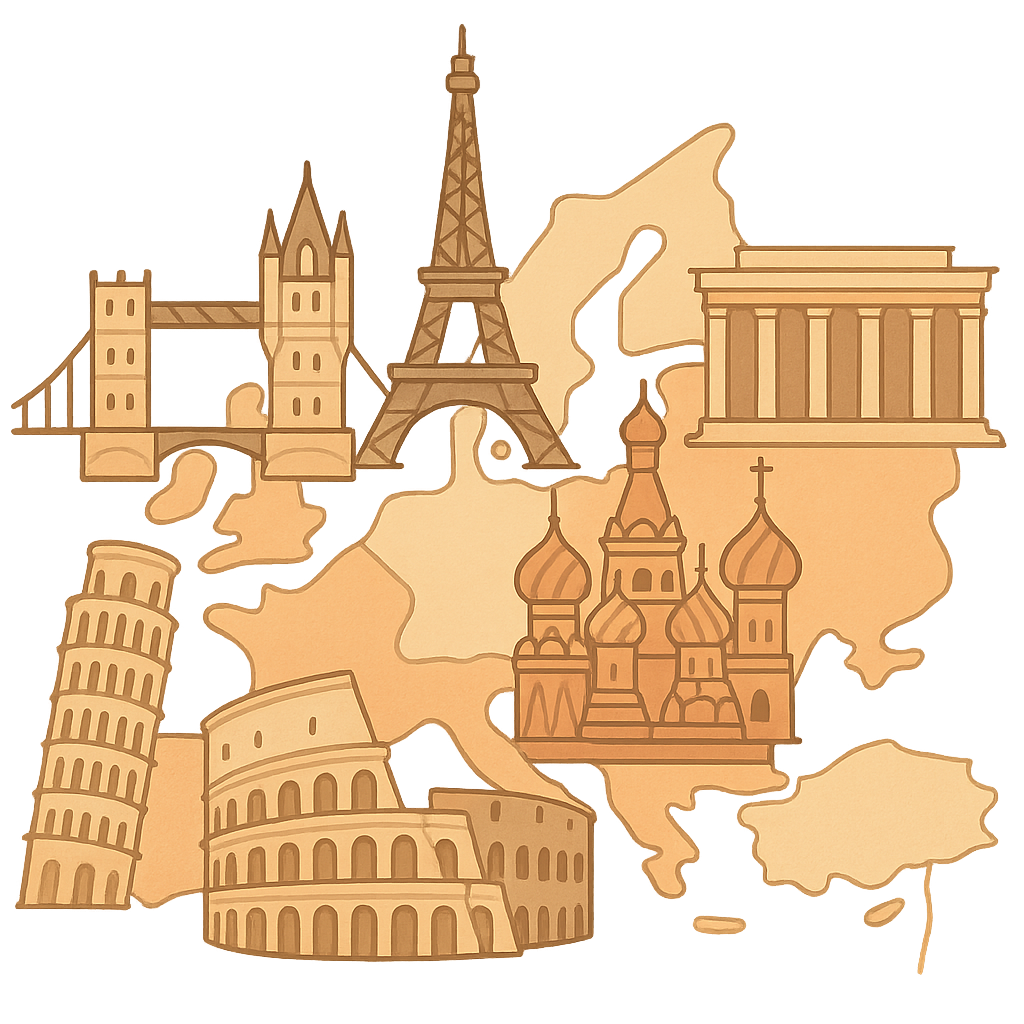
The Continent of Stories
Feel the warmth of the sun on golden sands where blue waves gently lap the shore. Now, travel north, where jagged, snow-capped mountains touch the clouds and silent forests stretch for miles. Listen closely. You can hear the steady flow of ancient rivers carving paths through green valleys, and in my cities, you can hear a symphony of a hundred different languages spoken in bustling squares. Ancient stone circles stand watch over rolling hills, while sleek, modern trains connect capitals filled with art, music, and ideas. I am a patchwork of kingdoms, republics, cultures, and landscapes, stitched together by thousands of years of history. I am a continent of stories. I am Europe.
My story begins long ago, after the great sheets of ice retreated around 10,000 BCE. My forests grew back, and people who had once hunted great beasts began to build the first settlements and farms. Millennia passed, and on my sunny southern peninsulas, a brilliant culture blossomed among the ancient Greeks. In their sun-drenched city-states, they dreamed up ideas that would change the world, like democracy, where people could choose their own leaders, and philosophy, where thinkers like Socrates and Plato asked big questions about life and justice. Then, from a single city, a mighty power grew. The Roman Empire rose, and its engineers became masters of their craft. They built incredible roads that connected my lands, and aqueducts that carried fresh water for miles. The legions of Rome spread laws and language from the foggy shores of Britain to the coast of the Black Sea, creating a vast, interconnected world until the Western Empire finally fell in the 5th century CE.
In the centuries that followed, known as the Middle Ages, my people built for protection and for faith. Mighty stone castles with thick walls and high towers rose across the countryside, homes to knights and nobles. At the same time, communities worked for generations to build soaring cathedrals that reached for the heavens, their stained-glass windows telling stories in jewel-toned light. Then, starting in my Italian cities in the 14th century, a great awakening began, a time of incredible creativity and curiosity. I call it the Renaissance, which means “rebirth.” It was a rebirth of wonder. Artists like Leonardo da Vinci painted portraits that seemed to breathe, and Michelangelo made marble statues come alive. Thinkers looked at the world in new ways. An astronomer named Copernicus looked to the stars and bravely suggested that the Earth was not the center of the universe, challenging everything people thought they knew and paving the way for scientists like Galileo.
My people’s curiosity could not be contained by land. In the 15th century, a new era of adventure began—the Age of Exploration. Daring sailors like Christopher Columbus and Vasco da Gama guided their ships across vast, unknown oceans. Their voyages connected me to the Americas, Africa, and Asia in ways never before imagined. This led to an incredible exchange of foods, animals, and ideas that changed the world forever, but it also brought great conflict and hardship to people in the lands they reached. A different kind of revolution started a few centuries later, not with ships, but with steam and steel. Beginning in the 18th century, the hum and clatter of the Industrial Revolution could be heard. Inventions like the steam engine powered factories and trains, transforming my landscape. People moved from farms to rapidly growing cities to work, and life changed at a speed that was both exciting and challenging.
My long history has not been without deep sorrow. The 20th century brought two terrible World Wars that scarred my lands and my people. These conflicts taught my nations a painful but vital lesson about the devastating cost of division and the importance of peace. From these ashes came a powerful and unique idea: what if my nations chose partnership over conflict? This led to the creation of the European Union, a project where countries that were once enemies decided to work together for a shared future of prosperity and cooperation. Today, I am a vibrant tapestry of cultures, foods, and traditions. People travel freely across my lands, sharing ideas and learning from one another. My story, with all its triumphs and struggles, teaches that while the past shapes us, the future is something we can build together, through understanding, respect, and the enduring hope for peace.
Activities
Take a Quiz
Test what you learned with a fun quiz!
Get creative with colors!
Print a coloring book page of this topic.










 Free for Educators