The Abode of Snow

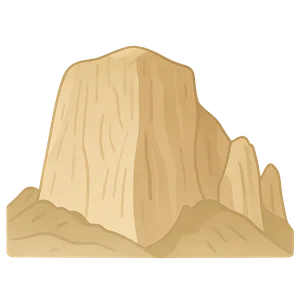
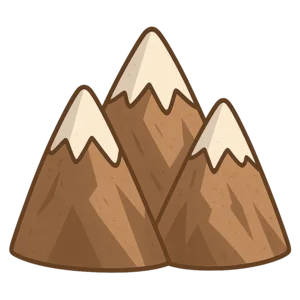
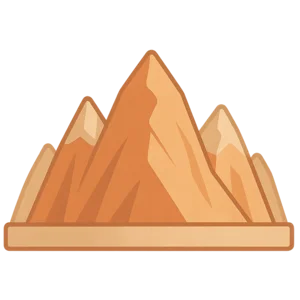
I feel the wind whip around my peaks, a timeless song that only the eagles and the highest clouds can hear. Below me, the world is a soft blanket of white mist, and the air is so sharp and thin it feels like breathing pure ice. For millennia, I have been a wrinkle on the Earth's skin, a stony spine holding up the sky, a silent witness to the grand theater of the world. I have watched civilizations flicker into existence in my shadow, their bustling cities like tiny, glowing embers against the vast darkness of time. I’ve seen them build great monuments and write epic poems, their fleeting moments like sparks carried on the wind. I have felt glaciers, my slow-moving rivers of ice, carve their powerful way down my slopes, shaping my valleys with unstoppable force. Humans look up at my shimmering crowns, their hearts filled with a mixture of fear and wonder. Their dreams and ambitions seem to reflect in my icy faces. They have given me many names, calling me Chomolungma or Sagarmatha, but I know myself by the one that captures my essence best. I am the Himalayas, the “Abode of Snow.” My story is not one of years, but of eons, written in rock, ice, and the spirit of all who have sought my heights.

My birth was a magnificent and slow collision, a drama that unfolded over millions of years, long before the first humans walked the Earth. Imagine the planet's surface not as a solid ball, but as a collection of giant, floating puzzle pieces called tectonic plates. These plates are always moving, drifting on the molten rock deep within the Earth like colossal rafts on a fiery sea. For an unimaginably long time, one of these pieces, the Indian plate, was on a solo journey. It broke away from a supercontinent and began inching its way northward across a vast ocean, traveling faster than any other plate at the time. Its destination was the colossal Eurasian plate, which was waiting like a sleeping giant. Around 50 million years ago, their epic journey ended in a spectacular, slow-motion crash. The impact was so immense that the ocean floor between them was squeezed and lifted high into the air. The Indian plate, being dense and determined, refused to be pushed under. Instead, it pushed forward with unstoppable force, ramming into the Eurasian plate. Think of what happens when you push a thick rug against a wall; it doesn't stay flat but bunches up, creating high folds and wrinkles. That is exactly what happened to the land. The ground buckled, folded, and was thrust upward, kilometer by kilometer, creating the towering peaks and deep valleys that define me today. This grand arrival was not a single event but a continuous process. Even now, deep beneath the surface, the Indian plate continues its relentless push, and because of this constant pressure, I grow a few millimeters taller every single year, still reaching for the heavens.
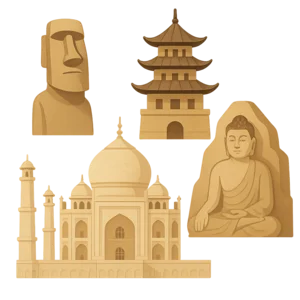
Long after my stone peaks settled into the sky, the first humans arrived at my feet. They were not conquerors seeking to tame my wildness, but humble wanderers who saw something more than just rock and ice. They looked up at my shimmering summits, which seemed to touch the stars, and felt a profound sense of awe. In their eyes, I was not a barrier to cross, but a sacred space, a bridge between the Earth and the heavens. For followers of Hinduism, my highest peaks became the divine home of the gods, a place of immense spiritual power where the great deity Shiva was said to meditate in solitude. My frozen lakes were considered holy, and the rivers born from my glaciers were seen as goddesses bringing life to the plains below. For Buddhists, my quiet valleys and remote caves offered the perfect solitude for deep contemplation and the search for enlightenment. Monasteries, like the famous Tiger’s Nest in Bhutan, cling to my cliffsides like eagle nests, filled with the peaceful sound of chanting and the scent of incense. And through all these ages, one group of people became my closest companions: the Sherpa. They are not just inhabitants of my slopes; they are my steadfast friends. They understand my changing moods, from the calm of a sunny morning to the sudden fury of a blizzard. Their knowledge of my paths is woven into their culture, passed down through generations. They move through my challenging terrain with a grace and strength born from a deep, abiding respect for my power, a connection that goes beyond mere survival.

As the world grew smaller with new inventions like airplanes and radios, human ambition turned toward my highest point. A new kind of dream took hold: to stand on the very roof of the world. My tallest peak, known to the world as Mount Everest but to Tibetans as Chomolungma, “Goddess Mother of the World,” became the ultimate prize in a global race to the sky. Many expeditions from different countries tried, and many were forced to turn back, for I do not give up my secrets easily. The thin air, brutal cold, and treacherous ice are formidable guardians that test the limits of human endurance. But in 1953, a British-led expedition brought together two men, bound by a shared goal and incredible courage, who would change history. One was Tenzing Norgay, a Sherpa whose experience and wisdom were as vast as my landscapes. He had attempted to reach the summit many times before. The other was Edmund Hillary, a determined beekeeper from New Zealand with a spirit as rugged as my cliffs. They were not rivals, but partners. They relied on each other's strength, skill, and judgment with every step, cutting footholds in the ice and securing ropes. On the morning of May 29th, 1953, after weeks of grueling effort and establishing camps up my slopes, they made their final push. They stood together on my summit, looking out at the curve of the Earth. For the first time, human eyes looked out from the highest point on the planet, a victory not of conquest, but of extraordinary perseverance, partnership, and respect.

My story continues to unfold. I am more than just a challenge for climbers; I am a lifeline for billions. My glaciers and snowfields act as a massive frozen reservoir, feeding great rivers like the Indus, the Ganges, and the Brahmaputra, which provide fresh water to countless communities across Asia. My remote forests and high-altitude meadows are a sanctuary for rare and beautiful creatures, including the elusive snow leopard. Today, scientists come to study my ice, seeking to understand the Earth's changing climate and what the future holds for us all. I remain a symbol of what is possible when humanity faces an immense challenge with courage, respect, and cooperation. I teach that the greatest heights are reached not by overpowering nature, but by working with it, and that the view from the top is always best when it is shared.

Reading Comprehension Questions

Click to see answer

Answer: The Himalayas were formed by the collision of two tectonic plates, which are like giant puzzle pieces on the Earth's surface. About 50 million years ago, the Indian plate, which had been traveling north, crashed into the Eurasian plate. Because the Indian plate couldn't go under, it pushed the land upward, creating the mountains. The story uses the analogy of pushing a thick rug against a wall and watching it wrinkle and fold up to describe how the mountains were formed.

Answer: In this context, 'formidable' means something that inspires fear or respect because it is impressively powerful, intense, or difficult. It's a good word choice because it shows that the challenges of climbing Everest aren't just hard; they are incredibly daunting and demand great respect and strength to overcome, which is why so many early attempts failed.

Answer: The main lesson is that great challenges are often overcome not by individual strength alone, but through teamwork, partnership, and perseverance. They succeeded because they worked together, trusted each other, and refused to give up, showing that cooperation is essential to achieving incredible goals.

Answer: They are a physical 'barrier' because their immense size and difficult terrain make them hard to cross, as seen in the challenges faced by climbers. At the same time, they are a 'sacred space' because people have long viewed them as a spiritual place. The story mentions that Hindus see them as the home of the gods and Buddhists use them as a place for meditation, showing that their awe-inspiring nature inspires deep spiritual feelings.

Answer: Having the Himalayas tell their own story makes the place feel alive and personal, like a wise, ancient character. It allows the reader to connect with the mountains on an emotional level, understanding their long history, their feelings about the people who visit, and their role in the world. It turns a geology and history lesson into an engaging and personal journey.