

 English

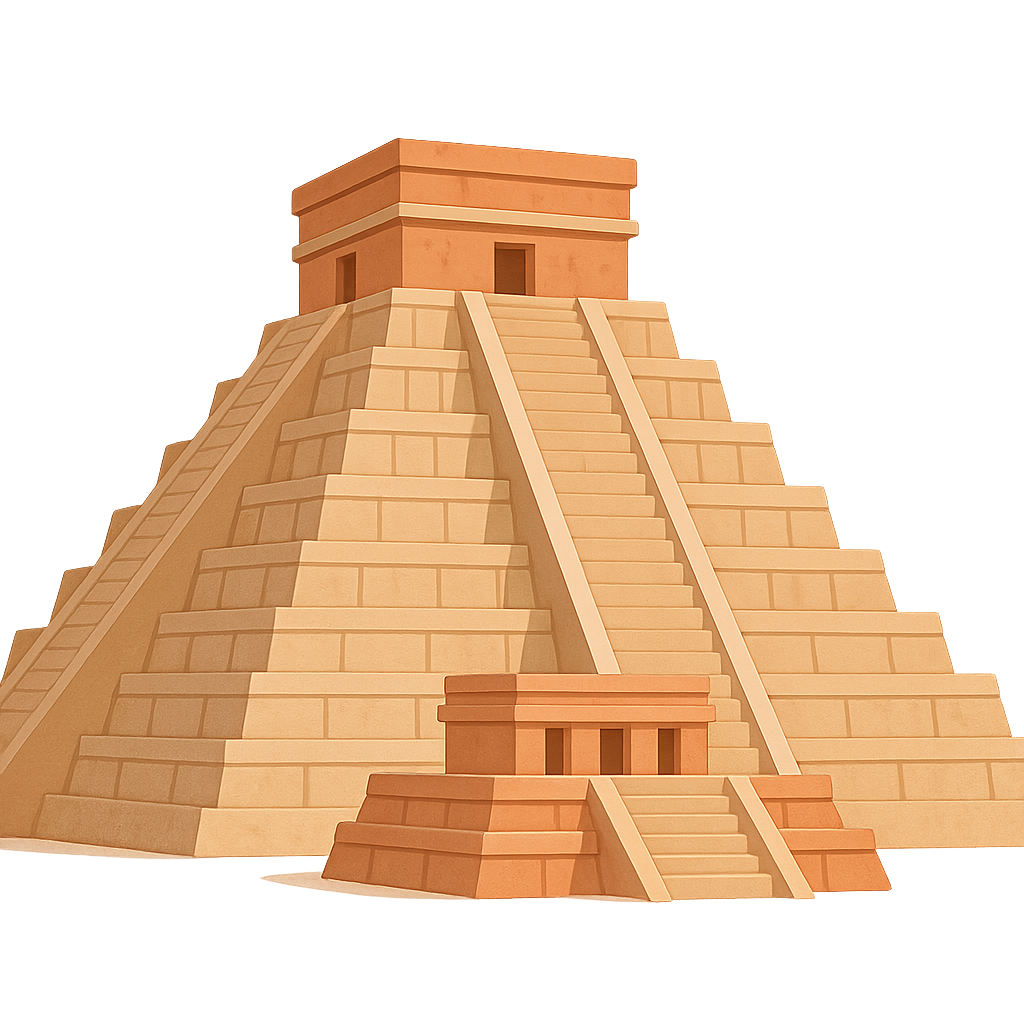
The Maya Civilization: A Whisper from the Jungle
Listen closely. Can you hear the sharp cry of a macaw or the deep call of a howler monkey echoing through the trees? Feel the warm, damp air on your skin, thick with the scent of earth and flowers. If you look up, you will see a tangled green canopy so dense that sunlight has to fight its way through in golden spears. But here and there, something else rises above the leaves. It is the top of a great stone pyramid, its limestone blocks weathered by centuries of rain and sun. For a very long time, my world was a secret, a kingdom of stone and jungle hidden from the outside world. My story is carved into monuments and whispered by the wind that rustles through my silent plazas. I am a testament to human genius, a civilization that mapped the stars and built cities to touch the sky. I am the Maya Civilization.
For centuries, my heart beat strongest in great city-states, bustling centers of art, science, and ceremony that rose from the lowlands of Mesoamerica. During my Classic Period, from about the 250th year CE to the 900th year CE, my people achieved wonders. In cities like Tikal, with its towering Temple of the Great Jaguar, and Palenque, with its elegant palace and detailed carvings, my architects built magnificent pyramids not just as tombs, but as sacred mountains to bring them closer to the gods. My astronomers were brilliant observers of the sky. From specially built observatories, they tracked the movements of the sun, moon, and planets with incredible accuracy. They developed one of the most precise calendars the world has ever known, understanding time in great cycles that guided everything from planting crops to performing religious ceremonies. To do this, they needed advanced mathematics, and my people were among the very first in the world to understand the concept of zero. This powerful idea allowed them to make complex calculations and record enormous numbers. They also created a sophisticated system of writing using pictures and symbols called hieroglyphs, carving their history, beliefs, and royal lineages onto stone pillars called stelae. These stone libraries tell the stories of powerful rulers, great battles, and the cosmic beliefs that shaped every part of daily life, from the sacred ball game played in my courts to the vibrant markets filled with jade, obsidian, and colorful textiles.
But time, like a great river, always changes its course. Around the 900th year CE, a profound shift began in my southern lowlands. The powerful cities that had flourished for centuries grew quiet. Their grand plazas became empty, and the jungle slowly began to reclaim the stone temples. For many years, people called this a mysterious collapse, imagining that my people simply vanished. But the truth is more complex and shows their incredible ability to adapt. This was not a sudden event but a gradual transformation. My people faced enormous challenges, possibly a series of long droughts that made it difficult to grow enough food for the large populations in the cities. The land may have become exhausted from centuries of farming. Faced with these difficulties, they made a choice. They began migrating away from the old city centers, moving northward to the Yucatán Peninsula. They did not disappear; they moved and rebuilt. New, magnificent cities like Chichén Itzá and Uxmal rose to prominence, blending old traditions with new ideas. My culture did not end; it evolved. My people proved that survival is not just about holding on, but about knowing when and how to change.
For hundreds of years after this shift, the jungle kept my southern cities a well-guarded secret. Then, in the 19th century, explorers and archaeologists began to venture into the dense rainforests. They were astonished by what they found: entire cities of breathtaking beauty, covered in vines and roots. The world was captivated, and a new era of understanding my past began. Yet, my story is not just one of ancient stones and forgotten ruins. My heart beats on, stronger than ever, in the millions of Maya people who live today in Mexico, Guatemala, Belize, and Honduras. They speak the languages of their ancestors, weave textiles with patterns passed down through generations, and practice traditions that connect them to the same earth and sky my ancient astronomers once studied. I am a living legacy, a reminder that great ideas and a resilient spirit can endure through the ages. I am proof that a culture’s true strength lies not in its buildings, but in its people and their connection to the past, the earth, and the stars.
Activities
Take a Quiz
Test what you learned with a fun quiz!
Get creative with colors!
Print a coloring book page of this topic.













 Free for Educators