Intro
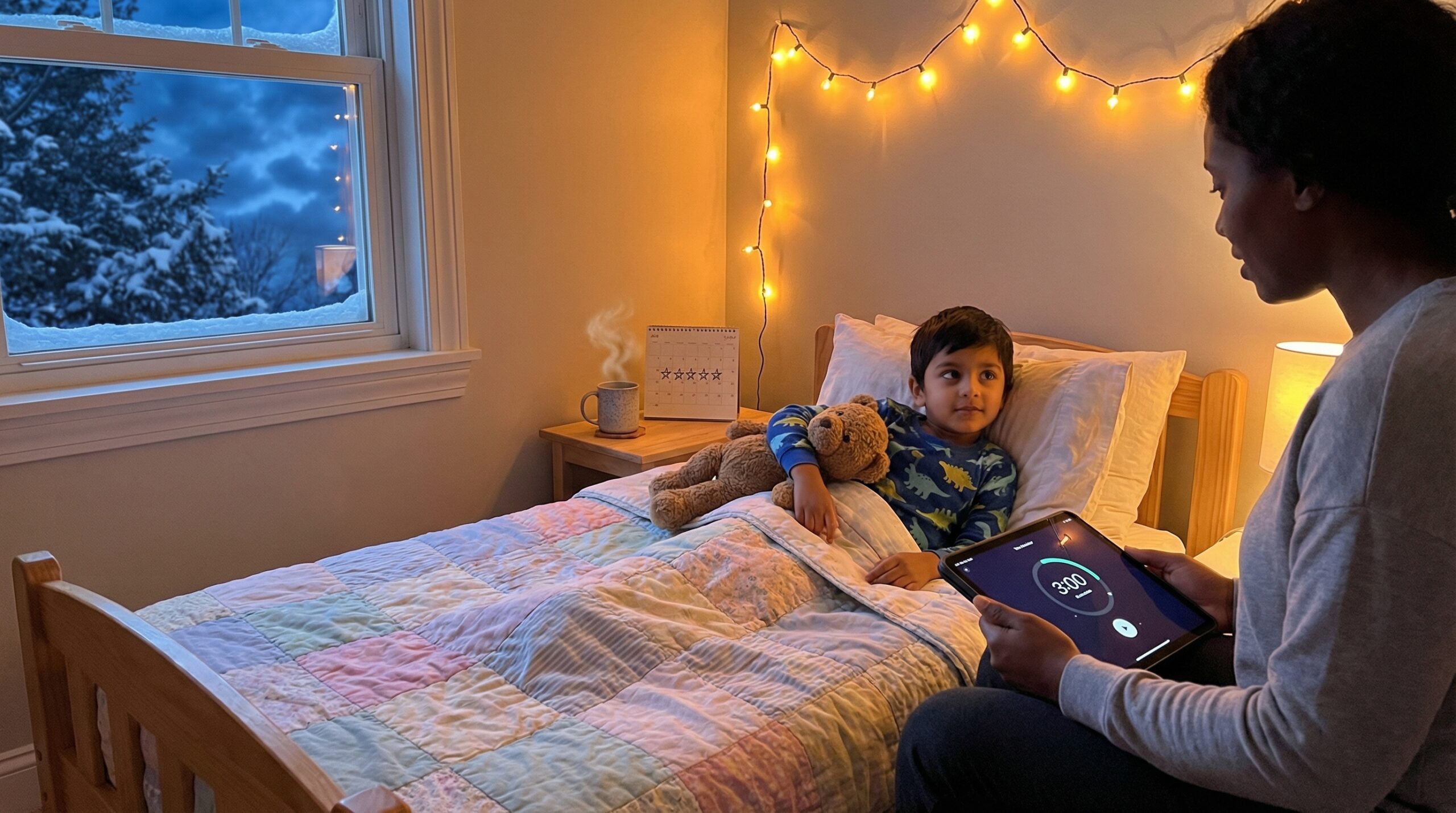
A bedtime mini story ritual is a short, predictable tale played each night to cue calm. I press play, whisper goodnight, and give one tiny choice. It lasts three to five minutes. The routine becomes a cozy sleep signal. Research shows that consistent bedtime routines, including storytelling started as early as 3 months, are associated with fewer night-time awakenings and longer sleep durations by age 3, highlighting the long-term benefits of bedtime storytelling in improving children’s sleep quality according to a 2025 study.
Why the bedtime mini story ritual works
Children respond to predictability. Also, short routines reduce pushback and speed sleep time. The same story at the same point in the routine becomes a cue. Over time, the tale signals the brain that bedtime is next. In fact, a nationally representative US analysis of 112,925 children published by the Centers for Disease Control and Prevention found that 34.7% of children aged 3–17 had short sleep duration; among children with an inconsistent bedtime, 57.3% experienced short sleep duration. This underscores the importance of consistent bedtime routines, such as storytelling, to prevent short sleep duration in children.
How to do it
Keep the steps simple and repeatable. Then you can make this a tiny nightly ritual that sticks.
- Pick one 3 to 5 minute story. Repeat the same tale for three nights. Tiny magic: repetition turns the story into a sleep cue.
- Place it late in the routine. After teeth and pajamas. Also keep lights low and screens dim if you must use them. The American Academy of Pediatrics recommends avoiding screen use for 1 hour before bedtime as part of strategies to improve children’s sleep, emphasizing the importance of bedtime routines.
- Keep it simple. For toddlers, use very predictable wording. For preschoolers, use a short arc. For early school age, offer a single small choice.
Quick tips
Use audio when possible. Audio keeps screens out of the room. Next, whisper one question or choice to deepen connection.
Age scripts you can use tonight
Here are short scripts you can try right away. They are bite sized and repeatable.
- 0 to 12 months (audio lullaby): “Soft boat rocks. Warm blanket. Your breath slows. Sleep comes.”
- 1 to 3 years (toddler script): “Once there was a sleepy bear who found a blanket. He yawned. He hugged. Sleep came.”
- 4 to 7 years (short narrative): “I tried to fly a kite. It got stuck in a tree. I counted to three. Then the kite came free and I sighed. Night came and the stars listened.”
Three-night experiment
Try one tale for three nights. Then measure time to sleep each night. Also note protests on a zero to five scale. Many families see change by night three. That is conditioning at work.
Safety and privacy
Prefer audio-only or a dimmed display. Also keep content age-appropriate. If you use an app like Storypie, check parental controls and privacy settings. I like consistent voices, but I avoid bright screens right before bed.
What you gain beyond sleep
Short rituals boost vocabulary, attention, and emotional regulation. Repetition helps memory. A 2024 longitudinal analysis of preschoolers found that substituting 50% of weekly screen-based media time with book reading (about 20 minutes/day) was associated with improved overall sleep quality. They also connect your family to a long human tradition of lullabies and bedside tales. It is tiny bedtime bliss.
Quick share for social
Storypie here — winter evenings are perfect for a 3 to 5 minute mini story ritual. Tip: play the same tale three nights in a row to cue calm. In a recent survey, 71% of parents agreed that storytelling helps their children wind down at bedtime, with 49% naming it their preferred method according to a 2025 survey. Start tonight with the Storypie app.
Final note
I try this when evenings get rushed. I press play, whisper one question, and the room quiets. You may call it a tiny ritual. I call it a five-minute win for the whole family.