
 English
 For Schools
 For Homeschool

A Bald Eagle's Tale of Survival and Hope
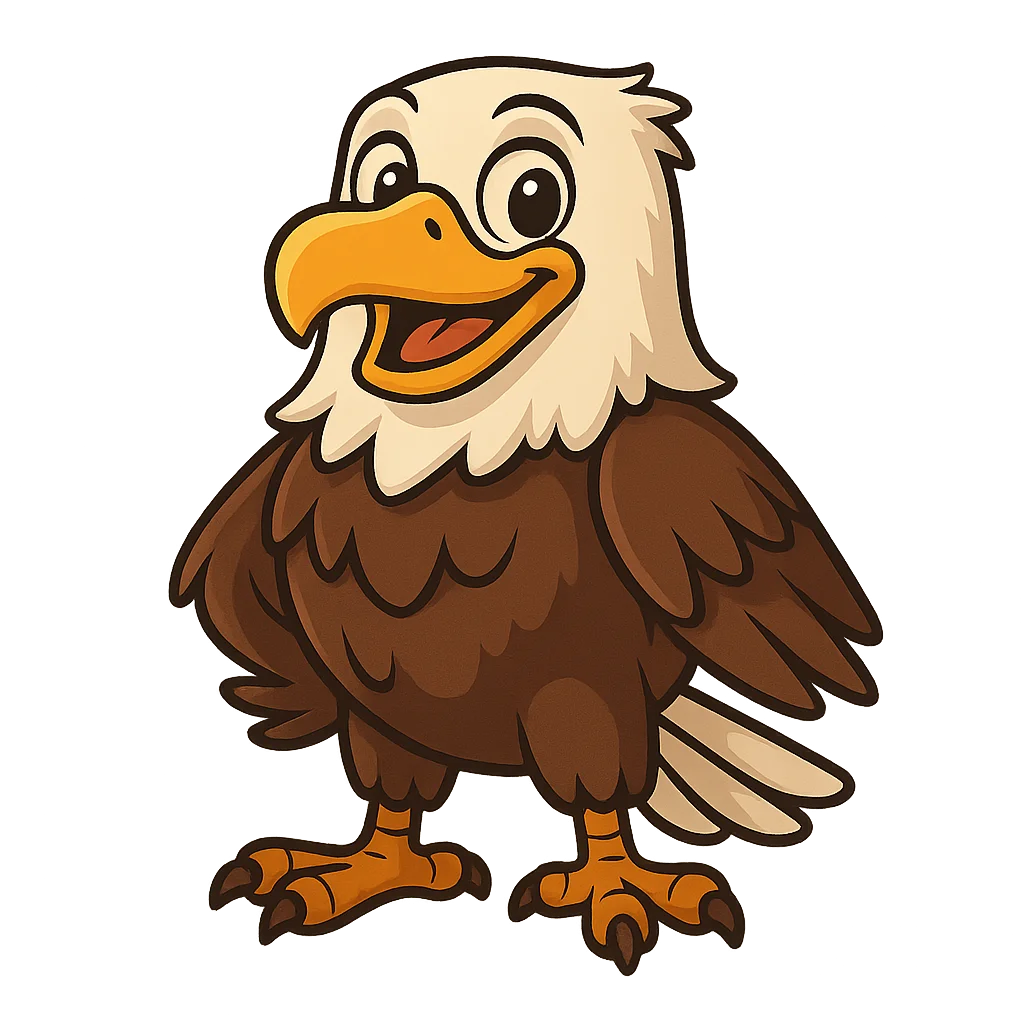
Hello, I am a Bald Eagle, and my story unfolds in the vast skies above the rivers and lakes of North America. From my vantage point high in the air, I see the world with incredible clarity. My brilliant white head, which gives me my name, isn't truly bald; the name comes from an old English word, 'balde,' meaning white. My golden eyes are so sharp that I can spot a fish swimming below the water’s surface from a mile away, a skill essential for my survival. My wings are my strength, stretching to a magnificent seven-foot wingspan that allows me to ride the thermal currents effortlessly for hours. It was this image of power and freedom that led a young country to choose me as its symbol. The Bald Eagle was adopted as the emblem on the Great Seal of the United States on June 20, 1782, but it was officially designated as the national bird on December 24, 2024. My home is never far from the water that provides my food. High in the oldest, tallest trees, my mate and I build our nest, a massive structure called an eyrie, which we return to and expand year after year.
My life began in one such eyrie, a fortress of sticks and branches woven together high above the ground. I hatched from a dull white or off-white egg, occasionally with a tan tinge or light brown blotches, a tiny, downy eaglet protected by the deep walls of my nest. My parents were diligent builders, adding new material to our home each season until it grew to an incredible size, sometimes weighing as much as a small car. For weeks, I stayed within the safety of the eyrie, growing stronger as my parents brought fish for me to eat. Then came the most important test of my young life: learning to fly. This process, called fledging, involved weeks of strengthening my wings, hopping from branch to branch, until I finally gathered the courage to take my first leap into the open air. The feeling of the wind catching my wings for the first time was a thrill I will never forget. As I mastered flight, I also honed my skills as a hunter, learning to dive at incredible speeds to snatch fish from the water with my powerful, sharp talons. In my ecosystem, I am a top predator but also engage in scavenging and food theft, helping to maintain a healthy balance among the other animal populations.
For generations, my kind thrived. But in the mid-1900s, a shadow fell over our world. Our numbers began to decline at an alarming rate. While the loss of our forest homes to human development was a problem, there was a new, invisible danger that threatened our very existence. This threat came from a chemical pesticide called DDT, which humans used on farms to protect their crops. When it rained, the DDT washed from the fields into the rivers, where it was absorbed by small aquatic life. These were eaten by the fish, and when I ate the fish, the poison built up inside my body. The DDT didn't make me sick in a way I could feel, but it had a devastating effect. It interfered with my ability to produce strong eggshells. When my mate and I tried to start a family, the shells of our eggs were thin and brittle. They were so fragile that they would often break under the gentle weight of a parent trying to keep them warm. Our nests became silent, and our families were vanishing before they ever had a chance to begin.
Just when it seemed our future was lost, people began to notice our absence from the skies. They saw our empty nests and realized something was terribly wrong. Scientists discovered the connection between DDT and our fragile eggs, and a movement began to save us. It was a story of hope, driven by human action. The turning point came in the year 1972, when the United States government officially banned the use of DDT. This was a monumental step, but more help was needed. A year later, in 1973, the Endangered Species Act was passed, creating a powerful law designed to protect animals like me from extinction. By 1978, the Bald Eagle was officially listed as endangered in most of the country. This new status gave us and our habitats critical legal protection from harm. With the poison slowly disappearing from the rivers and new laws safeguarding our nesting sites, a miracle began to happen. Our eggs grew strong again, and the sound of chirping eaglets returned to the eyries. Slowly but surely, our numbers began to climb.
My story is one of resilience, and it ends not with silence, but with a soaring victory. After decades of protection and careful conservation efforts by dedicated people, our population had recovered. On June 28th, 2007, my species was officially removed from the endangered species list. This was a proud day not just for us eagles, but for the humans who worked so hard to bring us back from the brink. Today, I soar freely across the skies of North America, a common sight once again. My journey serves as a powerful reminder of how fragile nature can be, but it is also a testament to how human care and determination can heal the world. My continued presence in the wild is a living symbol of hope and the incredible success of conservation.
Activities
Take a Quiz
Test what you learned with a fun quiz!
Get creative with colors!
Print a coloring book page of this topic.