

 English
 For Schools
 For Homeschool

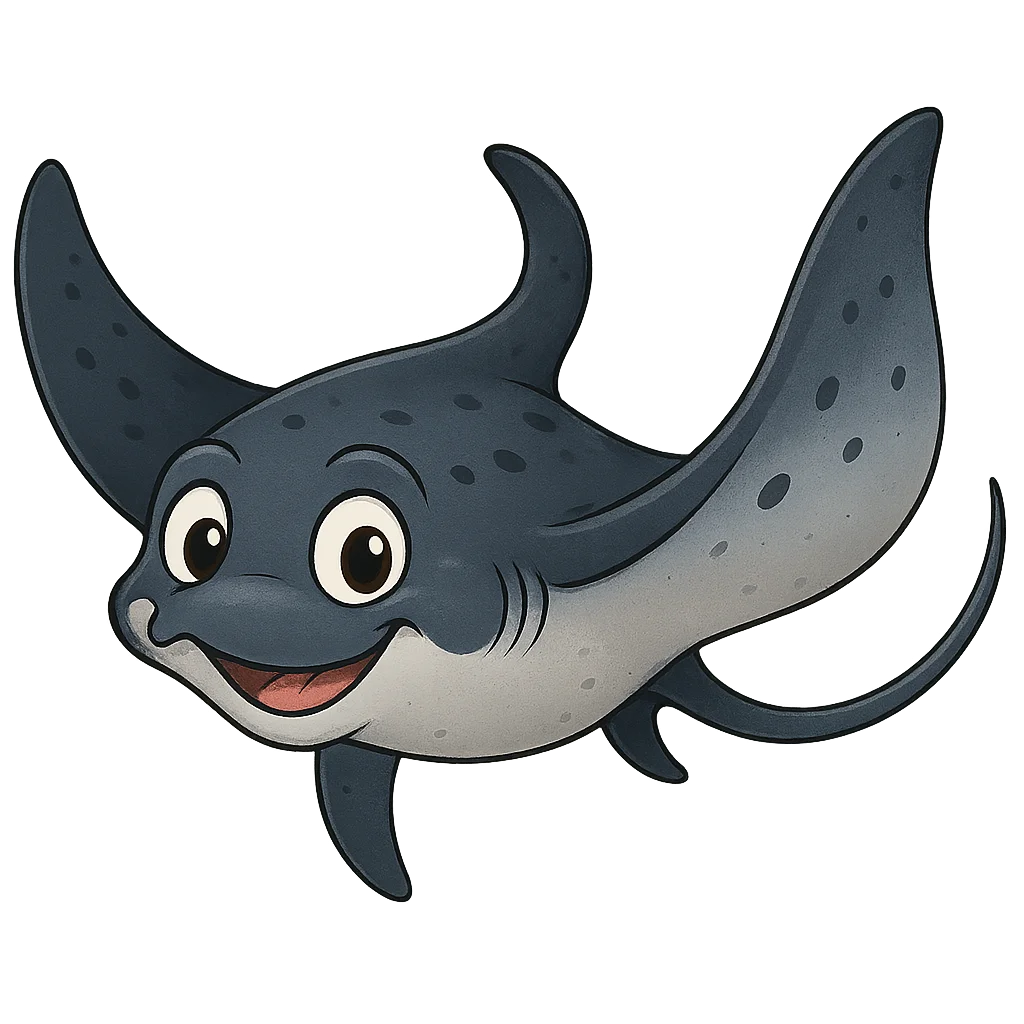
An Ocean Voyager's Tale
Hello from the big blue! My name is Mobula, and I am a Giant Manta Ray, one of the gentle giants of the sea. Imagine a creature so wide that its wingspan could stretch over your family car—that’s me! My wings, which can measure over 20 feet from tip to tip, don’t just help me swim; they allow me to 'fly' through the ocean with a grace that surprises many. As I glide through the currents, I feel more like a bird soaring in the sky than a fish swimming in the water. If you were to look closely at my underside, you would see a unique pattern of spots on my belly. Just like a human's fingerprint, no two manta rays have the same pattern. It’s my personal signature. At the front of my head, I have two special fins called cephalic lobes. When it’s time to eat, I unfurl them to help guide clouds of delicious, tiny plankton right into my wide mouth. They are like two flexible hands that make feeding a breeze as I journey through the nutrient-rich waters of my home.
My story and my name have traveled through time. For many years, scientists and explorers who saw me gliding through the ocean tried to understand who I was. It was back in 1792 that Johann Julius Walbaum first described the species as Raja birostris. The genus name Manta was introduced later, and the species is now classified as Mobula birostris. For over two centuries, that was the name humans knew me by. It was a good name, but science is always learning and making new discoveries. Recently, in 2017, scientists took a much closer look at my DNA and my physical features. They studied my relatives and realized that I was part of a larger family of rays than they had previously thought. This exciting discovery led to a change in my official classification. So, while you might still hear people call me a Manta Ray, my formal scientific name is now Mobula birostris, connecting me to my cousins, the Mobula rays. It’s a reminder that there is always more to learn about the ocean's mysteries.
My life is one of constant travel. I am an ocean voyager, undertaking long migrations that can cover thousands of kilometers across the vast, open sea. My days are spent soaring on ocean currents, exploring different parts of my world. My diet consists almost entirely of tiny organisms called zooplankton. To eat, I simply open my mouth and glide through dense patches of these creatures, filtering them from the water. While I love the freedom of the open ocean, I also rely on the communities of the coral reef. There, I visit special 'cleaning stations,' which are like a spa day for me. It’s a fascinating partnership. I approach the reef and hover patiently, and small fish called cleaner wrasse swim all around me. They bravely nibble away any parasites or dead skin from my body. It feels wonderful, and it keeps me healthy for my long journeys. Many humans are surprised to learn that for my size, my brain is the largest of any fish. This makes me very curious and able to learn and remember things, like the locations of my favorite feeding spots and cleaning stations.
Even though I am a large and powerful creature, my life in the modern ocean has become filled with challenges. The greatest dangers I face come from human activities. Sometimes, as I travel, I encounter massive fishing nets. While they aren't meant for me, I can get tangled in them, a serious problem that scientists call 'bycatch.' My ocean home is also being filled with plastic pollution, which can harm me and the tiny plankton I rely on for food. Because of these growing threats, my species has been listed as Endangered by conservation groups, which means we are at risk of disappearing forever. But there is also hope. I remember a significant moment on March 14, 2013, during the 16th Conference of the Parties (CoP16) in Bangkok, when governments agreed to list five shark species and two manta ray species under CITES Appendix II. This important step was a promise to help ensure our survival, giving me and my fellow rays a better chance to navigate our ocean world safely.
My journey through the seas is more than just a personal adventure; it’s a vital part of the ocean's rhythm. Giant manta rays inhabit both deep oceanic waters and coastal areas near coral reefs, exhibiting vertical movements between these habitats. I carry nutrients from the depths to the coast, helping to fertilize the entire ecosystem and keep it healthy and balanced. With a lifespan that can reach up to 50 years, I am a long-term witness to the changes happening in our ocean. My presence is a sign of a thriving marine environment. My story serves as a reminder that the ocean is a vast, interconnected home for countless creatures. When people work to protect the seas from pollution and overfishing, they are not just protecting a place—they are protecting me and all my fellow ocean travelers, ensuring we can continue to glide through the great blue expanse for generations to come.
Activities
Take a Quiz
Test what you learned with a fun quiz!
Get creative with colors!
Print a coloring book page of this topic.