English
 For Schools
 For Homeschool

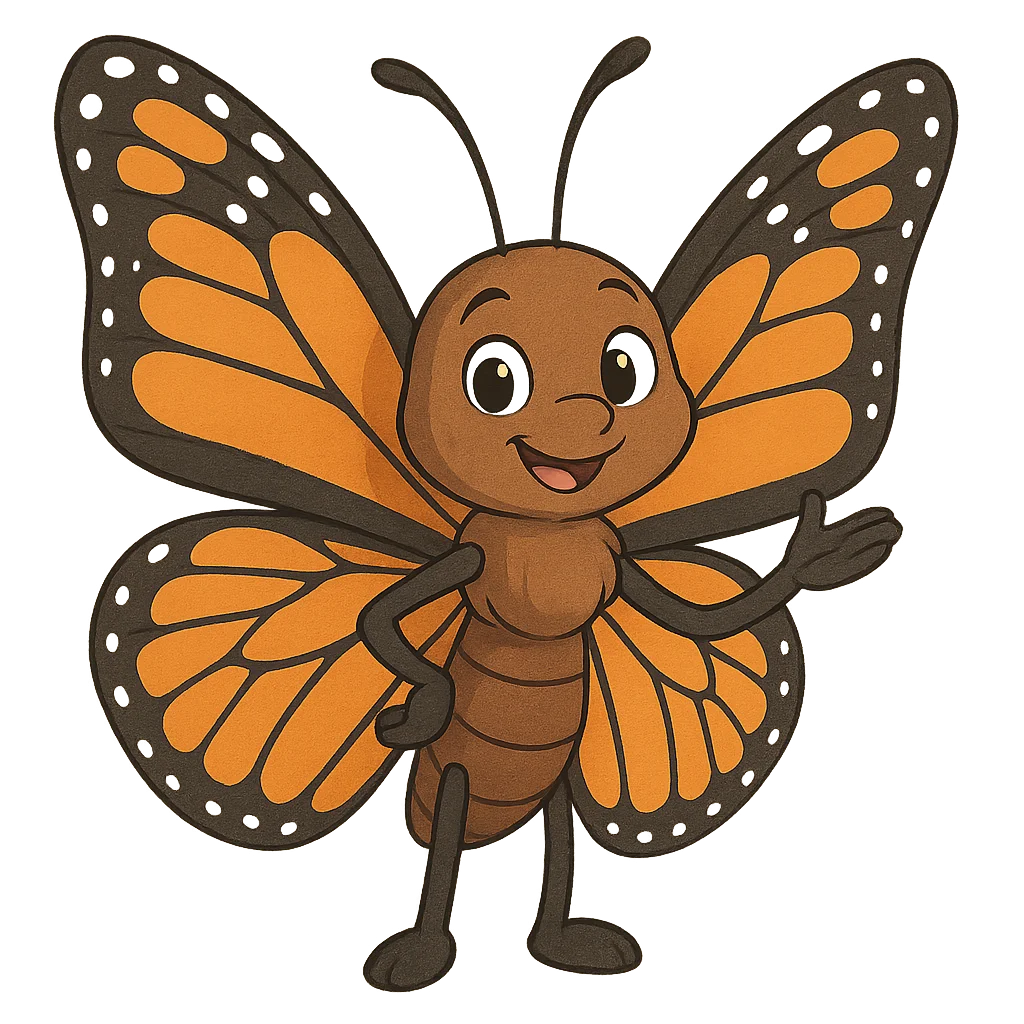
My Journey as a Monarch Butterfly
Hello, my name is Monarch, and I am a butterfly known for my incredible journey. My life began not with a flutter, but as a tiny, ridged egg clinging to the underside of a milkweed leaf in North America one late summer. When I hatched, I was not a butterfly at all, but a very hungry caterpillar. From the moment I emerged, I had only one desire: to eat. The only food my body could process was the milkweed plant I was born on. I spent my days munching on its leaves, growing bigger and bigger. The milky sap of the plant contained special chemicals called cardiac glycosides. As I ate, these chemicals built up in my body, giving me a special kind of superpower. They made me taste terrible to predators like birds and lizards. This bitter taste was a defense that would protect me for my entire life, a natural warning shield I carried within me. My distinctive yellow, black, and white stripes as a caterpillar were the first sign to others that I was not a meal to be enjoyed.
After several weeks of constant eating, a powerful change began to stir within me. I found a safe spot, attached myself upside down to a twig, and my striped skin split away to reveal a new form. I had become a chrysalis, a beautiful, jade-green jewel decorated with shimmering golden spots. To an outsider, it might have looked like I was sleeping, but inside, something truly amazing was happening. This process is called metamorphosis, and it is a complete remaking of my entire body. During metamorphosis, many of the caterpillar's tissues break down, but specialized cells called imaginal discs remain intact and develop into adult structures. After about two weeks, the green casing turned clear, and you could see my new wings folded inside. The moment had come. I pushed my way out, a fully formed butterfly. My wings were damp and crumpled, but I patiently pumped fluid into them. As they dried, they unfurled to reveal their famous bright orange and black pattern, a bold and beautiful warning sign that announced to the world that I was poisonous and not a tasty snack.
I emerged as an adult throughout the spring and summer, with the final generation emerging in late summer and early fall, which meant I was part of a very special group of my kind known as the 'Methuselah generation'. Unlike the monarchs born earlier in the year, who live for only a few weeks, my generation was destined for a much longer life and a far greater journey. A powerful, mysterious instinct began to pull at me, an unstoppable urge to fly south. I had never been to our winter home, yet I knew exactly where to go. This incredible migration would take me nearly 3,000 miles, from the fields of North America to a specific forest in Mexico. To find my way, I used the sun as a compass to orient myself during the day. Monarch butterflies use a light-dependent inclination magnetic compass to aid in navigation during migration. For centuries, humans were mystified by our annual disappearance. They knew we left, but they had no idea where we went. It wasn't until 1975 that a dedicated scientist named Dr. Fred Urquhart and his team of researchers finally solved the puzzle and discovered our secret winter sanctuary.
After a long and tiring journey, I finally arrived. The air grew cooler and damper as I flew higher into the mountains of Michoacán, Mexico. There, I found the oyamel fir forests, a perfect place for me to rest and survive the winter. And I was not alone. Millions of other Monarchs, all part of the same Methuselah generation, had made the same incredible journey. We began to cluster together on the thick branches of the oyamel firs, huddling in massive groups to protect ourselves from wind and rain, not primarily to stay warm. There were so many of us that our combined weight caused the branches to sag. From a distance, the trees themselves seemed to turn a brilliant, living orange. The forest, once green and quiet, now whispered with the gentle, rustling sound of millions of butterfly wings. We would spend the entire winter here, waiting for the warmth of spring to signal the start of our journey back north.
When spring finally arrived, that same powerful instinct urged me to fly north again. But this time, the journey would be different. I would not complete it myself. Our migration is a multi-generational relay race. I flew as far north as I could, until I found the first shoots of milkweed emerging from the warming soil. There, I laid my eggs, passing the torch to the next generation. My children, after hatching and transforming, would continue the journey northward. It takes three or four generations to finally return to the same northern regions where my own life began. This incredible cycle, however, faces many challenges. The milkweed habitats we depend on are disappearing, and our winter forests in Mexico are threatened. Because of these dangers, the migratory monarch butterfly was listed as endangered in July of 2022. My story is a reminder of the amazing connections in nature. As pollinators, we link the ecosystems of Canada, the United States, and Mexico. I am a small but vital part of this grand journey, and when people plant milkweed gardens, they help ensure that this great relay race can continue for generations to come.
Activities
Take a Quiz
Test what you learned with a fun quiz!
Get creative with colors!
Print a coloring book page of this topic.