
 English

Discovery of Electricity
The story of how Benjamin Franklin's curiosity about lightning led to his famous kite experiment…
Reads at Grades 3–5 Listens at Grades 1–5
 Screen-free speaker. Built for your kids.
No card, no commitment. One email when there is real news, and one click to stop.
Print & create
Answer keys·No prep·Free with an account
28 worksheets · answer keys · full story · quiz · Ages 8-10 · CEFR B1
Plus adds 102,000+ more stories in 27 languages, audio for every one, and printables for all of them.
Just want Discovery of Electricity?
My name is Benjamin Franklin, and my mind has always been a whirlwind of questions. Here in my home of Philadelphia, in the mid-1700s, life was full of wonders and mysteries. We had cobbled streets filled with the clatter of horse-drawn carriages and the calls of merchants, but there were some things that silenced everyone. Nothing was more powerful or frightening than a thunderstorm. When the sky turned a dark, bruised purple and the clouds began to rumble, people would hurry inside, shuttering their windows. They saw lightning as a sign of anger from the heavens, a terrifying and mysterious force that could split a tree in two or set a church steeple ablaze in an instant. But I saw something else. I saw a magnificent, brilliant flash of what I called 'electrical fire.' I had seen tiny sparks of this same fire right here on Earth. If you shuffled your feet on a wool rug and touched a metal doorknob, ZAP. You could create a tiny spark. I wondered, could this tiny, harmless spark be a miniature version of the tremendous, fearsome lightning in the sky? The thought took hold of my mind and wouldn't let go. It was a bold, daring question, and I just knew I had to find the answer.
That answer came to me on a stormy afternoon in June of 1752. The air was thick and heavy, and the sky looked like a pot of boiling grey soup. Most people were hiding indoors, but I saw it as the perfect opportunity. My son, William, stood by my side, his eyes wide with a mix of excitement and a little bit of worry. Together, we had built a special kite, not for a sunny day, but for this very storm. It was made of silk, so the rain wouldn't tear it apart. At the very top, I fastened a sharp metal wire to attract the electrical charge from the clouds. The string was made of hemp, which I knew would conduct electricity when it got wet. But for my own safety, I tied a dry silk ribbon to the end of the hemp string. That silk ribbon was what I would hold, as silk does not conduct electricity and would keep me safe. The most important part was the simple metal house key I tied to the string, right where the wet hemp met the dry silk. We ran out into an open field as the first drops of rain began to fall. We got the kite soaring high into the dark, swirling clouds. Then, we waited under the shelter of a small shed. My heart pounded with anticipation. For a long time, nothing happened. I started to wonder if I was wrong. But then, I saw it. The tiny, loose threads of the hemp string began to stand straight up, reaching for my hand. The electrical charge was flowing down the string. Taking a deep breath, I reached out my knuckle toward the metal key. A tiny, bright spark jumped from the key to my finger with a small snap. I felt a familiar tingle, the same one I felt from the static on the rug. It was just a little spark, but in that moment, it lit up the world. I had done it. I had proven that lightning was electricity.
Benjamin Franklin and the Electric Sky
My name is Benjamin Franklin, and my mind has always been a whirlwind of questions. Here in my home of Philadelphia, in the mid-1700s, life was full of wonders and mysteries. We had cobbled streets filled with the clatter of horse-drawn carriages and the calls of merchants, but there were some things that silenced everyone. Nothing was more powerful or frightening than a thunderstorm. When the sky turned a dark, bruised purple and the clouds began to rumble, people would hurry inside, shuttering their windows. They saw lightning as a sign of anger from the heavens, a terrifying and mysterious force that could split a tree in two or set a church steeple ablaze in an instant. But I saw something else. I saw a magnificent, brilliant flash of what I called 'electrical fire.' I had seen tiny sparks of this same fire right here on Earth. If you shuffled your feet on a wool rug and touched a metal doorknob, ZAP. You could create a tiny spark. I wondered, could this tiny, harmless spark be a miniature version of the tremendous, fearsome lightning in the sky? The thought took hold of my mind and wouldn't let go. It was a bold, daring question, and I just knew I had to find the answer.
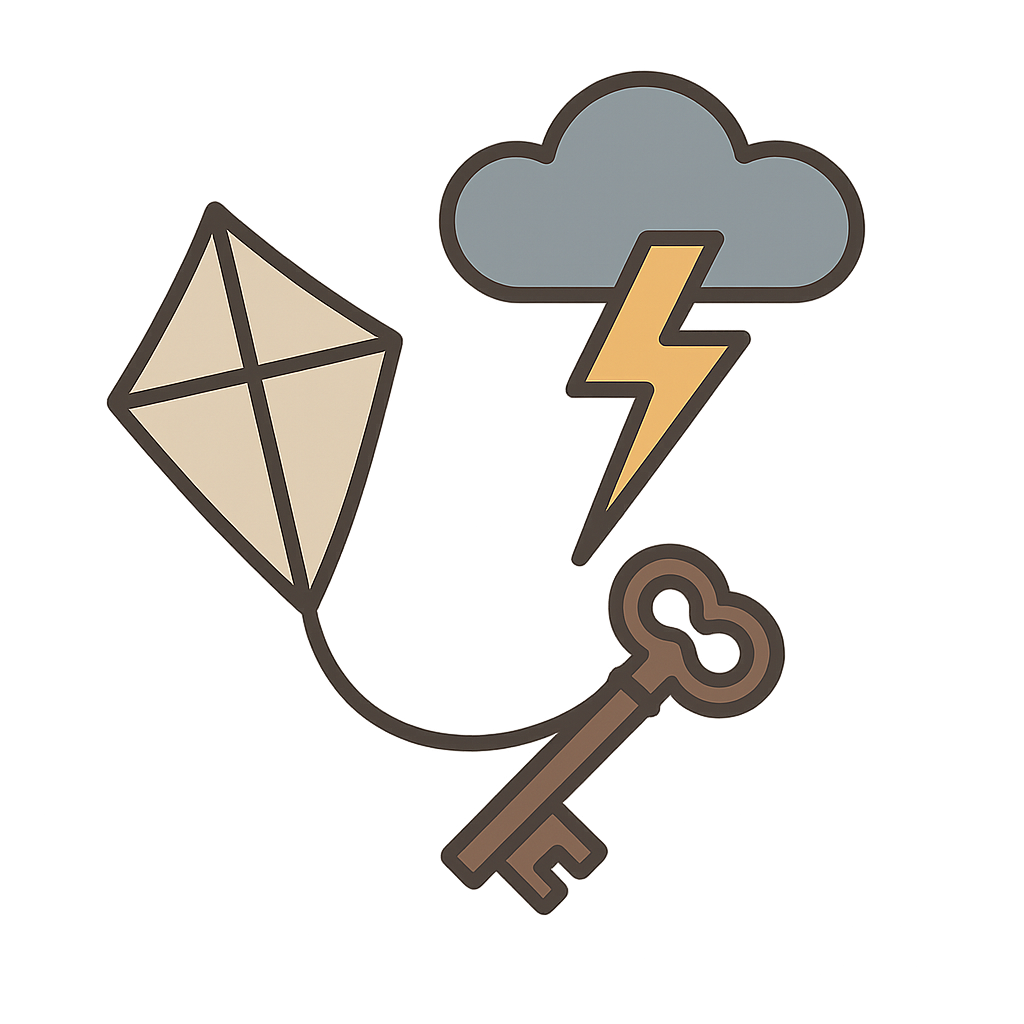
That answer came to me on a stormy afternoon in June of 1752. The air was thick and heavy, and the sky looked like a pot of boiling grey soup. Most people were hiding indoors, but I saw it as the perfect opportunity. My son, William, stood by my side, his eyes wide with a mix of excitement and a little bit of worry. Together, we had built a special kite, not for a sunny day, but for this very storm. It was made of silk, so the rain wouldn't tear it apart. At the very top, I fastened a sharp metal wire to attract the electrical charge from the clouds. The string was made of hemp, which I knew would conduct electricity when it got wet. But for my own safety, I tied a dry silk ribbon to the end of the hemp string. That silk ribbon was what I would hold, as silk does not conduct electricity and would keep me safe. The most important part was the simple metal house key I tied to the string, right where the wet hemp met the dry silk. We ran out into an open field as the first drops of rain began to fall. We got the kite soaring high into the dark, swirling clouds. Then, we waited under the shelter of a small shed. My heart pounded with anticipation. For a long time, nothing happened. I started to wonder if I was wrong. But then, I saw it. The tiny, loose threads of the hemp string began to stand straight up, reaching for my hand. The electrical charge was flowing down the string. Taking a deep breath, I reached out my knuckle toward the metal key. A tiny, bright spark jumped from the key to my finger with a small snap. I felt a familiar tingle, the same one I felt from the static on the rug. It was just a little spark, but in that moment, it lit up the world. I had done it. I had proven that lightning was electricity.
That tiny spark from the key was more than just the answer to my question. It was the beginning of a way to protect people from the destructive power of lightning. Now that I understood what it was, I could figure out how to control it. My mind immediately began to design an invention: the lightning rod. It was a simple idea, really. A pointed iron rod would be placed on the highest point of a building, like a church steeple or a barn roof. A wire would run from that rod all the way down the side of the building and deep into the ground. When lightning was about to strike, it would be attracted to the metal rod and follow the wire safely into the earth, completely avoiding the building. It was a way to guide the 'electrical fire' harmlessly away from our homes and families. This discovery, this taming of the lightning, showed that by understanding the world around us, we could make it a safer place. Looking back, I see that moment changed everything. It opened the door for so many other ideas and inventions powered by electricity. So I ask you to always stay curious. Always ask 'why?' and 'what if?'. You never know when your own big question might spark an idea that brightens the entire world.
Wow facts
About
The story of how Benjamin Franklin's curiosity about lightning led to his famous kite experiment, proving that lightning is a form of electricity.
Take a Quiz
Question 1 of 5
Why do you think Benjamin Franklin used a silk ribbon to hold the kite string instead of just holding the wet string itself?
Explore next




Want to do even more?
Go beyond exploring. Unlock tools that turn every story into real learning.

Storypie Plus for families
Full stories, quizzes, and printables. Nights and car rides, sorted.
- Unlimited audio stories
- Create Mode: your child stars in the story
- Offline downloads
- Printable worksheets & coloring pages

Why Storypie for Schools
Students engaged. Prep in seconds. Evenings back to you.
- Worksheets & Quizzes
- Classroom Management
- Formative Assessment
- Custom Curriculum & Lesson Plans
- 27 Languages

Why Storypie for Homeschool
Curriculum done. They'll ask for more. Hours back in your day.
- Worksheet Generator
- First-Person Audio Stories
- Built-in Comprehension Quizzes
- Custom Curriculum & Lesson Plans
- Print & Go Activities