English

Discovery of Electricity
The story of how Benjamin Franklin's curiosity about lightning led to his famous kite experiment…
Reads at Grades 6–8 Listens at Grades 4–8
 Screen-free speaker. Built for your kids.
No card, no commitment. One email when there is real news, and one click to stop.
Print & create
Answer keys·No prep·Free with an account
28 worksheets · answer keys · full story · quiz · Ages 10-12 · CEFR B2
Plus adds 102,000+ more stories in 27 languages, audio for every one, and printables for all of them.
Just want Discovery of Electricity?
My name is Benjamin Franklin, and while you may know me as one of the men who helped shape a new nation, my heart has always belonged to the thrill of discovery. In the Philadelphia of the 1700s, where I worked as a printer and writer, the world felt like a great, unsolved puzzle. We lived in a time called the Enlightenment, a period when people believed that reason and science could unlock any mystery. One of the most captivating mysteries of our day was a strange force we called 'electric fluid.' We knew how to create it in small doses. By rubbing a glass tube with a piece of silk, we could generate a tiny spark that would make a person's hair stand on end or jump from one person to another in a parlor game. It was a fascinating amusement, but I felt there was something much grander to it. I would watch the summer thunderstorms roll over the city, great flashes of lightning tearing across the sky with a deafening crash of thunder. People saw it as a terrifying, unpredictable display of power, perhaps even the anger of the heavens. But I saw something familiar in those jagged bolts of light. I saw the same crackle and spark we made in our little experiments, magnified a million times over. The question took root in my mind and wouldn't let go: could it be that the magnificent, frightening lightning in the clouds was the very same thing as the tiny spark from a glass tube? I believed it was, and I was determined to prove it.
Forming a hypothesis that lightning was a form of electricity was one thing; proving it was another matter entirely. It was a dangerous idea, and I knew that if I were wrong, or if something went awry, I would be seen as a fool. So, I decided to conduct my experiment in secret, with only my dear son, William, as my confidant and assistant. First, I constructed a special kite. It was not for play. I made the frame from two light strips of cedar wood and stretched a large silk handkerchief over it, as silk would hold up better than paper in the damp air of a storm. To the very top of the kite, I attached a sharp, pointed wire to attract the 'electric fluid' I was certain was in the clouds. The kite string was simple twine, but near my hand, I tied a brass house key. From the key, I ran a silk ribbon, which I would hold. I knew that the twine, once wet from the rain, would conduct electricity, but the dry silk ribbon would insulate me, protecting me from the full force of the charge. We waited patiently for the right kind of storm. Finally, in June of 1752, a promising thunderhead began to gather over Philadelphia. William and I rushed to a field, taking shelter under a small shed to keep the silk ribbon dry. My heart hammered in my chest as we launched the kite into the darkening sky. It danced and swooped, climbing higher and higher until it disappeared into the belly of a low-hanging cloud. For what felt like an eternity, nothing happened. The rain began to fall, soaking the twine string. I watched it, my hopes sinking with every passing moment. Then, I noticed it. The small, loose threads of the twine began to stand on end, separating from one another as if pushed by an unseen force. I knew that feeling. It was the sign of an electric charge. With a trembling hand, I slowly reached my knuckle toward the brass key. Just as my skin was about to touch the metal, a bright blue spark jumped across the gap with a distinct 'zap' and a small shock. It was a tiny event, but its meaning was immense. We had done it. We had captured lightning from the sky.
Benjamin Franklin and the Electric Sky
My name is Benjamin Franklin, and while you may know me as one of the men who helped shape a new nation, my heart has always belonged to the thrill of discovery. In the Philadelphia of the 1700s, where I worked as a printer and writer, the world felt like a great, unsolved puzzle. We lived in a time called the Enlightenment, a period when people believed that reason and science could unlock any mystery. One of the most captivating mysteries of our day was a strange force we called 'electric fluid.' We knew how to create it in small doses. By rubbing a glass tube with a piece of silk, we could generate a tiny spark that would make a person's hair stand on end or jump from one person to another in a parlor game. It was a fascinating amusement, but I felt there was something much grander to it. I would watch the summer thunderstorms roll over the city, great flashes of lightning tearing across the sky with a deafening crash of thunder. People saw it as a terrifying, unpredictable display of power, perhaps even the anger of the heavens. But I saw something familiar in those jagged bolts of light. I saw the same crackle and spark we made in our little experiments, magnified a million times over. The question took root in my mind and wouldn't let go: could it be that the magnificent, frightening lightning in the clouds was the very same thing as the tiny spark from a glass tube? I believed it was, and I was determined to prove it.
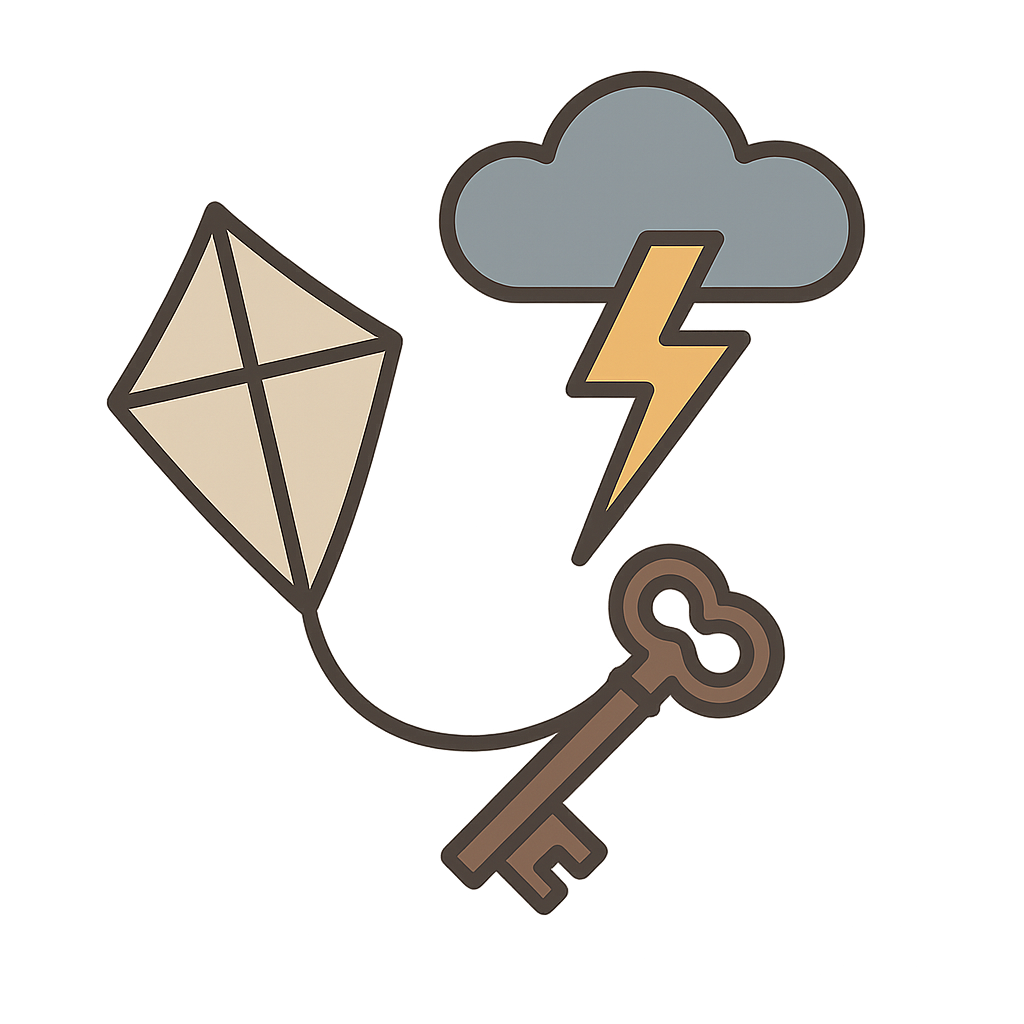
Forming a hypothesis that lightning was a form of electricity was one thing; proving it was another matter entirely. It was a dangerous idea, and I knew that if I were wrong, or if something went awry, I would be seen as a fool. So, I decided to conduct my experiment in secret, with only my dear son, William, as my confidant and assistant. First, I constructed a special kite. It was not for play. I made the frame from two light strips of cedar wood and stretched a large silk handkerchief over it, as silk would hold up better than paper in the damp air of a storm. To the very top of the kite, I attached a sharp, pointed wire to attract the 'electric fluid' I was certain was in the clouds. The kite string was simple twine, but near my hand, I tied a brass house key. From the key, I ran a silk ribbon, which I would hold. I knew that the twine, once wet from the rain, would conduct electricity, but the dry silk ribbon would insulate me, protecting me from the full force of the charge. We waited patiently for the right kind of storm. Finally, in June of 1752, a promising thunderhead began to gather over Philadelphia. William and I rushed to a field, taking shelter under a small shed to keep the silk ribbon dry. My heart hammered in my chest as we launched the kite into the darkening sky. It danced and swooped, climbing higher and higher until it disappeared into the belly of a low-hanging cloud. For what felt like an eternity, nothing happened. The rain began to fall, soaking the twine string. I watched it, my hopes sinking with every passing moment. Then, I noticed it. The small, loose threads of the twine began to stand on end, separating from one another as if pushed by an unseen force. I knew that feeling. It was the sign of an electric charge. With a trembling hand, I slowly reached my knuckle toward the brass key. Just as my skin was about to touch the metal, a bright blue spark jumped across the gap with a distinct 'zap' and a small shock. It was a tiny event, but its meaning was immense. We had done it. We had captured lightning from the sky.
That little spark was more than just a successful experiment; it was a revelation. It proved that lightning was not some random act of a supernatural power, but a natural, scientific force that followed predictable laws. If we could understand its rules, we could protect ourselves from its destructive power. My mind immediately went to work on a practical application. If a pointed metal wire on a kite could draw electricity from a cloud, could a pointed metal rod on a house do the same? This thought led directly to my invention of the lightning rod. I designed a simple iron rod to be placed at the highest point of a building, with a wire running down the side and deep into the ground. During a storm, the rod would attract any nearby lightning strike, guiding the dangerous electrical charge safely into the earth, away from the wooden structure and the people inside. It was a simple idea, born from a risky experiment, that would go on to save countless lives and buildings from fire. My journey started with a simple question and a deep curiosity about the world around me. That stormy afternoon taught me that we should never be afraid to ask 'what if?' or to challenge what we think we know. The universe is full of wonders, and sometimes, all it takes is a bit of courage and a curious mind to reach out and touch them, changing the world in the process.
Wow facts
About
The story of how Benjamin Franklin's curiosity about lightning led to his famous kite experiment, proving that lightning is a form of electricity.
Take a Quiz
Question 1 of 5
Why was Benjamin Franklin so determined to perform the kite experiment, despite the risks? What does this tell you about his character?
Explore next






Want to do even more?
Go beyond exploring. Unlock tools that turn every story into real learning.

Storypie Plus for families
Full stories, quizzes, and printables. Nights and car rides, sorted.
- Unlimited audio stories
- Create Mode: your child stars in the story
- Offline downloads
- Printable worksheets & coloring pages

Why Storypie for Schools
Students engaged. Prep in seconds. Evenings back to you.
- Worksheets & Quizzes
- Classroom Management
- Formative Assessment
- Custom Curriculum & Lesson Plans
- 27 Languages

Why Storypie for Homeschool
Curriculum done. They'll ask for more. Hours back in your day.
- Worksheet Generator
- First-Person Audio Stories
- Built-in Comprehension Quizzes
- Custom Curriculum & Lesson Plans
- Print & Go Activities