

 English

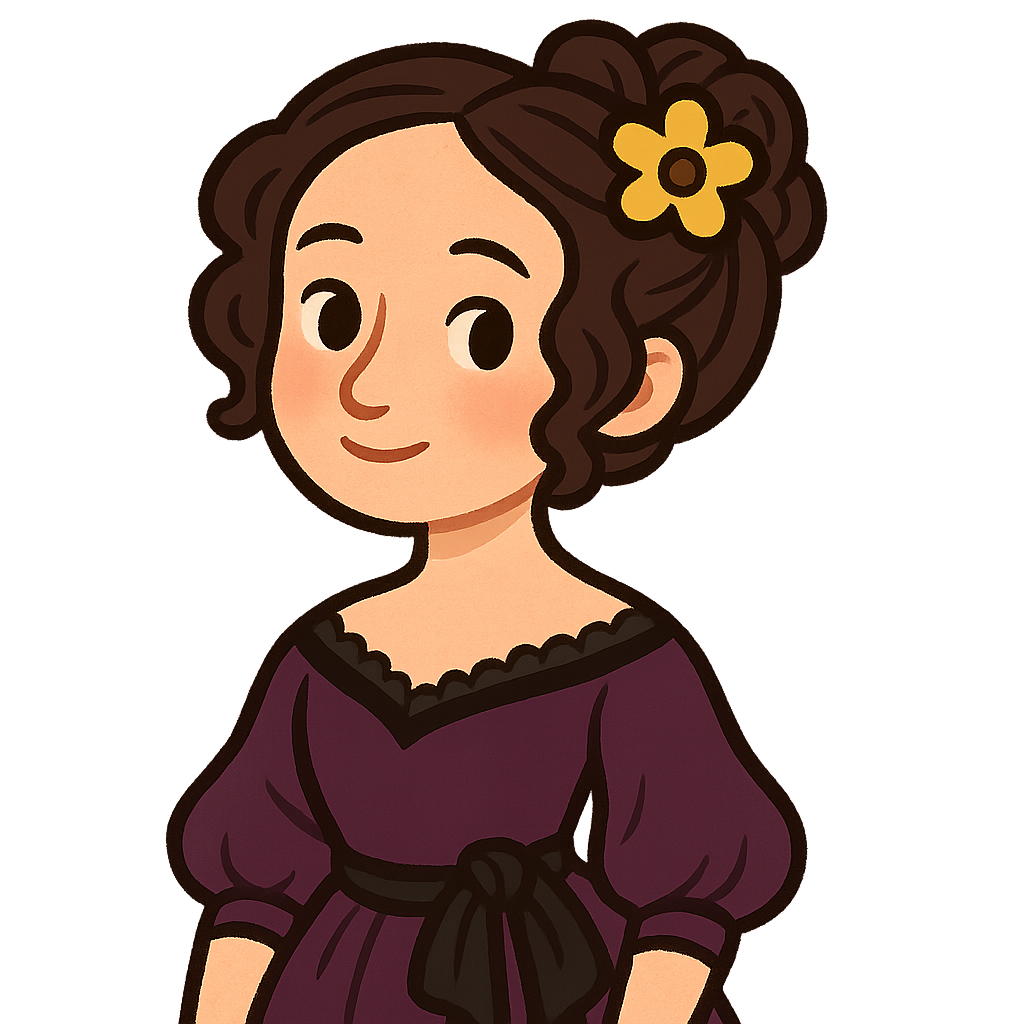
Ada Lovelace: The Enchantress of Numbers
Hello there. My full name is Augusta Ada King, Countess of Lovelace, but I would be delighted if you would simply call me Ada. I was born in London on a cold winter's day, December 10th, 1815, into a world of grand houses and new ideas. You may have heard of my father, the famous poet Lord Byron, but our story is a short one, as he left England when I was just a baby, and I never had the chance to know him. My life was shaped almost entirely by my mother, Anne Isabella Milbanke, whom people called Lady Byron. My mother was a brilliant woman with a deep love for mathematics, a subject she called the 'Princess of Parallelograms.' She was also determined that I would not follow in my father’s poetic, and rather wild, footsteps. To prevent any flighty, artistic tendencies from taking root in my mind, she designed a rigorous education for me, filled not with fairy tales, but with logic, science, and mathematics. From a young age, I was fascinated by how things worked. While other children played with dolls, I was dreaming of machines. I studied diagrams of new inventions and imagined creating my own. Before I was even a teenager, I began a project I called 'Flyology.' It was my very own scientific investigation into creating a steam-powered flying machine. I studied the anatomy of birds and tested materials, my mind soaring with possibilities. My studies were briefly interrupted when, at the age of fourteen, I fell ill with measles. The illness left me unable to walk for nearly a year, but it could not confine my mind. I used that time to dive deeper into my books, strengthening my mathematical skills and letting my imagination wander through the world of numbers.
As I grew into a young woman, I was introduced to the glittering social circles of London. It was a world of elegant parties and intellectual conversations, but for me, the most important event happened on the evening of June 5th, 1833. That was the night I met Charles Babbage, a brilliant, if somewhat grumpy, inventor and mathematician. He showed me a portion of a remarkable machine he had designed, the Difference Engine. It was a breathtaking contraption of polished brass gears and clicking wheels, designed to perform complex mathematical calculations with perfect accuracy. While others saw a clever calculator, I saw something much more profound. I understood the beautiful logic behind it and could see its immense potential. This meeting sparked a friendship and intellectual partnership that would last for the rest of my life. Mr. Babbage was impressed by my quick understanding of his work and soon gave me the nickname 'The Enchantress of Numbers.' A few years later, in 1835, I married a kind man named William King, and when he was made the Earl of Lovelace, I became the Countess of Lovelace. We had three children, and I loved my family dearly, but I never abandoned my studies. I dedicated my quiet hours to what I called 'poetical science.' I believed that imagination and creativity were just as important as logic and reason. To truly understand the universe, I felt one needed to combine the insight of a poet with the rigor of a mathematician.
My most significant contribution to science began with a simple request. Mr. Babbage had designed a new, far more ambitious machine called the Analytical Engine. It was a revolutionary concept—the world's first design for a general-purpose computer. An Italian engineer named Luigi Menabrea wrote an article about it, and my friend asked if I would translate it from French into English. I agreed, but as I worked, I realized the article didn't fully capture the incredible possibilities of the machine. My mind was buzzing with ideas that went far beyond what Menabrea had written. So, I began adding my own thoughts, which I called my 'Notes.' By the time I was finished, my 'Notes' were three times longer than the original article. They were published in a scientific journal in 1843, under my initials, A.A.L. In these notes, I made a crucial leap of imagination. I saw that the Analytical Engine could do more than just calculate numbers. I proposed that if you could represent things like musical notes or letters as symbols, the machine could manipulate them. It could weave 'algebraical patterns just as the Jacquard loom weaves flowers and leaves.' In essence, I had envisioned the modern, multipurpose computer, a machine that could create art and music, not just solve equations. To demonstrate this, I wrote a detailed, step-by-step sequence of operations for the Analytical Engine to calculate a complex series of numbers known as Bernoulli numbers. This set of instructions is now recognized as the world's very first computer program, which is why many people today call me the first computer programmer.
Sadly, the world was not quite ready for my ideas. The technology of the 19th century wasn't advanced enough to build the complex Analytical Engine, and very few people truly understood the vision I had laid out in my 'Notes.' My work was largely forgotten for a time, a whisper of a future that had not yet arrived. My own life was also cut short. I had struggled with poor health for many years, and on November 27th, 1852, I passed away at the age of 36. For nearly a century, my 'Notes' lay waiting in dusty archives. Then, in the mid-20th century, as pioneers like Alan Turing began building the first electronic computers, they rediscovered my work. They realized that a woman, a century earlier, had already grasped the fundamental concepts of computing. My legacy was finally understood. In the 1970s, the United States Department of Defense even named a powerful new computer programming language 'Ada' in my honor. My story shows that the greatest leaps forward often happen when we combine the logical world of science with the boundless world of imagination. Never be afraid to dream beyond what is possible today, because your vision might just be the blueprint for tomorrow.
Activities
Take a Quiz
Test what you learned with a fun quiz!
Get creative with colors!
Print a coloring book page of this topic.











 Free for Educators