

 English

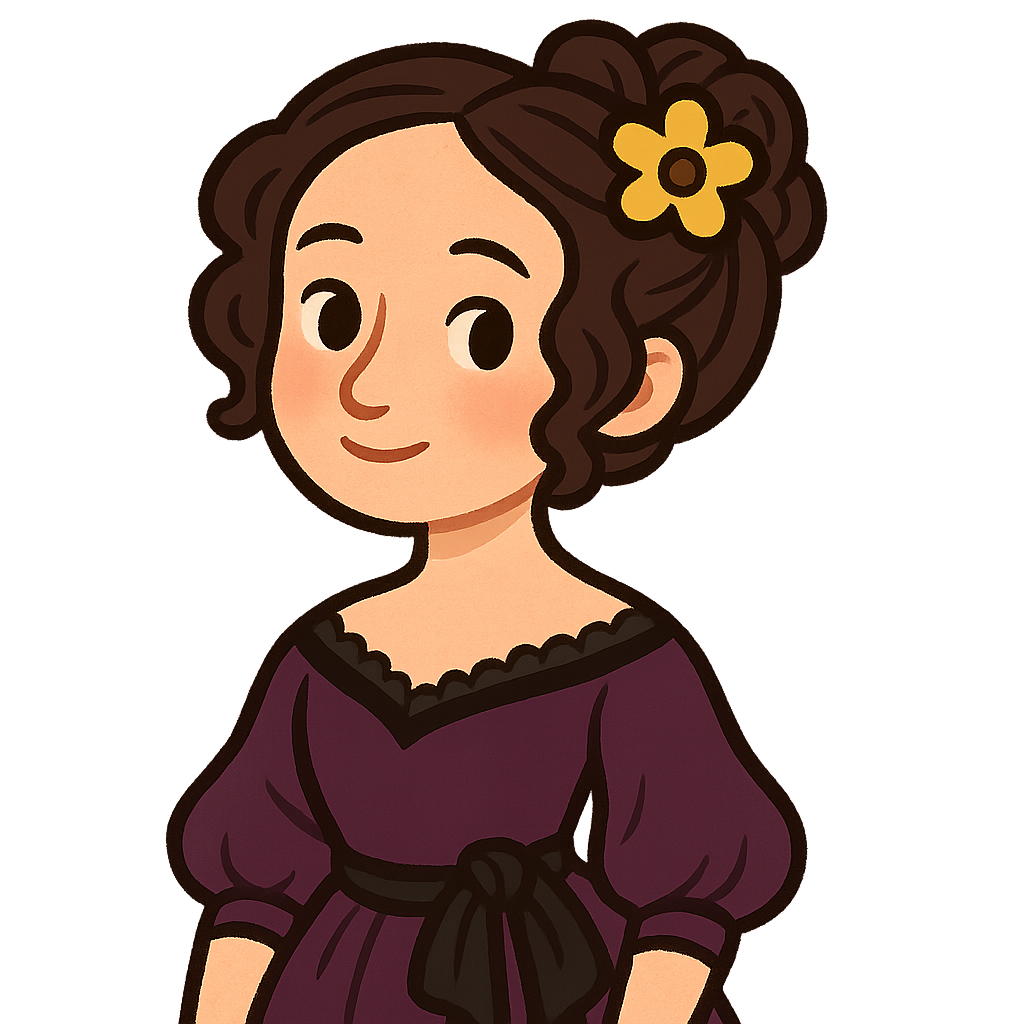
Ada Lovelace
Hello! My name is Ada Lovelace, and I am often called the world's first computer programmer. I was born a long, long time ago in London, England, on a chilly December 10th, 1815. My father was a very famous poet named Lord Byron, but I didn't know him. My mother, Anne Isabella Milbanke, was a brilliant woman who loved mathematics so much that she playfully called herself the 'Princess of Parallelograms.' In those days, girls were not usually taught subjects like math and science. But my mother insisted I have the best tutors. She believed that studying logic and numbers would keep me from becoming a dreamy poet like my father. But I had a secret: I loved to dream. When I was just twelve, I became obsessed with the idea of flying. I studied the wings of birds, thinking about what materials I could use to build my own wings. I even wrote a book about my ideas and called it 'Flyology.' I imagined a steam-powered flying machine that could carry a person through the air. My mind was always buzzing with what I called 'poetical science'—the beautiful meeting of imagination and technology.
My life changed forever on June 5th, 1833. I was a teenager when I met a brilliant and quirky inventor named Charles Babbage. He invited me to see a machine he had built called the Difference Engine. It was a marvelous contraption of shiny brass gears and clicking metal parts that could calculate numbers all by itself. I was completely mesmerized. While others saw a clever calculator, I saw a world of possibilities. Mr. Babbage was impressed by how quickly I understood his complex invention. We became wonderful friends and started writing letters to each other, filling pages with ideas about mathematics and new inventions. He saw that I had a unique way of looking at numbers, not just as a tool for sums, but as a language that could express incredible things. It was because of this that he gave me a special nickname: 'The Enchantress of Numbers.' It made me feel proud that my mind could weave spells with logic and reason.
Mr. Babbage wasn't finished inventing. He soon began designing an even more magnificent machine called the Analytical Engine. Unlike the Difference Engine, which could only do one job, the Analytical Engine could be programmed to do almost any kind of calculation. It was the great-great-grandfather of the computers you use today. In 1843, I was asked to translate an article written about the engine. As I worked, I realized the author hadn't explained its true potential. So, I added my own thoughts in a long section I simply called 'Notes.' In my notes, which ended up being three times longer than the original article, I suggested that the machine could do much more than just crunch numbers. I imagined it could one day compose music, create art, or help with scientific discoveries if you could just turn those things into patterns and symbols. To prove it, I wrote out a step-by-step set of instructions for the machine to solve a very complex mathematical sequence. Today, many people call that set of instructions the very first computer program ever written.
Sadly, my dear friend Mr. Babbage was never able to build his Analytical Engine. The technology just wasn't available back then, and it was a very expensive project. My own life ended too soon, after an illness, on November 27th, 1852. For a long time, my 'Notes' were mostly forgotten. My ideas were so far ahead of their time that it took the world more than one hundred years to catch up. But eventually, people rediscovered my work as they began building the first modern computers. Looking back, I am so happy that my vision came true. I always believed that imagination was the key to seeing the hidden wonders in science. I hope my story inspires you to see the poetry in numbers and to dream up amazing things that the world has never seen before.
Activities
Take a Quiz
Test what you learned with a fun quiz!
Get creative with colors!
Print a coloring book page of this topic.












 Free for Educators